‘We fight for what is reasonable and meaningful.’
Interview with Isabel Garcia, Coalicion de Derechos Humanos
By Colin Rajah, NNIRR
Movements have highs and lows – moments in history when certain energy and specific events converge and that’s what happened in 2006. Not only did marches stem from the hard work of folks working on human rights for many years, but the marches also reflect the current political conditions. In our efforts to educate our community about the situation – starting with the Minutemen mobilization in 2005 – we warned that this would have widespread ramifications. The Minutemen were received as heroes in DC, which ultimately allowed Sensenbrenner to come out with his bill. That stripped our long, hard work – but also brought out these historic marches this year.
Youth and students were a primary force of the mobilizations. They have always been at the forefront of movements, but this was different because they were not just typical activist students. They were young people who grew up in the harsh realities of the anti-immigrant climate. They were the children of the undocumented, the nieces and nephews of the undocumented, the grandchildren of the undocumented, the neighbors of undocumented. These were children who had grown up fearing la Migra [the immigration police] – seeing their mother’s fears when their father was a little late coming home from work, seeing an uncle being deported, seeing a 17-year-old brother deported for a joint of marijuana.
Youth deserve a lot of credit not only for their numbers but also why they mobilized – they didn’t just use this to get out of school. They got in the struggle because they had to live it. Bottom line is they gave the struggle another depth of experience – transformed themselves and others in our communities.
Key alliances to build
This movement cannot move forward without alliances. We have been trying to build alliances in Tucson for 30 years. First, we need to include labor because this is an economic and worker issue. Everything revolves around this. We need to make sure that labor must look at this issue as a labor issue.
We must also build alliances with African American communities – and not in a superficial or opportunistic thing. Many of us have been building those alliances. My father took me as a kid to a protest in front of a restaurant that didn’t serve African Americans. And we can’t say that they turned their backs against us. We need to make sure we solidify our alliances. We need to be cognizant of the racism in this country against African-Americans – we need to unite in a genuine way and we won’t succeed without building alliances with them.
We need to build with LGBT communities – they also face similar attacks – it’s not even subtle, they want to strip all LGBT of their rights as well.
We have to continue building with the faith-based community. A lot of our communities are faith-based. We have to tap into that – this is a result of long-term struggles.
We must fight alongside our indigenous brothers and sisters – they are treated as “indigenous aliens,” an oxymoron. The indigenous communities are treated as foreigners in their own land – we need to focus in on first Americans.
We need to build alliances with the environmentalist community – they have recognized that it’s not immigrants who are the cause of massive environmental destruction – it’s the militarization by Homeland Security on the border.
We also need to ally with groups and communities working on criminal justice – everything we do has to do with their struggle too. The policies here at the border were imported into the interior enforcement. We also have to ally with the anti-war movement – there’s the privatization of the war in Iraq because of the contracts for border security. Also, the ACLU-types that are interested in privacy issues – that comes from the border, tested out here. We need to make those alliances.
We need to articulate our vision and analyses so that they all adapt immigrant rights as part of their own agenda. Otherwise we will fail to obtain a just migration and border policy.
In making these alliances, we need to focus also on neoliberal policies as part of our educational work – how issues of the migration phenomenon are fueled by U.S. economic policies.
Key issues to focus on in 2007-2008
It is essential that we re-frame the debate so that we don’t fall into the kind of compromising that happens year after year, but especially this past year. If we look at what our “friends” brought on in 2005, it was a totally failed one – the argument that in order to get legalization, we have to allow border militarization. It’s important that we come to grips with that – some of us were more timid than others, we couldn’t denounce them. But this year we need to ask for accountability – the money they spent on extremely negotiated down position and for what? Look at what we got! We got a failed border strategy. And how can they come out against the militarization when they were in favor of criminalization, increasing border patrols etc. Our opposition to militarization, criminalization of immigrants and other enforcement strategies has to be seamless.
We fight for what is reasonable and meaningful. What are the problems brought on by U.S. border control policies? Number one is the deaths of migrants. How can all the deaths be ignored? We are asking for meaningful solutions. We need to show them that their strategy is a failed one. We can’t rely just on sound bites and talking points – we need to do hard work. If we just put money into talking points, we will fail. Funding has to support community organizing so that our communities can raise their own voices and demands. Otherwise, they can’t answer the hard questions – they get stuck because they rely on quick messages. Our job is to go deeper on profound issues and that requires organizing in communities.
We have to insist on a three-part response to migration:
1. We must look at root causes (economic policies etc.)
2. Current and past immigration laws that reflect our realities and how they have encouraged massive undocumented migration so that immigrants can be exploited for cheap labor. We need immigration policies that reflect the situation of the millions of undocumented people who are here. This includes eliminating the backlogs, allowing family unification – among other things. And,
3. We need to meaningful immigration reform. That means we need to stop enforcement now – more border patrols and increasing enforcement will not solve the problem.
How to break through Congress and rollback right-wing, xenophobic movement
Education is critical, especially on issues of race and migration. We cannot go to Congress to just lobby – we can feel good about educating one staff person. The bottom line is we cannot obtain substantial change unless we do widespread education to change the political conditions. It’s unrealistic to think that they will do what we want them to do – their constituents tell them what to do.
We have never seen so much attention on immigration – but now we see people trying to be players. But what we are looking for is to move the base. We can’t get too upset about this because in every movement in history there we’re those who really moved the base communities, and those that came in and took credit at the top.
Nowadays, I am a lot more frontal with the immigration lobbyists – you are part of the reason of why this happened. We need to hold them accountable too.
Colin Rajah directs NNIRR’s international migrant rights program. He interviewed Isabel García, co-chair of the Tucson-based Coalición de Derechos Humanos, last December. Isabel is also a member of NNIRR’s national board.
Thursday, May 03, 2007


Elvira Arellano: Resisting Deportation, The New Frontier of Civil Disobedience.
Elvira Arellano: Resisting Deportation, The New Frontier of Civil Disobedience.
By Maricela García
The act of seeking refugee in a holy place in search of immunity from the law is ancient. Churches have been providing sanctuary to people escaping persecution since medieval times. What is new about Elvira Arellano’s seeking sanctuary last August is that by defying her deportation order she brings the immigrant rights movement to a new level of resistance.
Elvira Arellano’s refusing to turn herself into the Department of Homeland Security in Chicago for deportation is generating heated polemics among anti immigrant and pro immigrant rights groups. The first argued that this was the ultimate mockery to U.S. immigration laws and the latter questioned the effectiveness of the tactic. Despite opposite points of view, there is agreement that what Elvira did is courageous and bold.
Elvira’s stand is forcing our society to look into the eyes of a mother pleading for an opportunity to stay in this country with her U.S. born son. If the show of political power demonstrated by the marches did not move people to understand the urgency of reforming our obsolete immigration laws, the story of a woman who is declaring her right to stay might.
Elvira’s personal story is about the intrinsic relationship between Mexico and the U.S., helping us understand that many of the people who crossed the border without authorization are victims of U.S. economic policies toward the region.
In an interview, Arellano explained why she came to the U.S., “After Mexico signed a free trade agreement with the U.S., many [Mexican] small farmers went bankrupt because they could not compete with the cheap prices of corn and grains that came from the U.S.” She is from a rural area in southwest Mexico, the state of Michoacán, where most people make their livelihood by farming. Up until recently, three out of every five Mexicans in the U.S. were from Michoacán, a region that has supplied several generations of immigrant labor for U.S. agriculture and industrial work since the 1880s.
Her father lost his source of income to support the family and Elvira had to come to the U.S. to work in order to help. Like Elvira, many people have been adversely affected by the dichotomy of U.S. economic policies toward Latin America that open markets and displace workers but close the borders to people. Unless we understand and address the roots of the problem, the immigration debate will continue failing to offer long-term solution to change future immigration flows into the US.
When Elvira says, “I represent the reality and suffering of many families that could be separated by deportations,” she speaks about 6.3 million immigrant families of which at least one parent is undocumented. Almost 5 million children, half of whom were born in the U.S., would be affected if their parents were deported. This poses a moral question for our society.
The way society treats vulnerable groups reveals its soul. The current immigration system is cruel, unfair and immoral. It forces many good people into breaking the law because there are limited legal channels to enter or remain in the U.S. legally. Employers who want to comply with the law find no solution to regularize the immigration status of their workers and unscrupulous ones take advantage of their status to exploit and abuse them.
Many undocumented immigrants live in fear and try to be invisible in society. Others usually speak for them. That is why Elvira’s action is empowering. She overcame her fears to speak truth to power. Her life story illustrates the complexity of unauthorized migration, explaining the causes and consequences that challenges us all to find the solutions.
If Elvira is deported, it will be a blow for immigrants and the immigrant rights movement must be prepared to respond massively. To prevent this possibility, more churches should become and are becoming sanctuaries and immigrant rights advocates must be prepared to engage in higher forms of resistance. It might take many more courageous people like Elvira to effect change in our society.
Elvira should remain in the U.S. to help make our society better. After all, the history of our country has been shaped by courageous individuals who have stood up against injustice. With each of these struggles, the full humanity of more people has been acknowledged and society as a whole has achieved higher levels of existence.
Maricela García is a member of the national board of the National Network for Immigrant and Refugee Rights and is the executive director of Latinos United, a policy & reserach organization. She served as the director of the Illinois Coalition for Immigrant and Refugee Rights from 1998 To 2001.
By Maricela García
The act of seeking refugee in a holy place in search of immunity from the law is ancient. Churches have been providing sanctuary to people escaping persecution since medieval times. What is new about Elvira Arellano’s seeking sanctuary last August is that by defying her deportation order she brings the immigrant rights movement to a new level of resistance.
Elvira Arellano’s refusing to turn herself into the Department of Homeland Security in Chicago for deportation is generating heated polemics among anti immigrant and pro immigrant rights groups. The first argued that this was the ultimate mockery to U.S. immigration laws and the latter questioned the effectiveness of the tactic. Despite opposite points of view, there is agreement that what Elvira did is courageous and bold.
Elvira’s stand is forcing our society to look into the eyes of a mother pleading for an opportunity to stay in this country with her U.S. born son. If the show of political power demonstrated by the marches did not move people to understand the urgency of reforming our obsolete immigration laws, the story of a woman who is declaring her right to stay might.
Elvira’s personal story is about the intrinsic relationship between Mexico and the U.S., helping us understand that many of the people who crossed the border without authorization are victims of U.S. economic policies toward the region.
In an interview, Arellano explained why she came to the U.S., “After Mexico signed a free trade agreement with the U.S., many [Mexican] small farmers went bankrupt because they could not compete with the cheap prices of corn and grains that came from the U.S.” She is from a rural area in southwest Mexico, the state of Michoacán, where most people make their livelihood by farming. Up until recently, three out of every five Mexicans in the U.S. were from Michoacán, a region that has supplied several generations of immigrant labor for U.S. agriculture and industrial work since the 1880s.
Her father lost his source of income to support the family and Elvira had to come to the U.S. to work in order to help. Like Elvira, many people have been adversely affected by the dichotomy of U.S. economic policies toward Latin America that open markets and displace workers but close the borders to people. Unless we understand and address the roots of the problem, the immigration debate will continue failing to offer long-term solution to change future immigration flows into the US.
When Elvira says, “I represent the reality and suffering of many families that could be separated by deportations,” she speaks about 6.3 million immigrant families of which at least one parent is undocumented. Almost 5 million children, half of whom were born in the U.S., would be affected if their parents were deported. This poses a moral question for our society.
The way society treats vulnerable groups reveals its soul. The current immigration system is cruel, unfair and immoral. It forces many good people into breaking the law because there are limited legal channels to enter or remain in the U.S. legally. Employers who want to comply with the law find no solution to regularize the immigration status of their workers and unscrupulous ones take advantage of their status to exploit and abuse them.
Many undocumented immigrants live in fear and try to be invisible in society. Others usually speak for them. That is why Elvira’s action is empowering. She overcame her fears to speak truth to power. Her life story illustrates the complexity of unauthorized migration, explaining the causes and consequences that challenges us all to find the solutions.
If Elvira is deported, it will be a blow for immigrants and the immigrant rights movement must be prepared to respond massively. To prevent this possibility, more churches should become and are becoming sanctuaries and immigrant rights advocates must be prepared to engage in higher forms of resistance. It might take many more courageous people like Elvira to effect change in our society.
Elvira should remain in the U.S. to help make our society better. After all, the history of our country has been shaped by courageous individuals who have stood up against injustice. With each of these struggles, the full humanity of more people has been acknowledged and society as a whole has achieved higher levels of existence.
Maricela García is a member of the national board of the National Network for Immigrant and Refugee Rights and is the executive director of Latinos United, a policy & reserach organization. She served as the director of the Illinois Coalition for Immigrant and Refugee Rights from 1998 To 2001.
World Social Forum on the Road from Nairobi to Atlanta: Who Does the WSF Belong to?
World Social Forum on the Road from Nairobi to Atlanta:
Who Does the WSF Belong to?
By Michael Leon Guerrero
February 13, 2007
The 2007 World Social Forum (WSF) was probably the most challenging WSF to date. Many contradictions surfaced and became tensions in Nairobi. There are criticisms that NGOs (non-governmental organizations) and churches dominated the process, and that local Kenyan movements were shut out. Some of the services of the forum were contracted to corporations – cell phone provider Celltel had a big presence as well as resort hotels like the Windsor, who had a beer and food tent located in the prime vending location of Kasarani Stadium, site of the WSF. The Kenyan Security Minister, also known as “the crusher” for his role in repressing anti-government political actions, owns the Windsor. On the third day of the forum, local Kenyans shut down the Windsor’s operation, protesting the high cost of food. They also mobilized actions each of the first two days to demand that the registration fees be waived for Kenyans. Ultimately, the gates were left open.
The Costs of Another World?
The fee structure was established by the International Council (IC) after a report was published by the Resources Commission: World Social Forum Financial Strategy, Report and Recommendations. The report was commissioned by IBASE , the Brazilian think tank and one of the founding organizations of the WSF. The study responded to the chronic deficits of the WSFs since 2005 and puts forward recommendations on how the WSF can be sustainable and less dependent on governments and foundations. One of the findings is that the registration fees are too low. In a breakdown of expenses per delegate, including airfares, lodging, food, shopping, etc. private businesses benefit much more financially than the WSF itself. In fact delegates paid $10 to the WSF out of an average of $1100 total contributed to the local economy. The IC implemented a new fee structure for WSF07, raising registration to as high as $500 per organization and $110 per individual for groups from the north.
The fee for Kenyans was roughly 500 Kenyan shillings – equivalent to one-week’s minimum-wage salary. Local organizers said that they had argued to lower the fee and after the first day everyone was admitted for free, but not in response to the protests. They also asserted that from the beginning there was a sliding scale and contingencies so that no Kenyans would be turned away. The role of corporate sponsors was a sore point and it is still not clear why Celltel and the Windsor were so prominent. One local observer speculated that this might have been a concession in order for the WSF to have access to the stadium facilities.
The fact that logistical issues like this flared into big political debates highlights underlying questions over the character and purpose of the World Social Forum. Who does the WSF belong to? Is it a space for the social movements to coordinate and strategize, an arena for intellectual debate, or is it a broader open space for political expression? The consensus among those involved in the process seems to be that the answer is “all of the above – and more”. Yet the debates in Nairobi raise questions about how broad the space should be.
The Past and Future of the WSF
“...The holistic approach was often just knee-jerk, "oppose all forms of exploitation". At that overall, movement level, there was little if any strategic thinking.
As a result, this year Davos won. Since that first WSF in 2001 China has doubled its wealth and output; India, and Turkey, have grown theirs by more than half. Then, Google had only recently got its initial funding. Today, the argument on climate change is over. For all the glitz and its versions of hot air, these huge changes are (as Simon Zadek's blog shows) being seriously mapped and assessed at Davos. In Nairobi they were addressed only peripherally, if at all.” (Anthony Barnett, openDemocracy)
Engaging in debates on these large questions was one of the original intents of the WSF. In a sense, in 2008 we are going back to the roots of the forum, which was born out of the mobilizations started at the Battle in Seattle in 1999. WSF was organized as the proactive response to define an alternative global vision to neoliberal capitalism. To date, there is no uniting vision for what “Another World” will look like - understanding that this is idealistic to expect from a young global process, and ultimately there may never be one vision. But it’s not clear how the structure of the forum or its agenda will lead to defining alternative visions.
The fourth day of the 2007 WSF was dedicated more to strategy discussions on global actions and campaigns. This ended up being somewhat messy. Originally morning sessions on the spectrum of issues were to lead into five afternoon plenaries where the groups would present their proposals. In this way there would be a convergence of different issue areas, so that groups working on housing could hear the plans of groups working on environment or militarism, etc. Somewhere along the way the agenda was changed so that in the end there were 21 plenaries based on separate issues. The locations of these plenaries were not in the program. People had to find banners hanging from the stadium that gave a list of the locations. At least one plenary – on free trade – did not happen.
In the end, some level of convergence happened at the Social Movements Assembly (SMA) during the last two hours of the forum. Two thousand people crowded into a tent and heard rousing speeches and declarations from the different discussions during the week. It was probably the most productive moment of the forum. SMA organizers have published the proceedings of the activity and a calendar is being developed.
2008: Back to the Streets
In 2008, there will be no WSF. In its place a week of mobilizations and activities will be organized by groups in their local communities under a broad theme that will be defined by a working group of the IC. This will be a refreshing and probably much needed break for the process. The point remains, however, that the agenda of the WSF in 2007 reverted to strategy, not vision. In some ways this is a step forward, since there are concrete initiatives for us to engage, but the WSF is supposed to be the distinct venue for this debate to happen at the global level. It is not clear whether we are closer or further from this happening.
Throughout its history the WSF has played a facilitating role in global coordination of international movements:
The key idea is the creation of networks, which the WSF is singularly equipped to construct at a global level. There is now an effective network of feminists. For the first time, at Nairobi, there was instituted a network of labor struggles (defining the concept of "worker" quite broadly). There is now an ongoing network of activist intellectuals. The network of rural/peasant movements has been reinforced. There is a budding network of those defending alternative sexualities (which permitted Kenyan gay and lesbian movements to affirm a public presence that had been difficult before). There is an anti-war network (immediately concerned with Iraq and the Middle East in general). And there are functional networks on specific arenas of struggle - water rights, the struggle against HIV/AIDS, human rights.
The WSF is also spawning manifestos: the so-called Bamako Appeal , which expounds a whole campaign against capitalism; a feminist manifesto, now in its second draft and continuing to evolve; a labor manifesto which is just being born. There will no doubt be other such manifestos as the WSF continues. The fourth day of the meeting was devoted essentially to meetings of these networks, each of which was deciding what kinds of joint actions it could undertake - in its own name, but within the umbrella of the WSF.
What some refer to as the Global Justice and Solidarity Movement (GJSM), has won significant victories against its neoliberal adversaries since the inception of the WSF. The Free Trade Area of the Americas, the extension of NAFTA-like trade policies was declared dead and “buried” in Mar de Plata, Argentina in November, 2005 . The WTO has met stiff resistance in every corner of the globe. Negotiations were disrupted in Cancún in September 2003 and later stalled in Hong Kong in December 2005. Some countries (Thailand, Brazil, Argentina, Indonesia) have declared that they will never again accept loans from the World Bank and International Monetary Fund. This is the result of governments from the Global South taking strong stands against the more powerful northern governments and multi-national corporations. This would not be possible if the south were not emboldened by the exponential growth and militancy of social movements.
The Social Movements Assembly, which was spawned at the first World Social Forum as the space where the international networks coordinate, plays a key role in mobilizing the GJSM. Although the relationship with the WSF is sometimes antagonistic, it is certainly symbiotic. Most meetings of the SMA happen during the WSF proceedings, and many of the same actors play leading roles in both the SMA and the International Council. The SMA was responsible for the largest peoples mobilization ever: the historic anti-war marches on February 15, 2003. Although this did not prevent the U.S. from invading Iraq, it did help to galvanize the anti-war movement in many parts of the world.
The Latin American Alternatives
Some on the International Council credit the WSF with bringing together movements that have helped shape the new political landscape of Latin America. One representative from Cuba said that “the WSF didn’t create anything in Latin America that wasn’t already there - the movements already existed. What the WSF created was a convergence of these movements.” It was no accident that South America, Brazil in particular, would be the birthplace of the WSF.
The site of the first three WSFs in Porto Alegre was significant, highlighting the model of Participatory Budgeting used by the local government and being implemented throughout southern Brazil. Hosting the WSF in Brazil also gave international visibility to Luis Ignacio da Silva (Lula) in his run towards his first term at the Presidency. Lula’s victory was the first in a chain of national electoral victories for the Left in Latin America – Nestor Kirchner in Argentina, Evo Morales in Bolivia, Michelle Bachelet in Chile, Rafael Correa in Ecuador, Daniel Ortega in Nicaragua. Despite charges of corruption, Lula won a run-off election handily for a second term, carried by the electoral support of the poor in Brazil. This provides an opportunity for the Latin American Presidents with publicly anti-neoliberal policies to consolidate their economic and political strength in the region.
Much of the debate and dialogue around alternatives now focuses on the actions of the Latin American governments – mainly the new initiatives toward economic integration like ALBA (Bolivarian Alternative for Latin America and the Caribbean). This is founded on a principal of economic cooperation and functions as a system of bartering for resources based on need (Cuba trading agricultural goods for oil to Venezuela, etc.) Agreements are also made between governments and social movements like the Landless Peoples Movement in Brazil. For many, the ALBA represents hope for a new kind of globalization that does not exploit people and the environment.
The underlying point of contention for the new, Leftist governments, however, will be energy policy. Although much of the oil and gas resources are being nationalized, the emphasis is still on fossil fuels development. This will create tensions over environmental concerns, Indigenous sovereignty and, ultimately, sustainability of the government experiments. If economic development and the alleviation of poverty are dependent on oil and gas, how long can it last?
Nevertheless, Latin America leads the way in terms of defining global political alternatives in an era where the U.S. empire is in decline and China and India are emerging as new global economic powers. This has created new challenges for the social movements in Latin America – how do they maintain autonomy from the newly elected governments and keep their elected leaders accountable. For this reason, some of the debates within the Americas Social Forum (ASF) are among the most interesting and strategic.
The Hemispheric Council of the ASF seems to strike an effective balance between the social movement organizations and NGOs. The process is anchored by large Brazilian organizations like the Unified Workers Confederation (CUT) and the MST, as well as international networks like the Convergence of Movements of Peoples of the Americas (COMPA) and the Continental Social Alliance (CSA), which formed in opposition to the Free Trade Area of the Americas.
Venezuelan participation has increased since the 2006 WSF. The Hemispheric Council is housed out of the Network of Women Transforming the Economy (REMTE) based in Quito, Ecuador (site of the first Americas Social Forum). Other research and policy organizations like IBASE in Brazil and CLACSO in Argentina are also active in the process. Another key group is the Cuban Martin Luther King Center, a faith-based organization in Havana that does capacity building and popular education.
The Hemispheric Council is now setting its sights on Central America. Political movements that survived the brutal repression and military interventions in the region by the U.S. during the ‘80s are gaining strength. This is partly signified by the victory of the Sandinista Party in Nicaragua earlier this year, when Daniel Ortega regained the Presidency. The HC announced that the next Americas Social Forum would be in Guatemala in mid-2008. A firm date has not yet been set. It is likely that the HC sees the ASF in Guatemala as a potentially catalytic event that could strengthen the movement building efforts throughout Central America, Mexico, the Caribbean and perhaps the United States.
The Road to Atlanta
The US Social Forum marks the next significant step in the Social Forum process. Like all social forums, the conditions within the U.S. are unique and, some would argue, even more difficult. Unlike Latin America, it is unclear whether we have strong social movements. Union membership is declining to historic lows, movements remain fractured and we are caught in many defensive battles rather than forging a long-term national agenda. The lack of a national progressive response to the disaster of Hurricanes Katrina and Rita demonstrated our shortcomings and a lack of effective national solidarity.
There have been hopeful signs, however, particularly with the huge immigrant rights mobilizations in 2006, the ouster of the Republican Party from control of the House and Senate and the growing rage against the war and occupation of the Middle East. Yet, there is no proactive agenda. While the immigrants rights movement debates legislation to provide some relief, we offer no vision for long-term economic, military and political change that will protect migrants in the U.S., nor prevent people from being displaced in the Global South. There is universal condemnation of the war, yet no national progressive plan for withdrawal or to change energy and resource policies to end U.S. military interventions.
It was clear from discussions with many people in the World Social Forum in Nairobi, that there is a lot of anticipation around the world for the U.S. Social Forum. Many international allies are anxious to attend, many are eager to know what initiatives emerge.
What can we expect from a USSF?
We need to be clear that during the course of five days we will not provide a roadmap for change in the U.S. While we talk about the USSF as a process, in reality, the USSF, like all social forums, will be a point of convergence for many processes. The trajectories of a variety of organizations and movements will come together in Atlanta. We need some time to reflect, to see each other and develop a snapshot of the progressive forces that will ultimately shape national and international politics in the future. The USSF will be a moment to take stock of where we are and what we have to build a movement. New relationships will be forged, older relationships will be reborn, current partnerships will be strengthened.
Some groups will come in ready to talk strategy. Grassroots Global Justice, for instance, is talking to partners in Latin America, Korea and the U.S. about organizing a response to the key U.S. trade agreements with South Korea, Colombia and Peru. Others are coming together around military bases. Groups from the Gulf Coast envision the USSF as a springboard towards the Peoples Tribunals and Survivors’ Conference in New Orleans in late August. Of course many others will be there to talk about the war, Indigenous sovereignty, energy, gay and lesbian rights, gender, education, immigrants rights and, without a doubt, the 2008 National Elections.
The National Planning Committee (NPC) has defined 5 core issues and will organize plenary discussions on these topics: 1) Gulf Coast Reconstruction, 2) The War and Militarism, 3) Immigrant Rights, 4) Energy Exploitation and Indigenous Sovereignty, and 5) Workers Rights. During the course of the past 18 months, key moments surfaced in each of these areas that provided significant national challenges or potential movement building moments. The extent to which we responded to, will respond, or build on these moments will be the subject of the plenaries and important dialogues. In addition, the agenda of the self-organized activities will be structured by a different theme each day: Day 1) Consciousness, Day 2) Vision, Day 3) Strategy. The cross-cutting themes will be defined by the NPC as activities are registered.
The purpose of all of this is to create a convergence – to look beyond our own issues and to think about how we build the whole as a movement. If the successes of the Southeast Social Forum and the Border Social Forum were any indication, we are on the right track.
We encourage people to organize activities with other groups that can help with this convergence. We must also bear in mind that this is an international process - that we are taking our place in a dialogue happening throughout the world. In a very real sense our fate is tied to what happens with the global justice and solidarity movement. A message needs to resonate from the USSF that we are not isolated from the international community.
Undoubtedly, many will leave the forum asking themselves and their colleagues ”What did we just do?“ The answers to that may not be totally clear on July 2. But in 10 years we may look back on this moment and realize that at a critical point during a critical time we came together and fought, struggled, argued, laughed, cried, sang and marched. And just maybe that ”aha moment“ will come to many of us, and we will have a glimpse of what a different U.S. will look like in the context of another world.
Michael Leon Guerrero is the Coordinator of the Grassroots Global Justice Alliance, www.ggjalliance.org and a member of the USSF National Planning Committee. He also serves as a GGJ representative to the World Social Forum International Council and was a member of the Americas Social Forum Operating Secretariat for the 2006 World Social Forum in Caracas, Venezuela.
Check the WSF website for links to coverage of the WSF 2007 in Nairobi:
http://www.forumsocialmundial.org.br/noticias_01.php?cd_news=2306&cd_language=2
For more info on the US Social Forum, go to: www.ussf2007.org.
Who Does the WSF Belong to?
By Michael Leon Guerrero
February 13, 2007
The 2007 World Social Forum (WSF) was probably the most challenging WSF to date. Many contradictions surfaced and became tensions in Nairobi. There are criticisms that NGOs (non-governmental organizations) and churches dominated the process, and that local Kenyan movements were shut out. Some of the services of the forum were contracted to corporations – cell phone provider Celltel had a big presence as well as resort hotels like the Windsor, who had a beer and food tent located in the prime vending location of Kasarani Stadium, site of the WSF. The Kenyan Security Minister, also known as “the crusher” for his role in repressing anti-government political actions, owns the Windsor. On the third day of the forum, local Kenyans shut down the Windsor’s operation, protesting the high cost of food. They also mobilized actions each of the first two days to demand that the registration fees be waived for Kenyans. Ultimately, the gates were left open.
The Costs of Another World?
The fee structure was established by the International Council (IC) after a report was published by the Resources Commission: World Social Forum Financial Strategy, Report and Recommendations. The report was commissioned by IBASE , the Brazilian think tank and one of the founding organizations of the WSF. The study responded to the chronic deficits of the WSFs since 2005 and puts forward recommendations on how the WSF can be sustainable and less dependent on governments and foundations. One of the findings is that the registration fees are too low. In a breakdown of expenses per delegate, including airfares, lodging, food, shopping, etc. private businesses benefit much more financially than the WSF itself. In fact delegates paid $10 to the WSF out of an average of $1100 total contributed to the local economy. The IC implemented a new fee structure for WSF07, raising registration to as high as $500 per organization and $110 per individual for groups from the north.
The fee for Kenyans was roughly 500 Kenyan shillings – equivalent to one-week’s minimum-wage salary. Local organizers said that they had argued to lower the fee and after the first day everyone was admitted for free, but not in response to the protests. They also asserted that from the beginning there was a sliding scale and contingencies so that no Kenyans would be turned away. The role of corporate sponsors was a sore point and it is still not clear why Celltel and the Windsor were so prominent. One local observer speculated that this might have been a concession in order for the WSF to have access to the stadium facilities.
The fact that logistical issues like this flared into big political debates highlights underlying questions over the character and purpose of the World Social Forum. Who does the WSF belong to? Is it a space for the social movements to coordinate and strategize, an arena for intellectual debate, or is it a broader open space for political expression? The consensus among those involved in the process seems to be that the answer is “all of the above – and more”. Yet the debates in Nairobi raise questions about how broad the space should be.
The Past and Future of the WSF
“...The holistic approach was often just knee-jerk, "oppose all forms of exploitation". At that overall, movement level, there was little if any strategic thinking.
As a result, this year Davos won. Since that first WSF in 2001 China has doubled its wealth and output; India, and Turkey, have grown theirs by more than half. Then, Google had only recently got its initial funding. Today, the argument on climate change is over. For all the glitz and its versions of hot air, these huge changes are (as Simon Zadek's blog shows) being seriously mapped and assessed at Davos. In Nairobi they were addressed only peripherally, if at all.” (Anthony Barnett, openDemocracy)
Engaging in debates on these large questions was one of the original intents of the WSF. In a sense, in 2008 we are going back to the roots of the forum, which was born out of the mobilizations started at the Battle in Seattle in 1999. WSF was organized as the proactive response to define an alternative global vision to neoliberal capitalism. To date, there is no uniting vision for what “Another World” will look like - understanding that this is idealistic to expect from a young global process, and ultimately there may never be one vision. But it’s not clear how the structure of the forum or its agenda will lead to defining alternative visions.
The fourth day of the 2007 WSF was dedicated more to strategy discussions on global actions and campaigns. This ended up being somewhat messy. Originally morning sessions on the spectrum of issues were to lead into five afternoon plenaries where the groups would present their proposals. In this way there would be a convergence of different issue areas, so that groups working on housing could hear the plans of groups working on environment or militarism, etc. Somewhere along the way the agenda was changed so that in the end there were 21 plenaries based on separate issues. The locations of these plenaries were not in the program. People had to find banners hanging from the stadium that gave a list of the locations. At least one plenary – on free trade – did not happen.
In the end, some level of convergence happened at the Social Movements Assembly (SMA) during the last two hours of the forum. Two thousand people crowded into a tent and heard rousing speeches and declarations from the different discussions during the week. It was probably the most productive moment of the forum. SMA organizers have published the proceedings of the activity and a calendar is being developed.
2008: Back to the Streets
In 2008, there will be no WSF. In its place a week of mobilizations and activities will be organized by groups in their local communities under a broad theme that will be defined by a working group of the IC. This will be a refreshing and probably much needed break for the process. The point remains, however, that the agenda of the WSF in 2007 reverted to strategy, not vision. In some ways this is a step forward, since there are concrete initiatives for us to engage, but the WSF is supposed to be the distinct venue for this debate to happen at the global level. It is not clear whether we are closer or further from this happening.
Throughout its history the WSF has played a facilitating role in global coordination of international movements:
The key idea is the creation of networks, which the WSF is singularly equipped to construct at a global level. There is now an effective network of feminists. For the first time, at Nairobi, there was instituted a network of labor struggles (defining the concept of "worker" quite broadly). There is now an ongoing network of activist intellectuals. The network of rural/peasant movements has been reinforced. There is a budding network of those defending alternative sexualities (which permitted Kenyan gay and lesbian movements to affirm a public presence that had been difficult before). There is an anti-war network (immediately concerned with Iraq and the Middle East in general). And there are functional networks on specific arenas of struggle - water rights, the struggle against HIV/AIDS, human rights.
The WSF is also spawning manifestos: the so-called Bamako Appeal , which expounds a whole campaign against capitalism; a feminist manifesto, now in its second draft and continuing to evolve; a labor manifesto which is just being born. There will no doubt be other such manifestos as the WSF continues. The fourth day of the meeting was devoted essentially to meetings of these networks, each of which was deciding what kinds of joint actions it could undertake - in its own name, but within the umbrella of the WSF.
What some refer to as the Global Justice and Solidarity Movement (GJSM), has won significant victories against its neoliberal adversaries since the inception of the WSF. The Free Trade Area of the Americas, the extension of NAFTA-like trade policies was declared dead and “buried” in Mar de Plata, Argentina in November, 2005 . The WTO has met stiff resistance in every corner of the globe. Negotiations were disrupted in Cancún in September 2003 and later stalled in Hong Kong in December 2005. Some countries (Thailand, Brazil, Argentina, Indonesia) have declared that they will never again accept loans from the World Bank and International Monetary Fund. This is the result of governments from the Global South taking strong stands against the more powerful northern governments and multi-national corporations. This would not be possible if the south were not emboldened by the exponential growth and militancy of social movements.
The Social Movements Assembly, which was spawned at the first World Social Forum as the space where the international networks coordinate, plays a key role in mobilizing the GJSM. Although the relationship with the WSF is sometimes antagonistic, it is certainly symbiotic. Most meetings of the SMA happen during the WSF proceedings, and many of the same actors play leading roles in both the SMA and the International Council. The SMA was responsible for the largest peoples mobilization ever: the historic anti-war marches on February 15, 2003. Although this did not prevent the U.S. from invading Iraq, it did help to galvanize the anti-war movement in many parts of the world.
The Latin American Alternatives
Some on the International Council credit the WSF with bringing together movements that have helped shape the new political landscape of Latin America. One representative from Cuba said that “the WSF didn’t create anything in Latin America that wasn’t already there - the movements already existed. What the WSF created was a convergence of these movements.” It was no accident that South America, Brazil in particular, would be the birthplace of the WSF.
The site of the first three WSFs in Porto Alegre was significant, highlighting the model of Participatory Budgeting used by the local government and being implemented throughout southern Brazil. Hosting the WSF in Brazil also gave international visibility to Luis Ignacio da Silva (Lula) in his run towards his first term at the Presidency. Lula’s victory was the first in a chain of national electoral victories for the Left in Latin America – Nestor Kirchner in Argentina, Evo Morales in Bolivia, Michelle Bachelet in Chile, Rafael Correa in Ecuador, Daniel Ortega in Nicaragua. Despite charges of corruption, Lula won a run-off election handily for a second term, carried by the electoral support of the poor in Brazil. This provides an opportunity for the Latin American Presidents with publicly anti-neoliberal policies to consolidate their economic and political strength in the region.
Much of the debate and dialogue around alternatives now focuses on the actions of the Latin American governments – mainly the new initiatives toward economic integration like ALBA (Bolivarian Alternative for Latin America and the Caribbean). This is founded on a principal of economic cooperation and functions as a system of bartering for resources based on need (Cuba trading agricultural goods for oil to Venezuela, etc.) Agreements are also made between governments and social movements like the Landless Peoples Movement in Brazil. For many, the ALBA represents hope for a new kind of globalization that does not exploit people and the environment.
The underlying point of contention for the new, Leftist governments, however, will be energy policy. Although much of the oil and gas resources are being nationalized, the emphasis is still on fossil fuels development. This will create tensions over environmental concerns, Indigenous sovereignty and, ultimately, sustainability of the government experiments. If economic development and the alleviation of poverty are dependent on oil and gas, how long can it last?
Nevertheless, Latin America leads the way in terms of defining global political alternatives in an era where the U.S. empire is in decline and China and India are emerging as new global economic powers. This has created new challenges for the social movements in Latin America – how do they maintain autonomy from the newly elected governments and keep their elected leaders accountable. For this reason, some of the debates within the Americas Social Forum (ASF) are among the most interesting and strategic.
The Hemispheric Council of the ASF seems to strike an effective balance between the social movement organizations and NGOs. The process is anchored by large Brazilian organizations like the Unified Workers Confederation (CUT) and the MST, as well as international networks like the Convergence of Movements of Peoples of the Americas (COMPA) and the Continental Social Alliance (CSA), which formed in opposition to the Free Trade Area of the Americas.
Venezuelan participation has increased since the 2006 WSF. The Hemispheric Council is housed out of the Network of Women Transforming the Economy (REMTE) based in Quito, Ecuador (site of the first Americas Social Forum). Other research and policy organizations like IBASE in Brazil and CLACSO in Argentina are also active in the process. Another key group is the Cuban Martin Luther King Center, a faith-based organization in Havana that does capacity building and popular education.
The Hemispheric Council is now setting its sights on Central America. Political movements that survived the brutal repression and military interventions in the region by the U.S. during the ‘80s are gaining strength. This is partly signified by the victory of the Sandinista Party in Nicaragua earlier this year, when Daniel Ortega regained the Presidency. The HC announced that the next Americas Social Forum would be in Guatemala in mid-2008. A firm date has not yet been set. It is likely that the HC sees the ASF in Guatemala as a potentially catalytic event that could strengthen the movement building efforts throughout Central America, Mexico, the Caribbean and perhaps the United States.
The Road to Atlanta
The US Social Forum marks the next significant step in the Social Forum process. Like all social forums, the conditions within the U.S. are unique and, some would argue, even more difficult. Unlike Latin America, it is unclear whether we have strong social movements. Union membership is declining to historic lows, movements remain fractured and we are caught in many defensive battles rather than forging a long-term national agenda. The lack of a national progressive response to the disaster of Hurricanes Katrina and Rita demonstrated our shortcomings and a lack of effective national solidarity.
There have been hopeful signs, however, particularly with the huge immigrant rights mobilizations in 2006, the ouster of the Republican Party from control of the House and Senate and the growing rage against the war and occupation of the Middle East. Yet, there is no proactive agenda. While the immigrants rights movement debates legislation to provide some relief, we offer no vision for long-term economic, military and political change that will protect migrants in the U.S., nor prevent people from being displaced in the Global South. There is universal condemnation of the war, yet no national progressive plan for withdrawal or to change energy and resource policies to end U.S. military interventions.
It was clear from discussions with many people in the World Social Forum in Nairobi, that there is a lot of anticipation around the world for the U.S. Social Forum. Many international allies are anxious to attend, many are eager to know what initiatives emerge.
What can we expect from a USSF?
We need to be clear that during the course of five days we will not provide a roadmap for change in the U.S. While we talk about the USSF as a process, in reality, the USSF, like all social forums, will be a point of convergence for many processes. The trajectories of a variety of organizations and movements will come together in Atlanta. We need some time to reflect, to see each other and develop a snapshot of the progressive forces that will ultimately shape national and international politics in the future. The USSF will be a moment to take stock of where we are and what we have to build a movement. New relationships will be forged, older relationships will be reborn, current partnerships will be strengthened.
Some groups will come in ready to talk strategy. Grassroots Global Justice, for instance, is talking to partners in Latin America, Korea and the U.S. about organizing a response to the key U.S. trade agreements with South Korea, Colombia and Peru. Others are coming together around military bases. Groups from the Gulf Coast envision the USSF as a springboard towards the Peoples Tribunals and Survivors’ Conference in New Orleans in late August. Of course many others will be there to talk about the war, Indigenous sovereignty, energy, gay and lesbian rights, gender, education, immigrants rights and, without a doubt, the 2008 National Elections.
The National Planning Committee (NPC) has defined 5 core issues and will organize plenary discussions on these topics: 1) Gulf Coast Reconstruction, 2) The War and Militarism, 3) Immigrant Rights, 4) Energy Exploitation and Indigenous Sovereignty, and 5) Workers Rights. During the course of the past 18 months, key moments surfaced in each of these areas that provided significant national challenges or potential movement building moments. The extent to which we responded to, will respond, or build on these moments will be the subject of the plenaries and important dialogues. In addition, the agenda of the self-organized activities will be structured by a different theme each day: Day 1) Consciousness, Day 2) Vision, Day 3) Strategy. The cross-cutting themes will be defined by the NPC as activities are registered.
The purpose of all of this is to create a convergence – to look beyond our own issues and to think about how we build the whole as a movement. If the successes of the Southeast Social Forum and the Border Social Forum were any indication, we are on the right track.
We encourage people to organize activities with other groups that can help with this convergence. We must also bear in mind that this is an international process - that we are taking our place in a dialogue happening throughout the world. In a very real sense our fate is tied to what happens with the global justice and solidarity movement. A message needs to resonate from the USSF that we are not isolated from the international community.
Undoubtedly, many will leave the forum asking themselves and their colleagues ”What did we just do?“ The answers to that may not be totally clear on July 2. But in 10 years we may look back on this moment and realize that at a critical point during a critical time we came together and fought, struggled, argued, laughed, cried, sang and marched. And just maybe that ”aha moment“ will come to many of us, and we will have a glimpse of what a different U.S. will look like in the context of another world.
Michael Leon Guerrero is the Coordinator of the Grassroots Global Justice Alliance, www.ggjalliance.org and a member of the USSF National Planning Committee. He also serves as a GGJ representative to the World Social Forum International Council and was a member of the Americas Social Forum Operating Secretariat for the 2006 World Social Forum in Caracas, Venezuela.
Check the WSF website for links to coverage of the WSF 2007 in Nairobi:
http://www.forumsocialmundial.org.br/noticias_01.php?cd_news=2306&cd_language=2
For more info on the US Social Forum, go to: www.ussf2007.org.
‘This Wall Must Fall’ - Palestinian Delegation at the US-Mexico Border Calls for Demilitarization
‘This Wall Must Fall’
Palestinian Delegation At the U.S. Mexico Border Joins in Call for Demilitarization of Communities
By Alexis Mazón
Palestinian community leaders of nonviolent resistance to the Israeli Apartheid Wall visited the U.S.-Mexico border March 2-3, 2007 as part of a “Wall-to-Wall Solidarity” delegation organized by NNIRR and the Coalición de Derechos Humanos (DH) with Middle East Justice Now in Tucson. Delegation members from Palestine, Mohammed Khatib and Feriyal Abu Haikal, both live in Occupied West Bank communities that are daily threatened with violent attacks by the Israeli military and the massive expansion of Israel’s 25-foot-tall Apartheid Wall, which cuts through their villages and prevents tens of thousands of Palestinians from reaching their places of work, school, health services, land for farming and family members.
On the first day of their visit, DH organizers took the delegation to Naco and Douglas, Arizona to see the 15-foot border walls, immigrant prisons and extensive presence of U.S. Border Patrol and National Guard troops which are intensifying the human rights crisis in border communities. When the van made its first stop in Naco, Abu Haikal jumped out first and ran to the wall to write, “This Wall Must Fall, here and in Palestine too,” and signed her name in Arabic.
Feriyal Abu Haikal is an educator and 60-year old mother of 11 children who recently retired after 11 years as the headmistress of the Qurtuba School, which serves 100 Palestinian children in grades 1-10. The school has served as a model of non-violent resistance by continuing to function despite almost constant Israeli attacks on students and staff.
Mohammed Khatib is a leading member of Bil’in’s Popular Committee Against the Wall and has been a principle organizer of Bil’in’s two-year-long creative, non-violent struggle to prevent the construction of the Apartheid Wall on Bil’in’s land and to block the expansion of neighboring illegal Israeli settlements.
Different Borders, Same Walls
The following day, a gathering of over 90 people gathered in Tucson to hear Khatib and Abu Haikal dialogue with DH members about the numerous connections between their respective struggles against the proliferation of walls, soldiers, policing, checkpoints, surveillance, prisons and vigilantism.
Khatib showed slides of Israel’s 600-km-long Apartheid Wall, who began building it in 2002. He pointed out that portions of the wall are electrified and inflict mortal injury upon contact. Every one kilometer of the concrete Wall costs an estimated $5 million to build, for a total of $3 billion. Cost estimates for the expansion of the Wall along the U.S.-Mexico border, as stipulated by the “Secure Fence Act” passed by the U.S. Congress in 2006, range between $2 billion and $10 billion. Some of the same private military contractors are involved in the construction of both walls and the militarization of the Middle East region, including Boeing and Elbit Systems, Ltd, an Israeli private security corporation.
The panelists pointed out further parallels. Khatib discussed how the Israeli Army often falsely claims that unarmed Palestinians “threw rocks” before shooting and killing them. The U.S. Border Patrol makes similar claims when carrying out unjustified killings of migrants. While Palestinians face attacks by Israeli settlers, who are protected by the Israeli military, immigrants in the U.S. face attacks by armed white supremacists, who are protected by law enforcement.
“We are both living in communities that are literally under occupation. The growing number of military and border police has brought us nothing but dehumanization and grief,” said Isabel García of DH. “Whether we are Mexican or Palestinian, we see that we share the same vision for a different kind of border.”
Khatib then showed video footage of Israeli soldiers dressed as Palestinians militants infiltrating demonstrations to provoke violence and thereby justify Israeli military aggression. This especially resonated with the Tucson audience because of the routine presence of undercover police officers at immigrant rights and anti-war protests here and attempts by Tucson police last year to provoke violence at the largest march in Tucson’s history.
Breaking the Silence
Panelist Mohyeddin Abdulaziz, a Palestinian American, co-founder of Middle East Justice Now and president of the Tucson chapter of the American Arab Anti-Discrimination Committee, told the audience that he was floored by his trip to Douglas. “Even though I have lived in Tucson for 25 years, I did not realize the extent to which the walls and policing apparatus had exploded. These grotesque border barriers here and in Palestine may look somewhat different, but the powers erecting them are practically the same.” Participants also concluded that both communities are essentially resisting the same government. Every year, the U.S. sends tens of billions of dollars to the Israeli military and billions to militarize the U.S.-Mexico border.
“We are, Israelis and Palestinians, all victims of the Occupation.” Abu Haikal added. García responded that the same holds true in this country where border militarization has made immigrants and citizens victims of human rights violations, both in border communities and in the interior U.S.
The Palestinian delegation to the U.S.-Mexico Border is part of the NNIRR’s “National Community Dialogue on Immigration Control and Border Militarization,” a national campaign with DH to break the national and international silence on militarization and impunity. The National Community Dialogue aims to develop and promote shared solutions to end the escalating humanitarian crisis on the U.S. Mexico border that has claimed more than 5,000 lives since 1994 when the current border control strategy was implemented, inflicting widespread human rights violations on border communities.
Alexis Mazón is a member of the Coalición de Derechos Humanos in Tucson.
Palestinian Delegation At the U.S. Mexico Border Joins in Call for Demilitarization of Communities
By Alexis Mazón
Palestinian community leaders of nonviolent resistance to the Israeli Apartheid Wall visited the U.S.-Mexico border March 2-3, 2007 as part of a “Wall-to-Wall Solidarity” delegation organized by NNIRR and the Coalición de Derechos Humanos (DH) with Middle East Justice Now in Tucson. Delegation members from Palestine, Mohammed Khatib and Feriyal Abu Haikal, both live in Occupied West Bank communities that are daily threatened with violent attacks by the Israeli military and the massive expansion of Israel’s 25-foot-tall Apartheid Wall, which cuts through their villages and prevents tens of thousands of Palestinians from reaching their places of work, school, health services, land for farming and family members.
On the first day of their visit, DH organizers took the delegation to Naco and Douglas, Arizona to see the 15-foot border walls, immigrant prisons and extensive presence of U.S. Border Patrol and National Guard troops which are intensifying the human rights crisis in border communities. When the van made its first stop in Naco, Abu Haikal jumped out first and ran to the wall to write, “This Wall Must Fall, here and in Palestine too,” and signed her name in Arabic.
Feriyal Abu Haikal is an educator and 60-year old mother of 11 children who recently retired after 11 years as the headmistress of the Qurtuba School, which serves 100 Palestinian children in grades 1-10. The school has served as a model of non-violent resistance by continuing to function despite almost constant Israeli attacks on students and staff.
Mohammed Khatib is a leading member of Bil’in’s Popular Committee Against the Wall and has been a principle organizer of Bil’in’s two-year-long creative, non-violent struggle to prevent the construction of the Apartheid Wall on Bil’in’s land and to block the expansion of neighboring illegal Israeli settlements.
Different Borders, Same Walls
The following day, a gathering of over 90 people gathered in Tucson to hear Khatib and Abu Haikal dialogue with DH members about the numerous connections between their respective struggles against the proliferation of walls, soldiers, policing, checkpoints, surveillance, prisons and vigilantism.
Khatib showed slides of Israel’s 600-km-long Apartheid Wall, who began building it in 2002. He pointed out that portions of the wall are electrified and inflict mortal injury upon contact. Every one kilometer of the concrete Wall costs an estimated $5 million to build, for a total of $3 billion. Cost estimates for the expansion of the Wall along the U.S.-Mexico border, as stipulated by the “Secure Fence Act” passed by the U.S. Congress in 2006, range between $2 billion and $10 billion. Some of the same private military contractors are involved in the construction of both walls and the militarization of the Middle East region, including Boeing and Elbit Systems, Ltd, an Israeli private security corporation.
The panelists pointed out further parallels. Khatib discussed how the Israeli Army often falsely claims that unarmed Palestinians “threw rocks” before shooting and killing them. The U.S. Border Patrol makes similar claims when carrying out unjustified killings of migrants. While Palestinians face attacks by Israeli settlers, who are protected by the Israeli military, immigrants in the U.S. face attacks by armed white supremacists, who are protected by law enforcement.
“We are both living in communities that are literally under occupation. The growing number of military and border police has brought us nothing but dehumanization and grief,” said Isabel García of DH. “Whether we are Mexican or Palestinian, we see that we share the same vision for a different kind of border.”
Khatib then showed video footage of Israeli soldiers dressed as Palestinians militants infiltrating demonstrations to provoke violence and thereby justify Israeli military aggression. This especially resonated with the Tucson audience because of the routine presence of undercover police officers at immigrant rights and anti-war protests here and attempts by Tucson police last year to provoke violence at the largest march in Tucson’s history.
Breaking the Silence
Panelist Mohyeddin Abdulaziz, a Palestinian American, co-founder of Middle East Justice Now and president of the Tucson chapter of the American Arab Anti-Discrimination Committee, told the audience that he was floored by his trip to Douglas. “Even though I have lived in Tucson for 25 years, I did not realize the extent to which the walls and policing apparatus had exploded. These grotesque border barriers here and in Palestine may look somewhat different, but the powers erecting them are practically the same.” Participants also concluded that both communities are essentially resisting the same government. Every year, the U.S. sends tens of billions of dollars to the Israeli military and billions to militarize the U.S.-Mexico border.
“We are, Israelis and Palestinians, all victims of the Occupation.” Abu Haikal added. García responded that the same holds true in this country where border militarization has made immigrants and citizens victims of human rights violations, both in border communities and in the interior U.S.
The Palestinian delegation to the U.S.-Mexico Border is part of the NNIRR’s “National Community Dialogue on Immigration Control and Border Militarization,” a national campaign with DH to break the national and international silence on militarization and impunity. The National Community Dialogue aims to develop and promote shared solutions to end the escalating humanitarian crisis on the U.S. Mexico border that has claimed more than 5,000 lives since 1994 when the current border control strategy was implemented, inflicting widespread human rights violations on border communities.
Alexis Mazón is a member of the Coalición de Derechos Humanos in Tucson.
Keeping our communities at the center of the demand for justice - Interview iwth Trishala Deb
Keeping our communities at the center of the demand for justice
Interview with Trishala Deb of the Audre Lorde Project
Interviewed for Network News Online by Diana Pei Wu
What are some of the lessons learned from the last year’s mobilizations?
Some of the lessons from last year, and looking forward to the next year, are how important it is for some folks within the broad immigrant rights movement to stand firm on demands for legalization for all people – to lift up options for legalization for all undocumented people and not just a fraction of them
One of the things that I am anxious about is that with the election of the Democratic House and Senate, we actually are going to have a harder time fighting the negative welfare reform compromises that were passed the last spring. What’s going to be passed in Congress is going to be less reactionary, so that it’s harder to explain to our communities why the proposed reform is still not going to be good for the majority of our communities.
Where does the immigrant rights movement intersect and overlap with the LGBTQ rights movement?
A lot of the proposed legislation and the national debate focus on who is likely to be representative of and who are the “good” immigrants – leaving out the people who are the poorest, the undocumented, the trans and LGBT folks, the folks from some of the countries that are geographically not likely to get attention. In our experience in New York, folks from continental Africa and the Caribbean tend to get the shaft on legal options. And in that list are also people who are HIV positive. So we at Audre Lorde Project keep those communities and sub-communities at the center as we build community.
Second, about the family values that we want to put out – and there are many people who will benefit and communities who will benefit from family reunification clauses. It is important that we don’t center our understanding on immigration policy just through family – and instead center on an idea of family and community that includes low-wage workers of all sexual orientations, genders, refugees, migrant folks, LGBT folks. It doesn’t have to be a polarized debate – but another way to remember that it’s just not families in that limited definition.
Third, to lift up that the neoconservative strategies around immigrant workers and in the context of globalization are connected. For instance, the religious strategy of isolating LGBT communities emerges out of this. But the challenge is to include both communities at the same time when the political bloc takes back power for all vulnerable people.
And finally, to recognize there’s not a single community that doesn’t include LGBT members – though how we call ourselves may differ from country to country and language to language.
Is there anything else you want to share about ALP with NNIRR members through Network News Online for this coming year?
We need to do a better job of taking advantage of the mobilizations – building relations with other groups in the city and opening up more spaces where we’re talking about transphobia and homophobia in our communities and how that connects with other issues.
For instance, we’re excited about the workshop we’re helping to design that connects globalization and migration policy with domestic policy and the war on terrorism. Especially in multi community conversations about immigration, where there are people who are present who aren’t immigrants, we need to take seriously the tension between people of color who are and are not immigrants on the immigration debate in the United States.
And to feel out what our members said, that they felt there were contradictions of supporting immigrant workers when there are already a lot of people who are poor and out of work. Instead of dismissing it, we started to talk about globalization – that creates this set of conditions and contradictions that put all workers at risk.
Trishala Deb is the Program Coordinator of the Audre Lorde Project’s Training and Resource Center. Trishala was interviewed in February by Diana Wu, director of NNIRR’s BRIDGE education and leaderdership training program.
Interview with Trishala Deb of the Audre Lorde Project
Interviewed for Network News Online by Diana Pei Wu
What are some of the lessons learned from the last year’s mobilizations?
Some of the lessons from last year, and looking forward to the next year, are how important it is for some folks within the broad immigrant rights movement to stand firm on demands for legalization for all people – to lift up options for legalization for all undocumented people and not just a fraction of them
One of the things that I am anxious about is that with the election of the Democratic House and Senate, we actually are going to have a harder time fighting the negative welfare reform compromises that were passed the last spring. What’s going to be passed in Congress is going to be less reactionary, so that it’s harder to explain to our communities why the proposed reform is still not going to be good for the majority of our communities.
Where does the immigrant rights movement intersect and overlap with the LGBTQ rights movement?
A lot of the proposed legislation and the national debate focus on who is likely to be representative of and who are the “good” immigrants – leaving out the people who are the poorest, the undocumented, the trans and LGBT folks, the folks from some of the countries that are geographically not likely to get attention. In our experience in New York, folks from continental Africa and the Caribbean tend to get the shaft on legal options. And in that list are also people who are HIV positive. So we at Audre Lorde Project keep those communities and sub-communities at the center as we build community.
Second, about the family values that we want to put out – and there are many people who will benefit and communities who will benefit from family reunification clauses. It is important that we don’t center our understanding on immigration policy just through family – and instead center on an idea of family and community that includes low-wage workers of all sexual orientations, genders, refugees, migrant folks, LGBT folks. It doesn’t have to be a polarized debate – but another way to remember that it’s just not families in that limited definition.
Third, to lift up that the neoconservative strategies around immigrant workers and in the context of globalization are connected. For instance, the religious strategy of isolating LGBT communities emerges out of this. But the challenge is to include both communities at the same time when the political bloc takes back power for all vulnerable people.
And finally, to recognize there’s not a single community that doesn’t include LGBT members – though how we call ourselves may differ from country to country and language to language.
Is there anything else you want to share about ALP with NNIRR members through Network News Online for this coming year?
We need to do a better job of taking advantage of the mobilizations – building relations with other groups in the city and opening up more spaces where we’re talking about transphobia and homophobia in our communities and how that connects with other issues.
For instance, we’re excited about the workshop we’re helping to design that connects globalization and migration policy with domestic policy and the war on terrorism. Especially in multi community conversations about immigration, where there are people who are present who aren’t immigrants, we need to take seriously the tension between people of color who are and are not immigrants on the immigration debate in the United States.
And to feel out what our members said, that they felt there were contradictions of supporting immigrant workers when there are already a lot of people who are poor and out of work. Instead of dismissing it, we started to talk about globalization – that creates this set of conditions and contradictions that put all workers at risk.
Trishala Deb is the Program Coordinator of the Audre Lorde Project’s Training and Resource Center. Trishala was interviewed in February by Diana Wu, director of NNIRR’s BRIDGE education and leaderdership training program.
Photo Essay 1: African American Human Rights Investigation at U.S.-Mexico Border

By Arnoldo Garcia
Notes from the U.S.-Mexico border April-May 2007: Here you can see how ridiculous, impractical and deadly the strategy of militarizaton, resulting in wall-building and almost head-to-toe placement of Border Patrol agents along the border is.
At the edge of border wall, you can can see how it artificially separates the land, harms wildlife and divides people. Every several hundred yards or so, when washes and gulleys appear, the border wall had slat openings supposedly to allow the water floods from occasional monsoon rains flow through.
The border is open to goods, capital, investments, trade of the varying "free" kind and slats so that wildlife can come and go as they please across the international border -- but not for human migrants. Migrants have to go around the walls, which in most places end in literal wilderness, where humans can barely survive without outdoors training, gear, supplies and water and where Border Patrol all-terrain vehicles can't enter. It is in places like this -- but even more desolate areas further away from urban centers and towns -- where migrant dead are recovered; those who venture into the desert and mountainous wilderness and get lost or die are never found or recovered.

We took several individual and group pictures on the U.S. "side" of the border. This edge of the wall is abut seven miles from the center of Douglas, Arizona, U.S. and Agua Prieta, Sonora, Mexico, where it cuts into the communities in both directions, east and west.
Our border wall pictures were taken at the western edge of the wall, which will continue being built until it's over seven-hundred miles long, double and triple walls in some areas. On the left side, you can see the stadium lights that cause electric light pollution, disturbing the natural world and its lives.
 As we were driving along the wall, a storm was threatening all around. Wind gusts, barely audible sprinkles could be felt, shook us a bit, mussing our hair, cooling our bodies. Then all of a sudden the storm and her winds dissipated and left altogether. We ran around taking pictures.
Some of us tried to scale the wall. Leilani, the youngest and bravest among us went to the other side and played peek-a-boo, defying the seriousness and intention of the wall. Later, Leilani would explain our romp at the border wall as a whithering blow for freedom.
"There have been so many migrant deaths on our land that our ceremonies used to cleanse the people and the land after wars or violence no longer work," Ofelia Rivas told delegation members of the "Braving Borders, Building Bridges -- A Journey for Human Rights," an African American community investigation into human rights violations at the U.S.-Mexico border organized by the Black Alliance for Just immigration with the Tucson-based Coalicion de Derechos Humanos and the National Network for Immigrant and Refugee Rights.
Fifteen representatives from 10 cities and six states participated in this African American visit to the U.S.-Mexico border during April 26-29, 2007.
Ms. Rivas represents Tohono O'odam Voices against the Wall, an Indigenous community effort to reclaim Tohono O'odham sovereignty over their lands that have been bisected by the U.S.-Mexico border and to rollback militarization. She concluded saying, "Whenever we recover a migrant dead, we cleanse our land. But it's no use because other migrants come and die in the same spots or other places and we cannot cleanse the land from the violence." There is so much violence and deaths resulting from the militarizartion of border and immigration control, she explained, that we can't keep up migrant deaths on our lands.
Ofelia Rivas was part of a panel speaking on Indigenous peoples' issues during a meeting between the delegation and representatives of the Pascua Yaqui Nation, Alianza Indigena Sin Fronteras (Indigenous Alliance without Borders), and the Tohono O'odham Nation. Ms. Rivas concluded by saying that after their ceremonies.
Photo below on right is a double exposure of two members of CDH "scalin"g the wall and a photo of Ron Wilkins, chronicler of Afro-Mexico relations and histories, posing beside the border wall near Douglas-Agua Prieta. All photos for this post by Arnoldo García.
 Organized by the Black Alliance for Just Immigration in partnership with Tucson-based Coalicion de Derechos Humanos and the National Network for Immigrant and Refugee Rights, based in Oakland, CA, the 15-member "Braving Borders" African American delegation hailed from six states and ten cities from across the U.S. The delegation spent four days of intensive meetings, discussions, dialogue and travel April 26-29, 2007 in Tucson, Douglas and Sasave, AZ and in Agua Prieta, Magdalena de Kino, Altar and Sasabe, Sonora in Mexico.
 The members of the BAJI human rights border tour learned first-hand the impact of U.S. immigration and national security policies on migrants, communities, Indigenous peoples, workers and people of color on the border.
[Right: Priscilla Hayes, from Community Coalition, viewing the desert where migrants beging their deadly trek.]
Ofelia Rivas heads up O'odham Voices against the Wall, organizing against the rampant militarization and Border Patrol violence on the Tohono O'odham lands that straddle both sides of the U.S.-Mexico border. She told us with some sadness and a lot of determination: "What good is it if after we cleanse the land with our ceremonies, migrants crossing will die once again on the same spots?"

[Left: BAJI delegation meeting over a meal with members of the Pascua Yaqui Nation, Alianza Indigena Sin Fronteras and O'odham Voice against the Wall.]
This is the face of the humanitarian crisis that begins at the U.S.-Mexico border and extends deep into our neighorhoods, workplaces, places of worship, where we study, shop and play.
In Altar, Sonora, three crosses, one each for the U.S. border states of California, Arizona and Texas, with the number of migrant dead recovered in each state, next to the CCAMYN migrant aid shelter.

Over 5,000 migrant dead have been recovered since 1994, when the U.S. government implemented the current border and immigration control strategy that forces migrants to cross through desolate and dangerous desert and mountainous regions of the Arizona-Sonora border. Members of University of Arizona's Binational Migration Institute presented the results of their study of the "funnel effect" of the border and immigration control strategy, called "prevention thrugh deterrence," that has created this deadly humanitarian crisis. Kat Rodriguez, staff of Derechos Humanos Coalition, reminded everyone that when we speak of migrant deaths we are talking about recovered bodies and remains. No one knows how many more have died and disappeared in the desert and mountains of Arizona and New Mexico, where border militarization increasingly pushes migrants further east into more dangerous and isolated parts of the border.
 Left: Rev. Kelvin Sauls and other members of the delegation taking their first look at the U.S.-Mexico border wall, getting off the vans to see close up the border wall that slices Douglas, AZ-Agua Prieta, Sonora.
BAJI border tour members visited the wall that literally cuts Douglass, Arizona from its twin city neighbor in Mexico, Agua Prieta, Sonora. The only openings are wide slats in washes that allow rainwater monsoons seep across gulleys and rivulets. Humans must climb over and risk serious injury and almost immediate detection and arrest. Or take the deadly trek into the desert, where the risk of injury and death is even greater. The wall at Douglas/Agua Prieta extends several miles into the desert. As drove alongside the wall we ran into several lime-green and dreaded Border Patrol hummvees driving from the horizon towards and past us, hunting migrants.
Photos below, left: Gerald Lenoir, coordinator of the Black Alliance for Just Immigration, speaking at meeting with human rights groups in Agua Prieta, Sonora. Right: Most members of the delegation in front of border wall.


Monday, March 19, 2007
Invitation: Night of 1.000 Conversations
Invitation to the Night of a 1,000 Conversations / Invitacion a la Noche de las
1,000 Conversaciones

Dear NNIRR Members, Partners, Allies & Supporters of the Liberty & Justice
for All campaign,

First, we want to thank the many individuals and organizations who have for endorsed
the principles of the Liberty & Justice for All Campaign. Your pledge is helping
strengthen and build the movement with members of Liberty & Justice for All
to restore due process rights to all immigrants.

Now, we are organizing a very special action and invite you to join us.

On Thursday, April 5, 2007 thousands of people all across the country will come
together in living rooms, basements, back yards, community centers, schools, and
places of worship to talk, dialogue and put our heads together to imagine a more
just and fair society, where basic rights are respected. Will you join us work towards
that goal?

The Night of 1,000 Conversations will build our grassroots momentum and make a splash
in the public?s awareness, as well as create the political pressure for lawmakers
in Congress to act. We?ve decided to stretch ourselves and reach for the stars with
a goal of organizing 1,000 events across the country on Thursday, April 5, 2007.
So far we have pledges for about 400 conversations.

Will you join us and help us reach our goal of 1,000?

If you host a conversation, we?ll give you the tools and training you need to succeed.

From the Campaign's website
www.rightsworkinggroup.org/?q=ConversationNight

you can find a one-pager to explain the action, resources to kick off the conversation
and a way to register yourself and your event. Soon you'll find a sample script,
common questions and answers, and more resources.

If you plan to host, you can join one of our Host Orientation sessions listed below.
All of these conference calls will take place by dialing:
1-877-888-7003 and using
code: 120011

Orientation for Hosts for the Night of 1,000 Conversations:
* Friday, March 16 at 4pm Eastern, 1pm Pacific
* Tuesday, March 20 at 9pm Eastern, 6pm Pacific
* Thursday, March 29 at 8pm Eastern, 5pm Pacific
* Friday, March 30 at 1pm Eastern, 10am Pacific

U.S. people need to know about the mean-spirited policies that do nothing to solve
the overall immigration issue so that we can put an end to them. Because when we
let the government violate the Constitution and deny due process for some, all of
our freedoms are at risk.

Join us today!

On behalf of the NNIRR,

Arnoldo Garcia
National Network for Immigrant and Refugee Rights
Red Nacional Pro Derechos Inmigrantes y Refugiados
310 8th Street STE 303
Oakland, CA 94607
Tel (510) 465-1984 ext 305
Fax (510) 465-1885
Email: agarcia@nnirr.org
www.nnirr.org
www.migrantdiaries.blogspot.com
Tuesday, January 30, 2007
Whose World Social Forum? Final Reflections from the 7th WSF in Nairobi, Kenya.
By Colin Rajah
So its been 4 days since the 7th edition of the World Social Forum (WSF) concluded in
 Since even before the opening of this year’s WSF, there have been objections from locals (primarily slum residents) about the Ksh 500 (about US$7.50) registration and entry fee. While US$7.50 might not seem much to us, it is roughly equivalent to a week’s wages for the average slum dweller, or almost US$600 to the average person in the
 As such, slum residents (many of whom we had met and become fast friends with in Korogocho during our site visits) staged daily protests at the main front gates, prompting WSF organizers to re-route participants to other gates and send in security guards to disburse the protestors. This naturally, drew heavy criticisms from all the WSF participants – its something you’d expect at the WTO or World Economic Forum meetings, not at a forum that espouses anti-globalization and civil society!
By Monday (the 3rd day) evening, WSF organizers came to agreement with slum organizers to allow them free entry. Wangui Mbatia, a young slum organizer responded by saying, “We have been congregating on the roadside for 2 days explaining to the officials that we cannot afford the fees. They went to [the slums] and saw the worst part of our poverty. Now we want to come here for the Forum to see the best part of us.”
 But it did not end there. Earlier on, many of us had noticed that almost all of the food suppliers (many paying sky-high fees) were assigned to a “food court” located far outside the gates without any clear signage and very few patrons. The only eatery inside the gates (and along the most prominent walkway at the WSF) called the Windsor Café, looked like a French bistro with waiters, white-attired chefs, a selection of international cuisine, and prices for entrees averaging around US$5. We later learned that the Windsor Café was an extension from a golf resort, owned by John Michuki, Kenya’s Internal Security Minister, infamously known as “Kimeendero” (the “Crusher”) for his role during British colonial times and his shutdown of one of Kenya’s national newspapers for its criticism of the government.
 Once again, the slum dwellers and youth in particular, challenged this horrible irony by rushing and peacefully yet forcibly “reclaiming” Windsor Café on Wednesday! For those of us privileged enough to witness it, it was an incredibly inspiring sight – hundreds of youth from the slums surrounding the Café, advancing towards the grills, claiming the food, and quickly feeding their hungry selves while the chefs and wait-staff standing back perhaps in silent agreement.
 These extraordinary events punctuated this year’s WSF like a sledge-hammer and I would be remiss if I did not report them. In fact, it points to the cross-roads the WSF faces. It has come under greater scrutiny that while it has been effective at providing a space for international debate, it lacked sharper political direction and tended to be insular. There is general consensus that the WSF needs broader participation from poorer countries and grassroots communities in general and will prove ultimately ineffective if it fails to do so quickly. Since no forum is planned in 2008 (an international week of actions has be set instead) and 2009 still unsure, there is little doubt that we are all keen to see a resolution soon.
 Linda from the Korogocho slums summed it up well when we chatted and prepared to say good-bye on the final day, “You know, we fight, and we struggle, but sometimes its too tough. Just too tough. The government is against us, we are stigmatized by the media, the public thinks we’re criminals or just out to take advantage of the system. No one bothers about our rights, even the NGOs who are supposed to be helping us. We get so tired sometimes. But we know we have to keep fighting, keep struggling.” Hmmm, sounds just like the immigrant rights movement, huh?
(Special thanks to TerraViva for much of the information used in this article.)
Thursday, January 25, 2007
Disturbing Similarities
By Colin Rajah
Reporting from the WSF, Nairobi
Many apologies to those of you who had been waiting anxiously for my next installment of news from Nairobi – yes both of you. The bout with extreme food poisoning I encountered on Tuesday that left me writhing in pain and unable to even stand, the power-outage last night, and the hectic 16-hour days of looking for workshops, walking to workshops, workshops themselves, figuring out where to meet, meetings themselves and the obligatory marches and rallies at the World Social Forum (WSF) all kind of put a slight delay in this issue.
 All pars for the course in the typical WSF experience. Being that this is its first visit to the African continent, there were some new expectations, hopes and desires though. But like every WSF, you’re never sure what will happen, who you’ll meet, how things will shake out, until it actually happens.
So while we had some expectations, hopes and desires about making more connections with migrant rights issues here in Africa, it appears we’ve done that primarily through enhancing our understanding of the European Union (EU), the neo-colonialism of North Africa, and the “NGO-tization” of any semblance of movement building on the continent. Even the WSF has stark evidence of these, but more on that in next week’s report. For now, here’s a synopsis of some very interesting and disturbing migrant rights analyses:
 As what is the norm in just about every region in the world, the primary causes of migration here seem to be neoliberal trade (where more and more foreign companies displace farmers and small businesses, and significant increases in costs of living occur due to privatization) as well as war and militarism that is very often sanctioned, financed and even directly carried out (as in the case of Somalia) by the U.S. government and closely followed by various European governments.
And just like how the migration track in Central America crosses through Mexico which then becomes a receiving, transit, and sending country, migration through Africa crosses various North, East and West African regions including Libya, Morocco and Senegal.
The disturbing part about these similarities are that in the past 5 years or so, the EU and its member states in Western Europe, have aggressively engaged with these African states in bi-lateral trade agreements which enable easier movement of capital and goods, but further limits movement of people except those with certain “required skill sets.” Hello, NAFTA?
 On top of that, these so called “cooperative agreements” include enormous provisions where the European partners (Italy for Libya, Spain for Morocco, Senegal for France and so on with the post-colonial relationships) provide funding for “development projects” on the condition that the their African partners police their borders and conduct EU immigration policy enforcement for them.
First, the “development projects” often entail purchasing development tools from their European donor countries and companies, and then implementing the projects via European NGOs and their agents. Moreover, the locals often loose their lands (which have become unaffordable to maintain) to these development companies in the process.
 But the most disturbing part of these “cooperative agreements” came from a series of EU meetings since 1999, which concluded that Africa needed to deal with Europe’s “illegal immigration problem!” The 2002 Seville EU statement states that any bilateral agreement can only be recognized if the African partners make measurable efforts to curtail undocumented migration. So now, the development funding also goes to establishing “processing centers” (i.e. temporary detention camps) to select the desired migrant for Europe, purchasing and using enforcement tools such as patrol boats, surveillance equipment and arms, etc.
 The results are as devastating as the humanitarian crisis at the Sonora desert. Since 2005, over 45,000 migrants have attempted to cross from Morocco to Spain even as immigration policing and repression increased. Of those, at least 3,000 have been found dead in the seas between these countries, forced to take greater risks since EU coast guards now patrol the African seas. Furthermore, the abuse and human rights violations reported in the “processing centers” are comparable to the horrifying torture at Guantanamo. Effectively, European borders are no longer in Europe but in Africa now.
 And what about walls? Yes, they are there too. The Spanish colonies in North Morocco now have almost 200 miles of walls, and the resemblance to the ones on the U.S.-Mexico border is no coincidence. The agency that was contracted to erect it was sent to the U.S. to study our border walls there!
 The need to deepen the understanding of these atrocities and further engage our new-found African and European allies in these struggles, cannot be over-stated. They have stated more than once this week, that Europe’s neo-colonization of African has progressed steadily and many African leaders now work for European interests than their own peoples. And the only way to counter that for migrant rights would be stronger, unified inter-community movements between our regions.
 And the seeds of that have been planted this week here in Nairobi. No, I don’t mean the tree-planting farce the WSF has conducted as part of its closing show. I mean the real beginnings of solidarity among migrant communities and grassroots organizers. Indeed, another world is only possible when the people build upon our own similarities, rather than be victimized by the disturbing similarities imposed by our governments.
Reporting from the WSF, Nairobi
Many apologies to those of you who had been waiting anxiously for my next installment of news from Nairobi – yes both of you. The bout with extreme food poisoning I encountered on Tuesday that left me writhing in pain and unable to even stand, the power-outage last night, and the hectic 16-hour days of looking for workshops, walking to workshops, workshops themselves, figuring out where to meet, meetings themselves and the obligatory marches and rallies at the World Social Forum (WSF) all kind of put a slight delay in this issue.
 All pars for the course in the typical WSF experience. Being that this is its first visit to the African continent, there were some new expectations, hopes and desires though. But like every WSF, you’re never sure what will happen, who you’ll meet, how things will shake out, until it actually happens.
So while we had some expectations, hopes and desires about making more connections with migrant rights issues here in Africa, it appears we’ve done that primarily through enhancing our understanding of the European Union (EU), the neo-colonialism of North Africa, and the “NGO-tization” of any semblance of movement building on the continent. Even the WSF has stark evidence of these, but more on that in next week’s report. For now, here’s a synopsis of some very interesting and disturbing migrant rights analyses:
 As what is the norm in just about every region in the world, the primary causes of migration here seem to be neoliberal trade (where more and more foreign companies displace farmers and small businesses, and significant increases in costs of living occur due to privatization) as well as war and militarism that is very often sanctioned, financed and even directly carried out (as in the case of Somalia) by the U.S. government and closely followed by various European governments.
And just like how the migration track in Central America crosses through Mexico which then becomes a receiving, transit, and sending country, migration through Africa crosses various North, East and West African regions including Libya, Morocco and Senegal.
The disturbing part about these similarities are that in the past 5 years or so, the EU and its member states in Western Europe, have aggressively engaged with these African states in bi-lateral trade agreements which enable easier movement of capital and goods, but further limits movement of people except those with certain “required skill sets.” Hello, NAFTA?
 On top of that, these so called “cooperative agreements” include enormous provisions where the European partners (Italy for Libya, Spain for Morocco, Senegal for France and so on with the post-colonial relationships) provide funding for “development projects” on the condition that the their African partners police their borders and conduct EU immigration policy enforcement for them.
First, the “development projects” often entail purchasing development tools from their European donor countries and companies, and then implementing the projects via European NGOs and their agents. Moreover, the locals often loose their lands (which have become unaffordable to maintain) to these development companies in the process.
 But the most disturbing part of these “cooperative agreements” came from a series of EU meetings since 1999, which concluded that Africa needed to deal with Europe’s “illegal immigration problem!” The 2002 Seville EU statement states that any bilateral agreement can only be recognized if the African partners make measurable efforts to curtail undocumented migration. So now, the development funding also goes to establishing “processing centers” (i.e. temporary detention camps) to select the desired migrant for Europe, purchasing and using enforcement tools such as patrol boats, surveillance equipment and arms, etc.
 The results are as devastating as the humanitarian crisis at the Sonora desert. Since 2005, over 45,000 migrants have attempted to cross from Morocco to Spain even as immigration policing and repression increased. Of those, at least 3,000 have been found dead in the seas between these countries, forced to take greater risks since EU coast guards now patrol the African seas. Furthermore, the abuse and human rights violations reported in the “processing centers” are comparable to the horrifying torture at Guantanamo. Effectively, European borders are no longer in Europe but in Africa now.
 And what about walls? Yes, they are there too. The Spanish colonies in North Morocco now have almost 200 miles of walls, and the resemblance to the ones on the U.S.-Mexico border is no coincidence. The agency that was contracted to erect it was sent to the U.S. to study our border walls there!
 The need to deepen the understanding of these atrocities and further engage our new-found African and European allies in these struggles, cannot be over-stated. They have stated more than once this week, that Europe’s neo-colonization of African has progressed steadily and many African leaders now work for European interests than their own peoples. And the only way to counter that for migrant rights would be stronger, unified inter-community movements between our regions.
 And the seeds of that have been planted this week here in Nairobi. No, I don’t mean the tree-planting farce the WSF has conducted as part of its closing show. I mean the real beginnings of solidarity among migrant communities and grassroots organizers. Indeed, another world is only possible when the people build upon our own similarities, rather than be victimized by the disturbing similarities imposed by our governments.
Sunday, January 21, 2007
Africa: Land, Displacement and Human Rights
from Nairobi, Kenya
by Colin Rajah
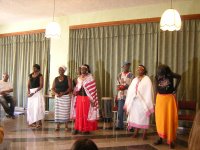 Yesterday, the World Social Forum (WSF) arrived on the African continent and
 Nairobi , Kenya 
by Colin Rajah
 Yesterday, the World Social Forum (WSF) arrived on the African continent and
That’s a vicious self-fulfilling prophecy cycle: if the media says it enough, people start to believe and talk about it, and the media reports that. And so the WSF has challenges even before it began.
 But for the 60+ of us who are a part of the Grassroots Global Justice (GGJ) delegation from the
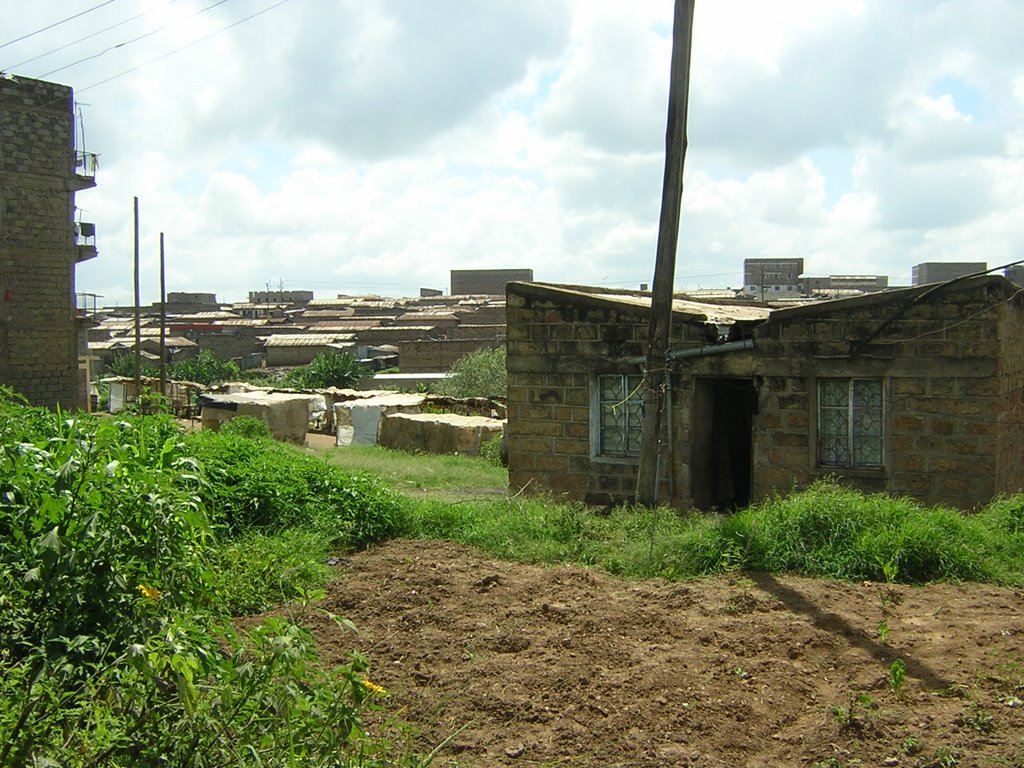 So when we began our WSF 2007 with a couple of site visits to the Korogocho slums and the Rukubi village, it was already recognizable. In spite of being the largest collection of slums – or more accurately, “people’s settlements” – in Nairobi, Korogocho has a growing network of community organizations that not only contend with the extreme poverty, but with public stigma of them as criminals (does having to turn to sex work or petty theft just to be able to put food on the table make one a criminal?)
 It boasts a community-run radio station, a number of cultural performance groups, a youth sports association that also doubles as a handicraft collective etc. And at the same time, they have to contend with the attempts by private companies who are attempting to “land grab” pieces of their land to gentrify. When land grabbing has happened, overnight communities have been displaced and forced into even more poverty.
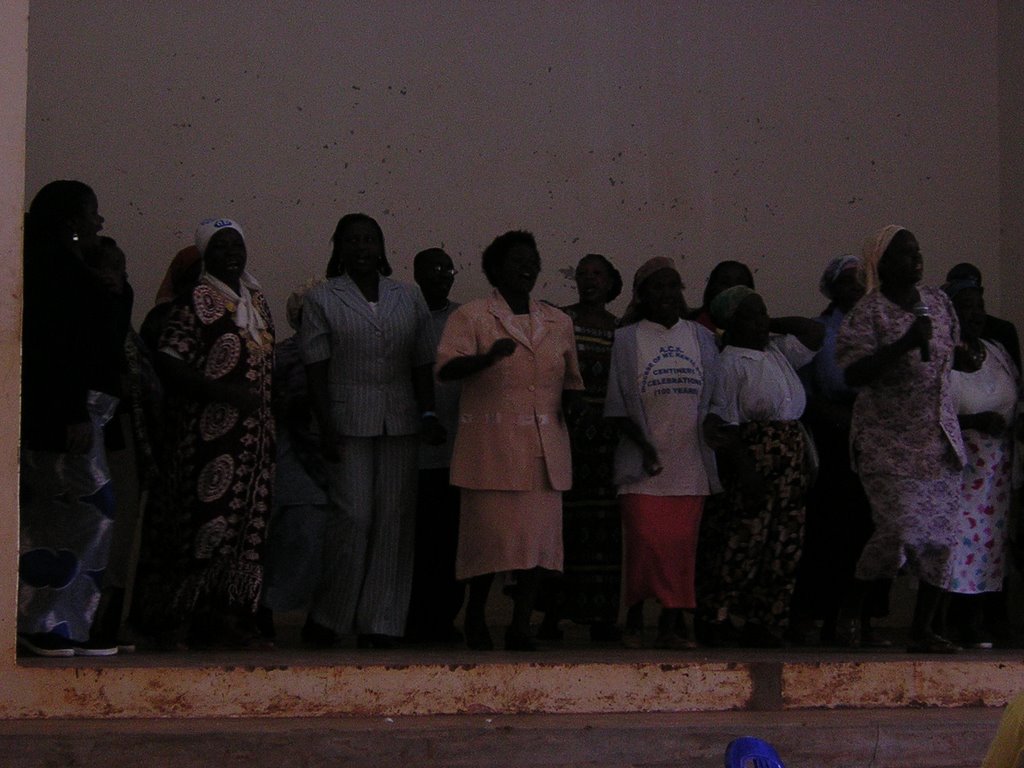 eir rural community that includes a lake has been leased to Oklahoma-based Dominion Farms to harvest products that are sold to the
 The
The
Wednesday, November 29, 2006


Monday, October 16, 2006
NNIRR Report from the Border Social Forum
NNIRR Report from the Border Social Forum (October 13-15, 2006)
by Arnoldo Garcia & Colin Rajah
transcribed by Diana Pei Wu
The Border Social Forum (Foro Social Fronterizo), part of the World Social Forum process, was held in Ciudad Juárez, Chihuahua México, on the US-Mexico border with EL Paso, TX from Oct 13th-15th, 2006. Some 1000 people, representing social justice, immigrant rights and labor organizations, as well as indigenous communities, farmworkers, women, youth, African-Americans, and many others, converged on Juárez.
 Ciudad Juárez is considered a laboratory for neoliberalism. The first maquiladoras of the global assembly lines, were first implemented in Juárez in the 1960s. It is also the site of mass repression against women maquiladora workers, including dozens of unaccounted murders. In this setting, all the discussions and program sessions were focused on creating alternatives to the militarized border where thousands of women, men and children have died as the result of US border policies and the US Department of Homeland Security.
THURSDAY, Oct 12
Prior to the official opening of the Border Social Forum, a number of border groups (including National Network member, the Agricultural Workers Center) organized a March Against NAFTA and Border Violence. Following that in the afternoon, participants embarked on a “border reality tour” to visit industrial sites and colonias (working class neighborhoods).
FRIDAY, Oct 13
The Border Social Forum had 14 themes or tracks of discussions, workshops, actions and proposals, including Globalization & Integration, US-Mexico Relations, Women & the Border, Labor & Workers, Environment & Justice, Health, Indigenous Peoples, Children & Elders, Youth, Human Rights, Art & Culture, Education & Communication, Food Sovereignty, and of course, Migration.
 The organizers kicked-off the Migration track with an opening panel on Migrant Struggles, that discussed the significance of the mass mobilizations in the past year. The panel opened with a presentation by National Network staff member Arnoldo Garcia who described the history of state repression in the region.
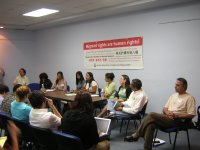 Other National Network members also mainly participated in the Migration track. Coalicion de Derechos Humanos from Arizona, Desis Rising Up & Moving -DRUM from New York, South Asian Network - SAN and Communities for Humane Immigrant Rights of Los Angeles - CHIRLA (both from Los Angeles), St. Peter’s Housing from San Francisco, Colonias Development Council and Agricultural Workers Center (both from the border in Texas), as well as NNIRR Board member Susan Alva, led an organizing workshop called “Building Walls, Destroying Rights: The International Implications of Immigration Legislation.” This workshop analyzed the panorama of anti-immigrant legislation, the immigrant fightback, and a proposal from the National Network for a US campaign for equity, liberty & justice.
SATURDAY, Oct 14
Most members of the National Network, (such as Coalicion de Derechos Humanos, DRUM, SAN, CHIRLA etc.) organized separate workshops on border violence and militarization. DRUM's workshop tied the militarization along the US-Mexico border to that in Palestine. The National Network also participated in a workshop organized by CHIRLA discussing interior immigration law enforcement issues, as well as one organized by the Grassroots Global Justice (GGJ) Alliance on "Black-Brown Alliance Building".
 Diverse community organizations and movements at the BSF presented a gamut of discussions, trainings, resources, video and audio to focus discussion on alternatives to the dominant forms of economic development now present. They also looked at the impacts of neoliberalism from indigenous peoples; land use to environmental justice to workers rights and all the challenges that variouos peoples (indigenous communities, working people and people of color) are facing.
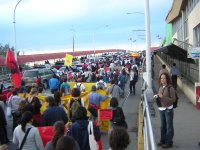 Saturday culminated in a march to the border and symbolic shutdown of it. It was estimated that more than 2000 people took part in this mass march that called for an end to the Border Wall of Death, and the rescinding of militarization at the border, as well the legislation and rhetoric that promotes it.
SUNDAY, Oct 15
 Each of the tracks presented a series of conclusions and proposals for action as a followup to the BSF. The National Network presented its proposal for a national campaign in the US to organize a national dialogue on the type of border communities want. This would feature human rights, solidarity and bringing diverse communities to meet their counterparts at the US-Mexico border to challenge the existing militarization and impunity at the border.
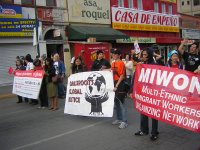 The outcomes from the Migration track recognize that the mass mobilizations of 2006 were the result of organized communities, especially over the last 10 years of work. It also emphasized that the current border militarization is part of the low intensity war being waged against migrants and border communities. The Migrant track put forth that toppling the border wall and ending militarization was a top priority.
The BSF participants by acclamation will organize a campaign to defend the rights of communities at the border to stop hate crimes and link it to stopping the war abroad as well. There is also a proposal for organized actions including boycotts and work stoppages for May 1, 2007. And finally, there are plans to hold a 2nd Border SF that is to held on Mexico’s southern border.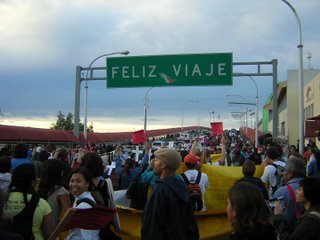
by Arnoldo Garcia & Colin Rajah
transcribed by Diana Pei Wu
The Border Social Forum (Foro Social Fronterizo), part of the World Social Forum process, was held in Ciudad Juárez, Chihuahua México, on the US-Mexico border with EL Paso, TX from Oct 13th-15th, 2006. Some 1000 people, representing social justice, immigrant rights and labor organizations, as well as indigenous communities, farmworkers, women, youth, African-Americans, and many others, converged on Juárez.
 Ciudad Juárez is considered a laboratory for neoliberalism. The first maquiladoras of the global assembly lines, were first implemented in Juárez in the 1960s. It is also the site of mass repression against women maquiladora workers, including dozens of unaccounted murders. In this setting, all the discussions and program sessions were focused on creating alternatives to the militarized border where thousands of women, men and children have died as the result of US border policies and the US Department of Homeland Security.
THURSDAY, Oct 12
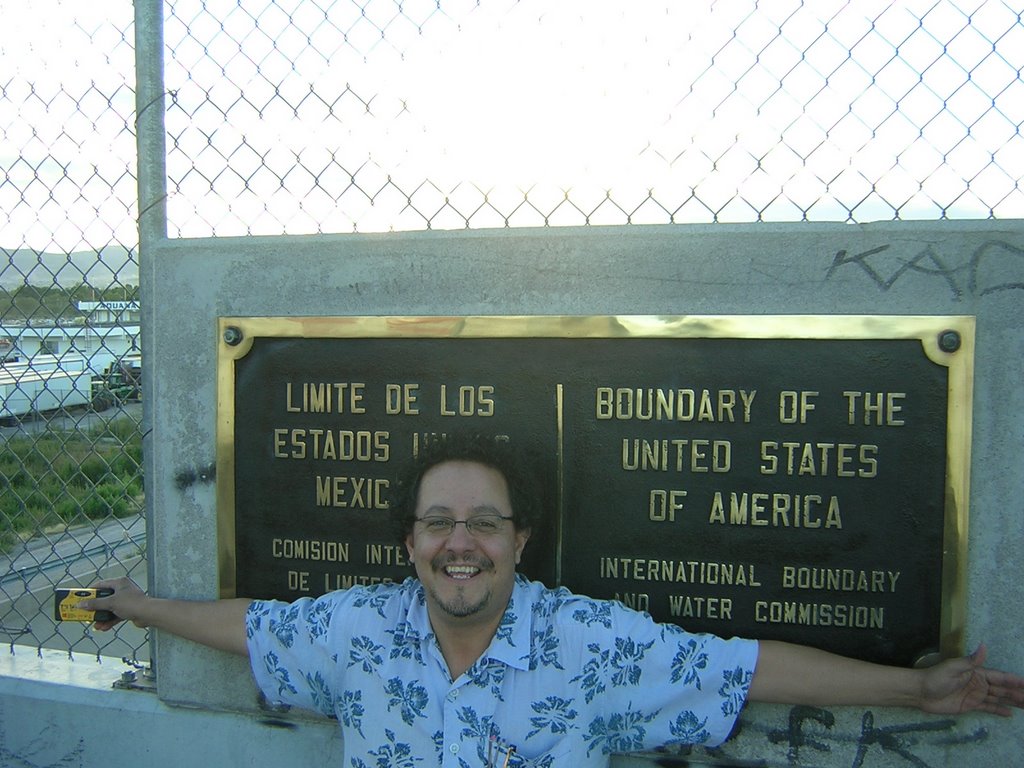
Prior to the official opening of the Border Social Forum, a number of border groups (including National Network member, the Agricultural Workers Center) organized a March Against NAFTA and Border Violence. Following that in the afternoon, participants embarked on a “border reality tour” to visit industrial sites and colonias (working class neighborhoods).
FRIDAY, Oct 13

The Border Social Forum had 14 themes or tracks of discussions, workshops, actions and proposals, including Globalization & Integration, US-Mexico Relations, Women & the Border, Labor & Workers, Environment & Justice, Health, Indigenous Peoples, Children & Elders, Youth, Human Rights, Art & Culture, Education & Communication, Food Sovereignty, and of course, Migration.
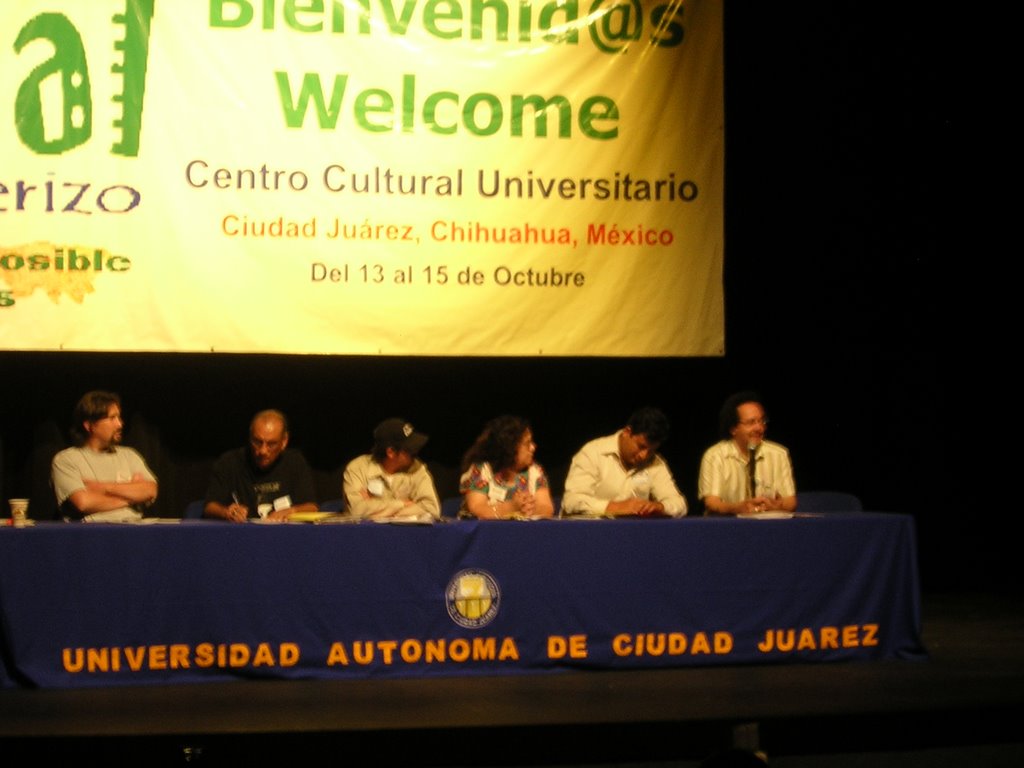 The organizers kicked-off the Migration track with an opening panel on Migrant Struggles, that discussed the significance of the mass mobilizations in the past year. The panel opened with a presentation by National Network staff member Arnoldo Garcia who described the history of state repression in the region.
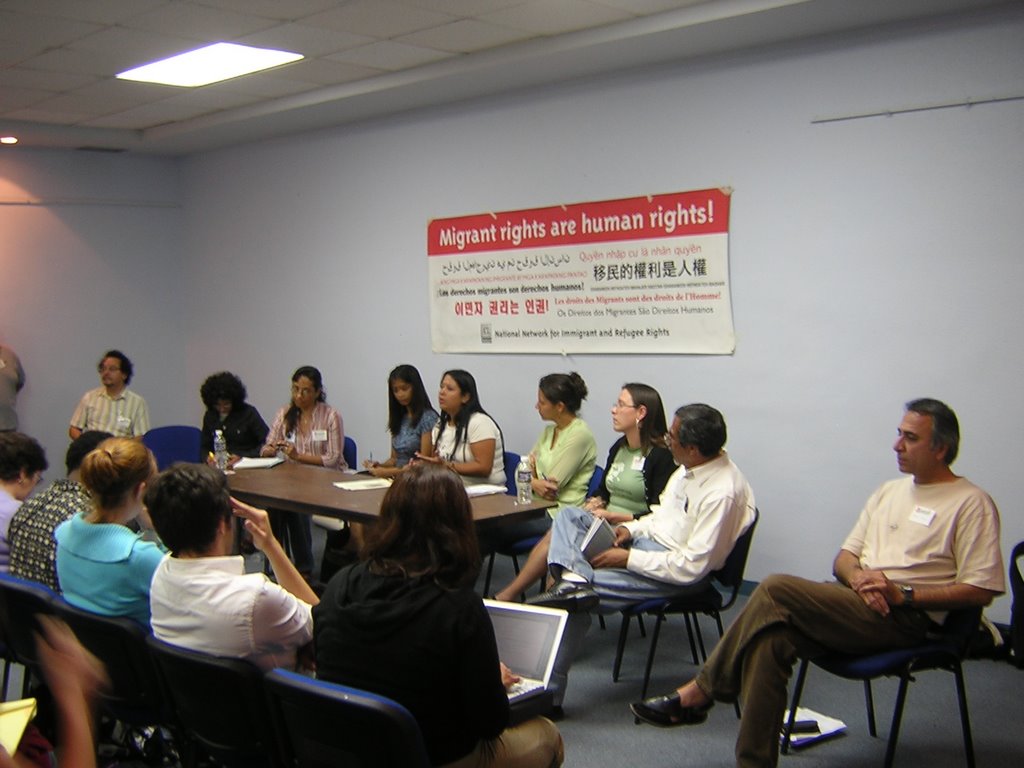 Other National Network members also mainly participated in the Migration track. Coalicion de Derechos Humanos from Arizona, Desis Rising Up & Moving -DRUM from New York, South Asian Network - SAN and Communities for Humane Immigrant Rights of Los Angeles - CHIRLA (both from Los Angeles), St. Peter’s Housing from San Francisco, Colonias Development Council and Agricultural Workers Center (both from the border in Texas), as well as NNIRR Board member Susan Alva, led an organizing workshop called “Building Walls, Destroying Rights: The International Implications of Immigration Legislation.” This workshop analyzed the panorama of anti-immigrant legislation, the immigrant fightback, and a proposal from the National Network for a US campaign for equity, liberty & justice.
SATURDAY, Oct 14

Most members of the National Network, (such as Coalicion de Derechos Humanos, DRUM, SAN, CHIRLA etc.) organized separate workshops on border violence and militarization. DRUM's workshop tied the militarization along the US-Mexico border to that in Palestine. The National Network also participated in a workshop organized by CHIRLA discussing interior immigration law enforcement issues, as well as one organized by the Grassroots Global Justice (GGJ) Alliance on "Black-Brown Alliance Building".
 Diverse community organizations and movements at the BSF presented a gamut of discussions, trainings, resources, video and audio to focus discussion on alternatives to the dominant forms of economic development now present. They also looked at the impacts of neoliberalism from indigenous peoples; land use to environmental justice to workers rights and all the challenges that variouos peoples (indigenous communities, working people and people of color) are facing.
 Saturday culminated in a march to the border and symbolic shutdown of it. It was estimated that more than 2000 people took part in this mass march that called for an end to the Border Wall of Death, and the rescinding of militarization at the border, as well the legislation and rhetoric that promotes it.
SUNDAY, Oct 15
 Each of the tracks presented a series of conclusions and proposals for action as a followup to the BSF. The National Network presented its proposal for a national campaign in the US to organize a national dialogue on the type of border communities want. This would feature human rights, solidarity and bringing diverse communities to meet their counterparts at the US-Mexico border to challenge the existing militarization and impunity at the border.
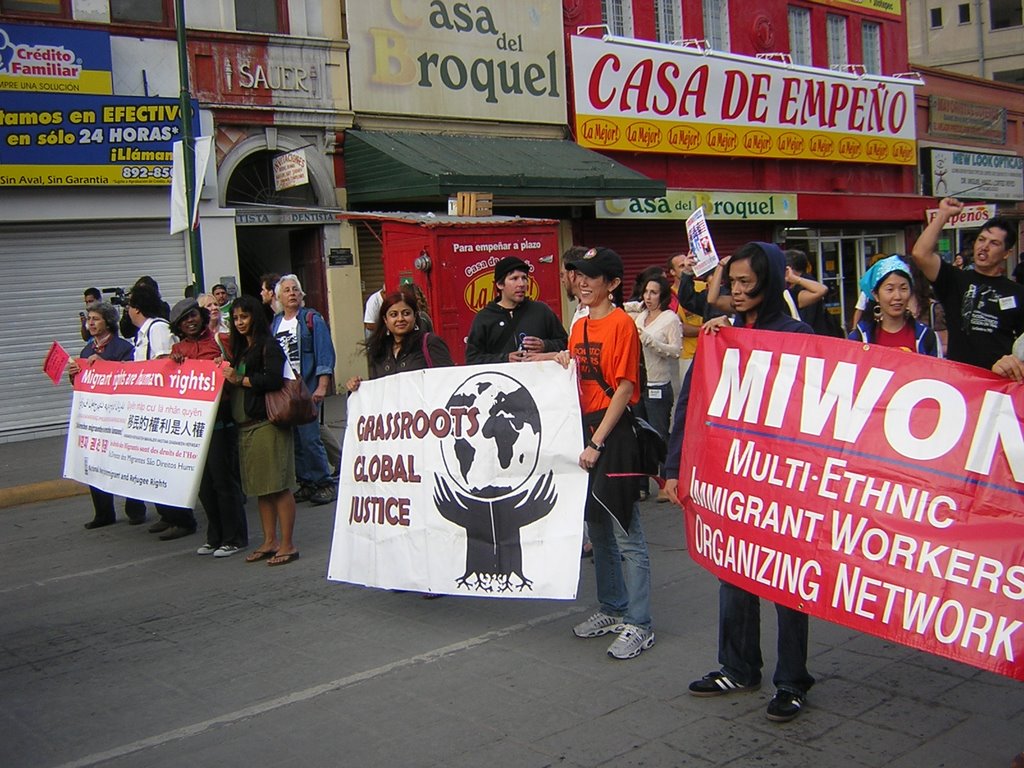 The outcomes from the Migration track recognize that the mass mobilizations of 2006 were the result of organized communities, especially over the last 10 years of work. It also emphasized that the current border militarization is part of the low intensity war being waged against migrants and border communities. The Migrant track put forth that toppling the border wall and ending militarization was a top priority.
The BSF participants by acclamation will organize a campaign to defend the rights of communities at the border to stop hate crimes and link it to stopping the war abroad as well. There is also a proposal for organized actions including boycotts and work stoppages for May 1, 2007. And finally, there are plans to hold a 2nd Border SF that is to held on Mexico’s southern border.

Friday, October 13, 2006
NNIRR at the Border Social Forum

La Red Nacional se fue al Foro Social Fronterizo, para El Paso y luego para pasar a Ciudad Juárez hoy, el viernes 13 de octubre.
REMINDER! -- NNIRR -- IRRTI 2006 - Scholarship Applications due Oct 18!
¡Matrículate ahora!
Register now!
Las solicitudes de beca y formularios de matriculación para el
3er Instituto Nacional de Capacitación ed Derechos Inmigrantes y Refugiados
se deben entregar para el dia 18 de octubre.
3rd National Immigrant and Refugee Rights Training Institute
Registration & Scholarship Application Forms are due October 18!
You can register in many ways. / se lo puedes hacer en varias maneras.
1. On paper: Go to our webpage and print out the forms and fax or mail them in:
Por escrito: Vaya a nuestra pagina de Web, imprime los formularios, llenarlos y mandelos a nosotros por fax o correo:
http://www.nnirr.org/projects/IRRTI2006/index.htm
2. Fill out the form online / Ahora, hazlotodo en la línea!
http://www.surveymonkey.com/s.asp?u=216322722859
un abrazo fuerte,
diana
* * * * *
Diana Pei Wu 吳珮珮
Program Director, Education & Capacity Building
National Network for Immigrant & Refugee Rights
310 8th Street, Suite 303
Oakland, CA 94607
Office: (510) 465-1984 x 304
Email: diana@nnirr.org
* * * * *
Diana Pei Wu 吳珮珮
coordinadora, programa de capacitación
red nacional pro derechos inmigrantes y refugiados
310 8th Street, Suite 303
Oakland, CA 94607
tel: (510) 465-1984 x 304
Email: diana@nnirr.org
Register now!
Las solicitudes de beca y formularios de matriculación para el
3er Instituto Nacional de Capacitación ed Derechos Inmigrantes y Refugiados
se deben entregar para el dia 18 de octubre.
3rd National Immigrant and Refugee Rights Training Institute
Registration & Scholarship Application Forms are due October 18!
You can register in many ways. / se lo puedes hacer en varias maneras.
1. On paper: Go to our webpage and print out the forms and fax or mail them in:
Por escrito: Vaya a nuestra pagina de Web, imprime los formularios, llenarlos y mandelos a nosotros por fax o correo:
http://www.nnirr.org/projects/IRRTI2006/index.htm
2. Fill out the form online / Ahora, hazlotodo en la línea!
http://www.surveymonkey.com/s.asp?u=216322722859
un abrazo fuerte,
diana
* * * * *
Diana Pei Wu 吳珮珮
Program Director, Education & Capacity Building
National Network for Immigrant & Refugee Rights
310 8th Street, Suite 303
Oakland, CA 94607
Office: (510) 465-1984 x 304
Email: diana@nnirr.org
* * * * *
Diana Pei Wu 吳珮珮
coordinadora, programa de capacitación
red nacional pro derechos inmigrantes y refugiados
310 8th Street, Suite 303
Oakland, CA 94607
tel: (510) 465-1984 x 304
Email: diana@nnirr.org
Subscribe to:
Posts (Atom)