Versión en español sigue
Stop the Sensenbrenner Anti-Immigrant Laws!
Call Your Two Senators and Representative NowThe Senate is poised to debate and vote on their counterpart legislation to the recently passed House Bill, the Secure Fence Act, H.R. 6061, which would build 700 miles of walls on the U.S.-Mexico border and would require the Department of Homeland Security to achieve "operational control" of the border as a condition before immigration reform is considered.
This week the House is expected to vote on three new immigration enforcement bills introduced by Representative Sensenbrenner (R-WI) from H.R. 4437. Now languishing in Congress, H.R. 4437, if made into law, would make being undocumented a felony and criminalize anyone who hires, assists, ministers to or cares for an undocumented immigrant.
Please call your two Senators and Congressional Representative, tell them:* Oppose and votes against the proposed laws in the House and Senate that promote border militarization and draconian immigration law enforcement measures. This legislation only criminalizes immigrant workers, families and communities. These policies have created untold suffering; thousands of migrants have already died at the border.
* Support genuine legalization that protects and expands the civil rights, civil liberties and labor rights of immigrant workers, families and communities.
* More border walls and militarization, guest worker programs, and detention and deportations make our communities vulnerable to exploitation and abuses.
* Only legalization with full rights, labor protections, and family reunification will work.
How to Contact your Congressional Delegation
* You can find out how to contact your Senators and Representative at http://www.facts-online.org/naoc_/leg-lookup/search.tcl* Or you can call the Congressional switchboard and ask to be connected to their offices: (202) 224-3121.
-------------------
¡Alto a las leyes anti-inmigrantes de Sensenbrenner!
Llame a sus dos Senadores y su Representante
El Senado está por debatir y votar sobre su proyecto de ley contraparte a la legislación recientemente aprobada por la Cámara de Representantes, el proyecto de ley "Acta de Muro Seguro ("Secure Fence Act"), H.R. 6061, que permitiría la construcción de case 700 millas de muros en la frontera entre EEUU y México y requeriría que el Departamento de Seguridad Nacional obtuviera el "control operative" de la frontera como precondición para considerer reformas migratorias.
Esta semana la Cámara de Representantes votara sobre tres nuevos proyectos de leyes de control policíaco migratorio, introducidos por el Representante Sensenbrenner (R-WI) de su proyecto de ley H.R. 4437. Ahora pendiente en en el Congreso, H.R. 4437, si llegaría a ser ley, calificaría de felonia el ser indocumentado y criminalizaría a cualquier persona que emplearía, ayudaría, comfortaría y cuidaría al inmigrante indocumentado.
Por favor contacte a sus dos Senadores y Representantes , dígales:* Opónganse a los proyectos de ley en la Cámara y en el Senado que promueven la militarización de la frontera y medidas represivas de control policíaco de la migración que solo criminalizan a los trabajadores, las familias y las comunidades de inmigrantes. Estas políticas han fomentado el sufrimiento sin cesar; miles de migrantes ya han muerto en la frontera como resultado de estas.
* Apoyen una legalización genuine que proteje y expande los derechos civiles, las libertades civiles y los derechos laborales de las y los trabajadores, familias y comunidades inmigrantes.
* Sólo una legalización con derechos plenos, protecciones laborales, y la reunificación de familias resolverá esta sitaución.
* Más muros y militarización en la frontera, más programas de trabajadores braceros (o huéspedes), y la detención y la deportación hace a nuestras comunidades vulnerables a la exploitación y los abusos.
Cómo contactar a su delegación Congresistas
* Puede hallar la información de contacto de sus 2 Senadores y Representante en:
http://www.facts-online.org/naoc_/leg-lookup/search.tcl
* O puede telefonear a la central telefónica del Congreso y pedir que sea conectado a las oficinas de sus 2 Senadores y Representante en: (202) 224-3121.
------------------
National Network for Immigrant and Refugee Rights
Red Nacional Pro Derechos Inmigrantes y Refugiados
310 8th Street Suite 303
Oakland, CA 94607
Tel (510) 465-1984
Fax (510) 465-1885
www.nnirr.org
Thursday, September 21, 2006
Stop Anti-Immigrant Sensenbrenner Bills! Call now.


Wednesday, September 13, 2006


MEDIA ADVISORY: Immigrant Communities in New York Join in Solidarity Rally with Migrant Leaders from Around the World on Eve of UN High Level Dialogue
For immediate release:
September 13, 2006
Immigrant Communities in New Yorkand Migrant Leaders from Around the World rally to pressure UN High Level Dialogue on Migration & Development
What: Migrant Rights Rally & Media Briefing – rain or shine
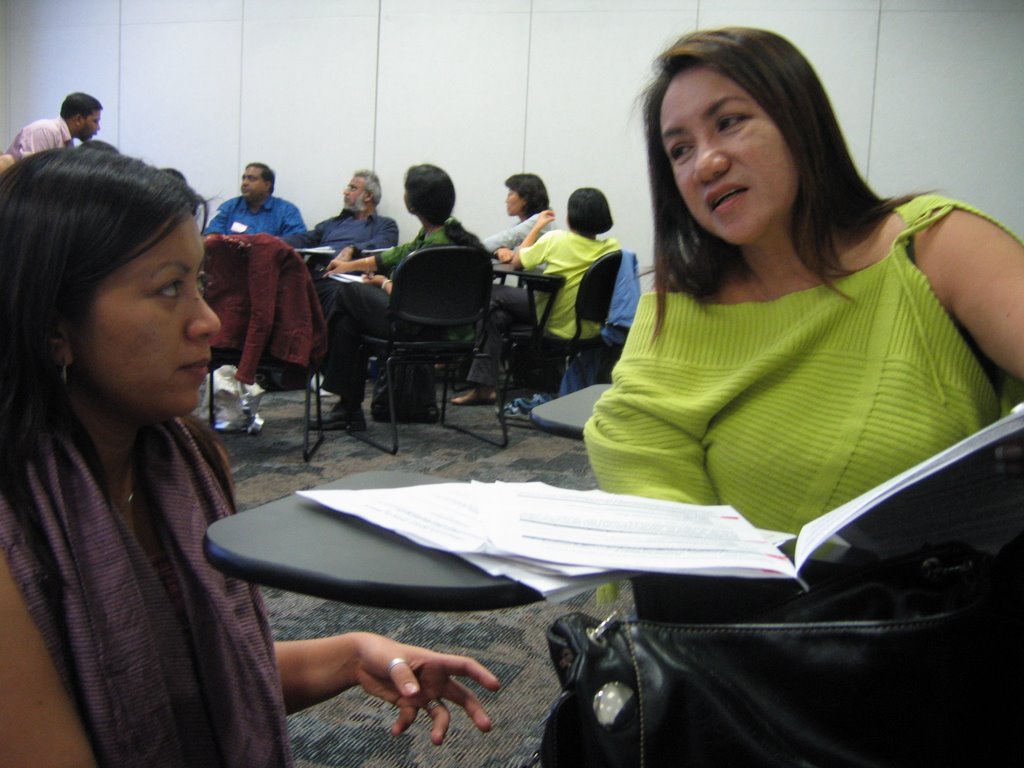
New York, NY -- Organizational representatives and participants of the Community Dialogue on Migration, Development and Human Rights will gather on Thursday in Dag Hammarskjold Plaza across from the United Nations to voice their demands for migration policies recognizing and respecting basic human rights and dignity. The UN High Level Dialogue on Migration and Development, in which very few participants from civil society have been invited to participate, is taking place this week at the UN on September 14 and 15, 2006. While migration is increasingly being discussed within the High Level Dialogue in economic terms, and in terms of filling labor needs of countries’ economic development, migrant communities from around the world insist that the High Level Dialogue directly include the voices of affected communities and highlight the economic and political factors that displace communities and push people to migrate. In addition, any outcomes of the High Level Dialogue should counteract repressive immigration policies that curtail migrants’ rights.
When: Thursday, September 14, 2006; 5:00 pm – 7:00 pm
Where: Dag Hammarskjold Plaza (across from UN); East 44th Street & 1st Avenue; New York City.
Who:
* Mary Robinson, Realizing Rights: Ethical Globalization Initiative (EGI)
* Ellene Sana, Migrant Forum Asia (Phillippines)
* Catherine Tactaquin, National Network for Immigrant & Refugee Rights – NNIRR (USA)
* Carolyn de Leon Hermogenes, CAAAV: Organizing Asian Communities (New York)
* Natividad Obeso, MIREDES (Argentina)
Visuals & Audio: Rally with people from all over the world and New York; lots of colorful signs and art banners, NGO organizational representatives and participants from over 20 countries (including: Chile, Taiwán, Argentina, Phillippines, Thailand, Peru, Bolivia, Colombia, Brazil, Mexico, USA, Germany, Italy, Singapore, Indonesia, Lebanon, India, Bangladesh, Sri Lanka, Burma, Spain, Bosnia Herzegovina) speaking as many languages!
For more information, contact:
Jose Maria Dimaandal (Migrant Forum in Asia)
+ 63 (927) 877-5810
j_mod@rocketmail.com
Arnoldo Garcia (la Red Nacional pro Derechos Inmigrantes y Refugiados)
(510) 928-0685
agarcia@nnirr.org
Organized By: Migrant Rights International, Migrant Forum Asia, National Network for Immigrant and Refugee Rights, UN HLD Working Group and New York UNHLD Working Group.
-- 30 --
September 13, 2006
Immigrant Communities in New Yorkand Migrant Leaders from Around the World rally to pressure UN High Level Dialogue on Migration & Development
What: Migrant Rights Rally & Media Briefing – rain or shine
New York, NY -- Organizational representatives and participants of the Community Dialogue on Migration, Development and Human Rights will gather on Thursday in Dag Hammarskjold Plaza across from the United Nations to voice their demands for migration policies recognizing and respecting basic human rights and dignity. The UN High Level Dialogue on Migration and Development, in which very few participants from civil society have been invited to participate, is taking place this week at the UN on September 14 and 15, 2006. While migration is increasingly being discussed within the High Level Dialogue in economic terms, and in terms of filling labor needs of countries’ economic development, migrant communities from around the world insist that the High Level Dialogue directly include the voices of affected communities and highlight the economic and political factors that displace communities and push people to migrate. In addition, any outcomes of the High Level Dialogue should counteract repressive immigration policies that curtail migrants’ rights.
When: Thursday, September 14, 2006; 5:00 pm – 7:00 pm
Where: Dag Hammarskjold Plaza (across from UN); East 44th Street & 1st Avenue; New York City.
Who:
* Mary Robinson, Realizing Rights: Ethical Globalization Initiative (EGI)
* Ellene Sana, Migrant Forum Asia (Phillippines)
* Catherine Tactaquin, National Network for Immigrant & Refugee Rights – NNIRR (USA)
* Carolyn de Leon Hermogenes, CAAAV: Organizing Asian Communities (New York)
* Natividad Obeso, MIREDES (Argentina)
Visuals & Audio: Rally with people from all over the world and New York; lots of colorful signs and art banners, NGO organizational representatives and participants from over 20 countries (including: Chile, Taiwán, Argentina, Phillippines, Thailand, Peru, Bolivia, Colombia, Brazil, Mexico, USA, Germany, Italy, Singapore, Indonesia, Lebanon, India, Bangladesh, Sri Lanka, Burma, Spain, Bosnia Herzegovina) speaking as many languages!
For more information, contact:
Jose Maria Dimaandal (Migrant Forum in Asia)
+ 63 (927) 877-5810
j_mod@rocketmail.com
Arnoldo Garcia (la Red Nacional pro Derechos Inmigrantes y Refugiados)
(510) 928-0685
agarcia@nnirr.org
Organized By: Migrant Rights International, Migrant Forum Asia, National Network for Immigrant and Refugee Rights, UN HLD Working Group and New York UNHLD Working Group.
-- 30 --
Tuesday, September 12, 2006

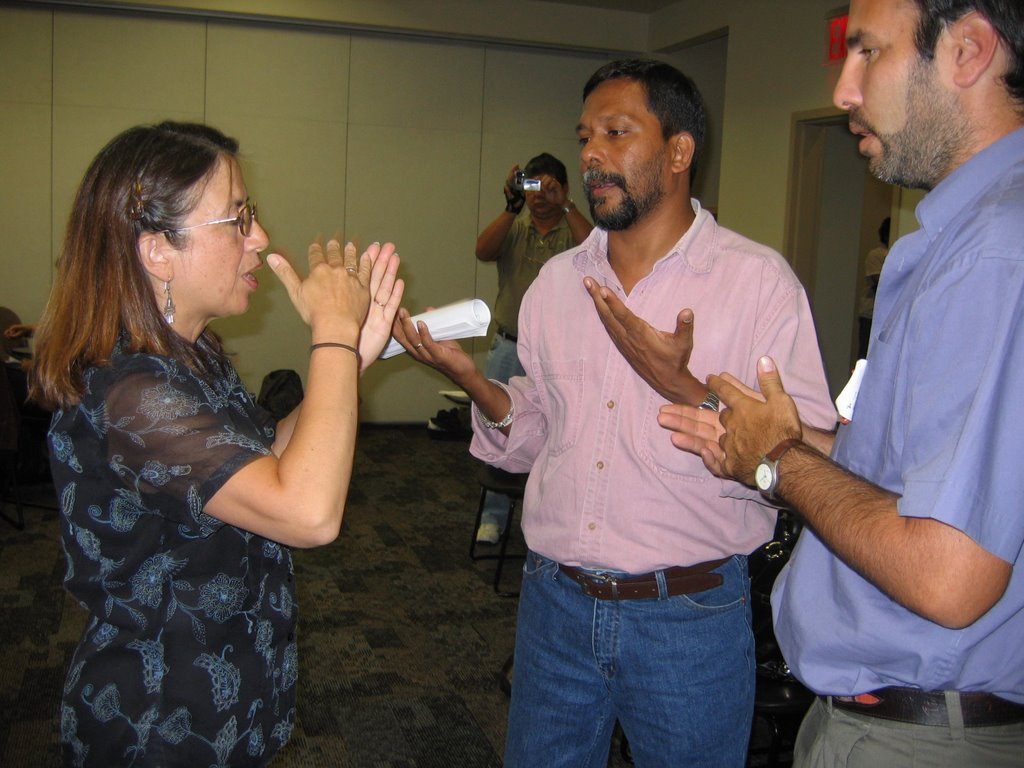
Civil Society Parallel Events and Activities on Migration, Development and Human Rights
Activities under the Civil Society Parallel Events on Migration, Development and Human Rights*
September 12, 2006
(1) Lobbying/Embassy Hopping
September 12 is dedicated to conducting lobbying work with key permanent government missions (embassies) in New York so that the civil society could raise its concerns about the UNHLD process, deliver position papers and discuss key issues on migration and development from a civil society perspective.
Venue: Queens College Worker Education Extension Center located at 25 W 43rd Street Between 5th & 6th, New York City
Time: 9:00 to 9:15 am for the FINAL BRIEFING
(2) International Migrants Rights Solidarity and Cultural Evening
To raise awareness, dialogue, and connect migrants rights struggles from around the world with the local migrant/immigrant rights struggles in New York and the US
Venue: Judson Memorial Church (55 Washington Square South, between Thompson & Sullivan Streets)
Time: 6:00 to 9:00 pm
September 13-15, 2006
Community Dialogue on Migration, Development and Human Rights
To highlight key migration issues from a community perspective, share experiences on how migrant response organizations in various countries and regions are working to achieve international recognition and enforcement of migrants’ human rights, collectively inform participants on the intended goals of the UNHLD and its policy implications for global migration, human rights and development.
Topics:
1. Global Economic Systems: Empty Promises for Developing Countries and Forced Migration
2. War and Armed Conflict and its Impact on Local and Migrant Populations
3. Shared Responsibilities and Co-Development between sending and destination countries: Creating Strategies for Compensation and Remittances
4. Strategies for Advancing the Rights of Undocumented Migrant Workers in the Global Economy
5. National Immigration Policy Regimes: The ‘Race to the Bottom’ & Challenges for the Implementation of International Migrants Human Rights Standards
6. Enforcing Borders: An International Snapshot of How Border Enforcement Violates Core Standards of Migrants Human Rights
7. The Abuse of Migrant Workers with Impunity
8. The Feminization of Migration
9. The Migration-Trafficking Nexus
10 The Global Strategy Session for Migrant Domestic Workers Rights
11. Migrant LGBT (Lesbian, Gay, Bisexual and Transgendered) Rights
Venue: Queens College Worker Education Extension Center located at 25 W 43rd Street Between 5th & 6th, New York City
Time: 9:00 to 5:00 pm
For interviews and more information, please contact:
Joey Dimaandal, Media Officer for the MRI Civil Society Parallel Events during the United Nations High-Level Dialogue on Migration and Development in New York City
Tel: +639175267171, +639278775810
Email: j-mod@rocketmail.com
Address: West Side YMCA, 5 West 63rd Street between Broadway and Central Park West, New York City.
Arnoldo Garcia (For Spanish language media organizations), National Network for Immigrant and Refugee Rights www.nnirr.org
Tel +1 510 928 0685
Email: agarcia@nnirr.org
* MFA is a regional network of 260 migrant workers associations, trade unions and NGOs in Asia. The contact information of MFA:
Regional Coordinator: William Gois
Address: 59-B Malumanay Street, Teachers’ Village West, Quezon City, Philippines
Email address: mfa@pacific.net.hk Web: www.mfasia.org
** Migrant Rights International has members in Asia, Europe, North America and Latin America.
September 12, 2006
(1) Lobbying/Embassy Hopping
September 12 is dedicated to conducting lobbying work with key permanent government missions (embassies) in New York so that the civil society could raise its concerns about the UNHLD process, deliver position papers and discuss key issues on migration and development from a civil society perspective.
Venue: Queens College Worker Education Extension Center located at 25 W 43rd Street Between 5th & 6th, New York City
Time: 9:00 to 9:15 am for the FINAL BRIEFING
(2) International Migrants Rights Solidarity and Cultural Evening
To raise awareness, dialogue, and connect migrants rights struggles from around the world with the local migrant/immigrant rights struggles in New York and the US
Venue: Judson Memorial Church (55 Washington Square South, between Thompson & Sullivan Streets)
Time: 6:00 to 9:00 pm
September 13-15, 2006
Community Dialogue on Migration, Development and Human Rights
To highlight key migration issues from a community perspective, share experiences on how migrant response organizations in various countries and regions are working to achieve international recognition and enforcement of migrants’ human rights, collectively inform participants on the intended goals of the UNHLD and its policy implications for global migration, human rights and development.
Topics:
1. Global Economic Systems: Empty Promises for Developing Countries and Forced Migration
2. War and Armed Conflict and its Impact on Local and Migrant Populations
3. Shared Responsibilities and Co-Development between sending and destination countries: Creating Strategies for Compensation and Remittances
4. Strategies for Advancing the Rights of Undocumented Migrant Workers in the Global Economy
5. National Immigration Policy Regimes: The ‘Race to the Bottom’ & Challenges for the Implementation of International Migrants Human Rights Standards
6. Enforcing Borders: An International Snapshot of How Border Enforcement Violates Core Standards of Migrants Human Rights
7. The Abuse of Migrant Workers with Impunity
8. The Feminization of Migration
9. The Migration-Trafficking Nexus
10 The Global Strategy Session for Migrant Domestic Workers Rights
11. Migrant LGBT (Lesbian, Gay, Bisexual and Transgendered) Rights
Venue: Queens College Worker Education Extension Center located at 25 W 43rd Street Between 5th & 6th, New York City
Time: 9:00 to 5:00 pm
For interviews and more information, please contact:
Joey Dimaandal, Media Officer for the MRI Civil Society Parallel Events during the United Nations High-Level Dialogue on Migration and Development in New York City
Tel: +639175267171, +639278775810
Email: j-mod@rocketmail.com
Address: West Side YMCA, 5 West 63rd Street between Broadway and Central Park West, New York City.
Arnoldo Garcia (For Spanish language media organizations), National Network for Immigrant and Refugee Rights www.nnirr.org
Tel +1 510 928 0685
Email: agarcia@nnirr.org
* MFA is a regional network of 260 migrant workers associations, trade unions and NGOs in Asia. The contact information of MFA:
Regional Coordinator: William Gois
Address: 59-B Malumanay Street, Teachers’ Village West, Quezon City, Philippines
Email address: mfa@pacific.net.hk Web: www.mfasia.org
** Migrant Rights International has members in Asia, Europe, North America and Latin America.
Migrants’ advocates to meet UN Permanent Mission to push for migrants rights in the upcoming UN High-Level Dialogue
[Sigue en espanyol]
September 12, 2006
Migrants’ advocates to meet UN Permanent Mission to push for migrants rights in the upcoming UN High-Level Dialogue
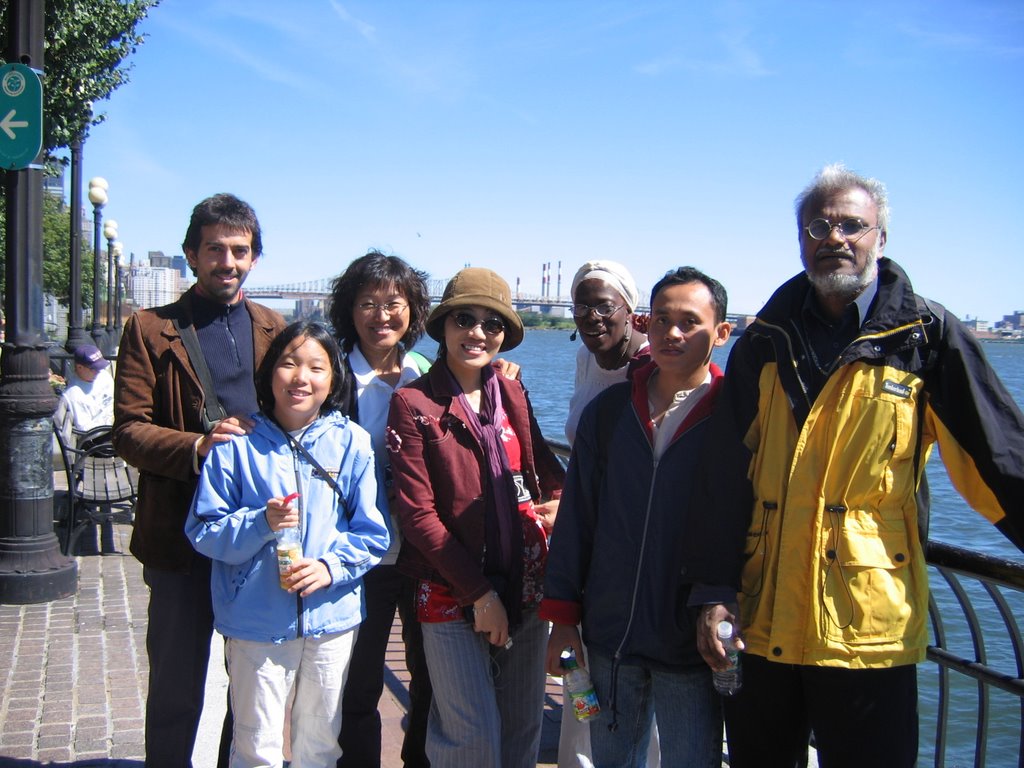
(New York City) Civil Society leaders and migrants’ rights advocates from the United States, Asia, the Middle East, Latin America and Europe gather in New York City today to meet with permanent mission representatives to the United Nations (UN) to present civil society perspectives on migration and development. The embassy visits are being organized by Migrant Forum in Asia (MFA) and Migrants Rights International (MRI) ahead of the United Nations High-Level Dialogue on Migration and Development on September 14-15, 2006.
“As part of the civil society, we exercise our right to speak out and deliver our position on critical issues related to migration and development,” says Sajida Ally, Programme Consultant of MRI. “It is imperative for us to present our perspectives to the permanent mission and government representatives. These are the people who will influence the course of the debate at the High-Level Dialogue. It is essential that they base discussions on the real situation of migrants’ human rights.”
According to MFA Regional Coordinator William Gois, the Asian delegates managed to secure appointments with the permanent missions of the Philippines, Bangladesh, Sri Lanka, Indonesia and South Korea. The Asian delegates called the Asian Alliance for Migration, Development and Human Rights will be presenting their recommendations to their government counterparts including the call to ratify and implement the 1990 International Convention on the Protection of the Rights of All Migrant Workers and Members of their Families as well as the relevant labor standards and other migration-related conventions of the International Labour Organization.
“Labor migration is quite dynamic in the Asian region which now hosts 53 million migrants, and it fast becoming an intra-regional phenomenon with around 2.5 million people a year moving within the region, says Mr. Gois. “The policy framework that will be created at the High-Level Dialogue as indicated by the Secretary General’s report leans more towards harnessing remittances as an economic benefit of migration. We are also concerned with the ‘co-development’ strategy wherein civil society has little or no participation at all. The main stakeholder in the migration process is the migrants themselves. Therefore, the policy on migration must be based primarily on the needs of people migrating,” adds Mr Gois.
MRI and MFA recommends for the establishment of a Permanent Forum on Migration that is inclusive and participatory. The group says that the forum should be a place to stimulate new ideas, approaches and perspectives in understanding migration and to enforce government commitments towards these.
“The forum should likewise include issues related to the contemporary nature of migration. A lot of things are happening and it is not just remittances. We must recognize that migration is a complex issue that should be based on human rights framework,” says Ms. Ally.
# # #
The Civil Society Parallel Events on Migration, Development and Human Rights are being held at the Queens College Workers Education Extension Center, 25 W 43rd Street between 5th and 6th Avenues in New York City until September 15, 2006.
For interviews and more information, please contact:
Joey Dimaandal
Tel: +639175267171, +639278775810
Email: j-mod@rocketmail.com
Address: West Side YMCA, 5 West 63rd Street between Broadway and Central Park West, New York City.
Arnoldo Garcia (For Spanish language media organizations)
Tel +1 510 928 0685
Email: agarcia@nnirr.org
+++
PARA DIFUSION INMEDIATA
12 de Septiembre, 2006
Defensores de derechos migrantes se reunirán con la Misión Permanente de la ONU exigiendo el cumplimiento de los derechos de las y los trabajadores migrantes en las reuniones próximas del Diálogo de Alto Nivel de la ONU
(Ciudad de Nueva York) Líderes y defensores de los derechos de las y los migrantes en la Sociedad Civil de los Estados Unidos, Asia, el Medio Oriente, América Latina y Europa están en Nueva York hoy para reunirse con representantes de la misión permanente de las Naciones Unidas (ONU) para presentar las perspectivas de la sociedad civil sobre la migración y el desarrollo. Las visitas a las embajadas han sido organizadas por el Foro Migrante en Asia (MFA, Migant Forum in Asia) y la Internacional de Derechos Migrantes (MRI, Migrant Rights International) en anticipación del Diálogo de Alto Nivel sobre la Migración y el Desarrollo de las Naciones Unidas el 14-15 de Septiembre, 2006.
“Como parte de la sociedad civil, ejercemos nuestro derecho a alzar la voz y entregarles nuestra perspectiva sobre temas críticas relacionados a la migración y el desarrollo,” dice Sajida Ally, Consultante de Programa de la MRI. “Es imperativo que nosotras presentemos nuestras posiciones a la misión permanente y los representantes de los gobiernos. Estos son los que influirán el curso del debate en el Diálogo de Alto Nivel. Es esencial que sus discusiones sean a base de la situación real de los derechos humanos de los y las migrantes.”
Según el coordinador regional del Foro Migrante en Asia (MFA), William Gois, los delegados asiáticos lograron conseguir reuniones con las misiones permanentes de las Filipinas, Bangladesh, Sri Lanka, Indonesia y Corea del Sur. Los delegados asiáticos llamados la Alianza Asiática por la Migración, Desarrollo y los Derechos Humanos están presentando sus recomendaciones a sus contrapartes gubernamentales incluyendo el llamado a ratificar e implementar la Convención Internacional sobre la Protección de los Derechos de los Trabajadores Migratorios y los Miembros de sus Familias de 1990 así como también las normas laborales relevantes y otras convenciones relacionadas a la migración a la Organización Internacional del Trabajo.
“La migración de trabajadores es muy dinámica en la región asiática la cual ahora es anfitriona a 53 millones de migrantes, y que rápidamente se está convirtiendo en un fenómeno intra-regional con unos 2.5 millones de personas por año moviéndose dentro de la región,” declara el Sr. Gois. “El marco político que será creado en el Diálogo de Alto Nivel como indicado por el informe del Secretario General tiende hacia el sometimiento de las remesas como un beneficio económico de la migración. Entonces, la política sobre migración tiene que ser basada principalmente en las necesidades de los pueblos en migración mismos,” añade el Sr. Gois.
La MRI y el MFA recomiendan el establecimiento de un Foro Permanente sobre la Migración que es inclusivo y participativo. El grupo dice que el foro debe de ser un espacio para estimular nuevas ideas, trayectorias y perspectivas en el entendimiento de la migración y para asegurar el cumplimiento de los gobiernos hacia éstas.
“El foro debe de incluir temas relacionados a la naturaleza actual de la migración. Muchas cosas están sucediendo y no sólo remesas. Tenemos que reconocer que la migración es un tema complejo que debe de ser basado en marco de los derechos humanos,” dice la Sra. Ally.
###
Los Evento Paralelos de la Sociedad Civil sobre a Migración, el Desarrollo, y los Derechos Humanos están siendo convocados en el Queens College Workers Education Extension Center (Centro Extensión Educativo de Trabajadores del Colegio de Queens), 25 W 43rd Street entre las Avenidas 5t y 6ta en la Ciudad de Nueva York City hasta el 15 de Septiembre, 2006.
Para entrevistas y más información, por favor de contactar:
Joey Dimaandal, portavoz de MRI para los eventos paralelos de la sociedad civil durante el Diálogo de Alto Nivel sobre Migración y Desarrollo de las Naciones Unidas en la Ciudad de Nueva York
Tel +639175267171, +639278775810
Correo electrónico: j-mod@rocketmail.com
Dirección: West Side MICA, 5 West 63rd Street, entre la Broadway y Central Park West, Ciudad de Nueva York
Arnoldo García (para los medios de comunicación en español)
Tel +1 (510) 928-0685
Correo electrónico: agarcia@nnirr.org
* MFA es una red regional de 260 asociaciones, sindicatos y ONGs de trabjadores migrantes en Asia. La información de contacto de MFA:
Coordinador regional: William Gois
Dirección: 59-B Malumanay Street, Teachers’ Village West, Quezón City, Las Filipinas
Correo electrónico: mfa@pacific.net.hk Web: www.mfasia.org
** La Internacional de Derechos Migrantes (MRI) tiene miembros en Asia, Europa, América del Norte y América Latina.
--30--
PRESS RELEASE [Sigue en espanyol]
September 12, 2006
Migrants’ advocates to meet UN Permanent Mission to push for migrants rights in the upcoming UN High-Level Dialogue
(New York City) Civil Society leaders and migrants’ rights advocates from the United States, Asia, the Middle East, Latin America and Europe gather in New York City today to meet with permanent mission representatives to the United Nations (UN) to present civil society perspectives on migration and development. The embassy visits are being organized by Migrant Forum in Asia (MFA) and Migrants Rights International (MRI) ahead of the United Nations High-Level Dialogue on Migration and Development on September 14-15, 2006.
“As part of the civil society, we exercise our right to speak out and deliver our position on critical issues related to migration and development,” says Sajida Ally, Programme Consultant of MRI. “It is imperative for us to present our perspectives to the permanent mission and government representatives. These are the people who will influence the course of the debate at the High-Level Dialogue. It is essential that they base discussions on the real situation of migrants’ human rights.”
According to MFA Regional Coordinator William Gois, the Asian delegates managed to secure appointments with the permanent missions of the Philippines, Bangladesh, Sri Lanka, Indonesia and South Korea. The Asian delegates called the Asian Alliance for Migration, Development and Human Rights will be presenting their recommendations to their government counterparts including the call to ratify and implement the 1990 International Convention on the Protection of the Rights of All Migrant Workers and Members of their Families as well as the relevant labor standards and other migration-related conventions of the International Labour Organization.
“Labor migration is quite dynamic in the Asian region which now hosts 53 million migrants, and it fast becoming an intra-regional phenomenon with around 2.5 million people a year moving within the region, says Mr. Gois. “The policy framework that will be created at the High-Level Dialogue as indicated by the Secretary General’s report leans more towards harnessing remittances as an economic benefit of migration. We are also concerned with the ‘co-development’ strategy wherein civil society has little or no participation at all. The main stakeholder in the migration process is the migrants themselves. Therefore, the policy on migration must be based primarily on the needs of people migrating,” adds Mr Gois.
MRI and MFA recommends for the establishment of a Permanent Forum on Migration that is inclusive and participatory. The group says that the forum should be a place to stimulate new ideas, approaches and perspectives in understanding migration and to enforce government commitments towards these.
“The forum should likewise include issues related to the contemporary nature of migration. A lot of things are happening and it is not just remittances. We must recognize that migration is a complex issue that should be based on human rights framework,” says Ms. Ally.
# # #
The Civil Society Parallel Events on Migration, Development and Human Rights are being held at the Queens College Workers Education Extension Center, 25 W 43rd Street between 5th and 6th Avenues in New York City until September 15, 2006.
For interviews and more information, please contact:
Joey Dimaandal
Tel: +639175267171, +639278775810
Email: j-mod@rocketmail.com
Address: West Side YMCA, 5 West 63rd Street between Broadway and Central Park West, New York City.
Arnoldo Garcia (For Spanish language media organizations)
Tel +1 510 928 0685
Email: agarcia@nnirr.org
+++
12 de Septiembre, 2006
Defensores de derechos migrantes se reunirán con la Misión Permanente de la ONU exigiendo el cumplimiento de los derechos de las y los trabajadores migrantes en las reuniones próximas del Diálogo de Alto Nivel de la ONU
(Ciudad de Nueva York) Líderes y defensores de los derechos de las y los migrantes en la Sociedad Civil de los Estados Unidos, Asia, el Medio Oriente, América Latina y Europa están en Nueva York hoy para reunirse con representantes de la misión permanente de las Naciones Unidas (ONU) para presentar las perspectivas de la sociedad civil sobre la migración y el desarrollo. Las visitas a las embajadas han sido organizadas por el Foro Migrante en Asia (MFA, Migant Forum in Asia) y la Internacional de Derechos Migrantes (MRI, Migrant Rights International) en anticipación del Diálogo de Alto Nivel sobre la Migración y el Desarrollo de las Naciones Unidas el 14-15 de Septiembre, 2006.
“Como parte de la sociedad civil, ejercemos nuestro derecho a alzar la voz y entregarles nuestra perspectiva sobre temas críticas relacionados a la migración y el desarrollo,” dice Sajida Ally, Consultante de Programa de la MRI. “Es imperativo que nosotras presentemos nuestras posiciones a la misión permanente y los representantes de los gobiernos. Estos son los que influirán el curso del debate en el Diálogo de Alto Nivel. Es esencial que sus discusiones sean a base de la situación real de los derechos humanos de los y las migrantes.”
Según el coordinador regional del Foro Migrante en Asia (MFA), William Gois, los delegados asiáticos lograron conseguir reuniones con las misiones permanentes de las Filipinas, Bangladesh, Sri Lanka, Indonesia y Corea del Sur. Los delegados asiáticos llamados la Alianza Asiática por la Migración, Desarrollo y los Derechos Humanos están presentando sus recomendaciones a sus contrapartes gubernamentales incluyendo el llamado a ratificar e implementar la Convención Internacional sobre la Protección de los Derechos de los Trabajadores Migratorios y los Miembros de sus Familias de 1990 así como también las normas laborales relevantes y otras convenciones relacionadas a la migración a la Organización Internacional del Trabajo.
“La migración de trabajadores es muy dinámica en la región asiática la cual ahora es anfitriona a 53 millones de migrantes, y que rápidamente se está convirtiendo en un fenómeno intra-regional con unos 2.5 millones de personas por año moviéndose dentro de la región,” declara el Sr. Gois. “El marco político que será creado en el Diálogo de Alto Nivel como indicado por el informe del Secretario General tiende hacia el sometimiento de las remesas como un beneficio económico de la migración. Entonces, la política sobre migración tiene que ser basada principalmente en las necesidades de los pueblos en migración mismos,” añade el Sr. Gois.
La MRI y el MFA recomiendan el establecimiento de un Foro Permanente sobre la Migración que es inclusivo y participativo. El grupo dice que el foro debe de ser un espacio para estimular nuevas ideas, trayectorias y perspectivas en el entendimiento de la migración y para asegurar el cumplimiento de los gobiernos hacia éstas.
“El foro debe de incluir temas relacionados a la naturaleza actual de la migración. Muchas cosas están sucediendo y no sólo remesas. Tenemos que reconocer que la migración es un tema complejo que debe de ser basado en marco de los derechos humanos,” dice la Sra. Ally.
###
Los Evento Paralelos de la Sociedad Civil sobre a Migración, el Desarrollo, y los Derechos Humanos están siendo convocados en el Queens College Workers Education Extension Center (Centro Extensión Educativo de Trabajadores del Colegio de Queens), 25 W 43rd Street entre las Avenidas 5ta y 6ta en la Ciudad de Nueva York City hasta el 15 de Septiembre, 2006.
Para entrevistas y más información, por favor de contactar:
Joey Dimaandal, portavoz de MRI para los eventos paralelos de la sociedad civil durante el Diálogo de Alto Nivel sobre Migración y Desarrollo de las Naciones Unidas en la Ciudad de Nueva York
Tel +639175267171, +639278775810
Correo electrónico: j-mod@rocketmail.com
Dirección: West Side MICA, 5 West 63rd Street, entre la Broadway y Central Park West, Ciudad de Nueva York
Arnoldo García (para los medios de comunicación en español)
Tel +1 (510) 928-0685
Correo electrónico: agarcia@nnirr.org
* MFA es una red regional de 260 asociaciones, sindicatos y ONGs de trabjadores migrantes en Asia. La información de contacto de MFA:
Coordinador regional: William Gois
Dirección: 59-B Malumanay Street, Teachers’ Village West, Quezón City, Las Filipinas
Correo electrónico: mfa@pacific.net.hk Web: www.mfasia.org
** La Internacional de Derechos Migrantes (MRI) tiene miembros en Asia, Europa, América del Norte y América Latina.
--30--
September 12, 2006
Migrants’ advocates to meet UN Permanent Mission to push for migrants rights in the upcoming UN High-Level Dialogue
(New York City) Civil Society leaders and migrants’ rights advocates from the United States, Asia, the Middle East, Latin America and Europe gather in New York City today to meet with permanent mission representatives to the United Nations (UN) to present civil society perspectives on migration and development. The embassy visits are being organized by Migrant Forum in Asia (MFA) and Migrants Rights International (MRI) ahead of the United Nations High-Level Dialogue on Migration and Development on September 14-15, 2006.
“As part of the civil society, we exercise our right to speak out and deliver our position on critical issues related to migration and development,” says Sajida Ally, Programme Consultant of MRI. “It is imperative for us to present our perspectives to the permanent mission and government representatives. These are the people who will influence the course of the debate at the High-Level Dialogue. It is essential that they base discussions on the real situation of migrants’ human rights.”
According to MFA Regional Coordinator William Gois, the Asian delegates managed to secure appointments with the permanent missions of the Philippines, Bangladesh, Sri Lanka, Indonesia and South Korea. The Asian delegates called the Asian Alliance for Migration, Development and Human Rights will be presenting their recommendations to their government counterparts including the call to ratify and implement the 1990 International Convention on the Protection of the Rights of All Migrant Workers and Members of their Families as well as the relevant labor standards and other migration-related conventions of the International Labour Organization.
“Labor migration is quite dynamic in the Asian region which now hosts 53 million migrants, and it fast becoming an intra-regional phenomenon with around 2.5 million people a year moving within the region, says Mr. Gois. “The policy framework that will be created at the High-Level Dialogue as indicated by the Secretary General’s report leans more towards harnessing remittances as an economic benefit of migration. We are also concerned with the ‘co-development’ strategy wherein civil society has little or no participation at all. The main stakeholder in the migration process is the migrants themselves. Therefore, the policy on migration must be based primarily on the needs of people migrating,” adds Mr Gois.
MRI and MFA recommends for the establishment of a Permanent Forum on Migration that is inclusive and participatory. The group says that the forum should be a place to stimulate new ideas, approaches and perspectives in understanding migration and to enforce government commitments towards these.
“The forum should likewise include issues related to the contemporary nature of migration. A lot of things are happening and it is not just remittances. We must recognize that migration is a complex issue that should be based on human rights framework,” says Ms. Ally.
# # #
The Civil Society Parallel Events on Migration, Development and Human Rights are being held at the Queens College Workers Education Extension Center, 25 W 43rd Street between 5th and 6th Avenues in New York City until September 15, 2006.
For interviews and more information, please contact:
Joey Dimaandal
Tel: +639175267171, +639278775810
Email: j-mod@rocketmail.com
Address: West Side YMCA, 5 West 63rd Street between Broadway and Central Park West, New York City.
Arnoldo Garcia (For Spanish language media organizations)
Tel +1 510 928 0685
Email: agarcia@nnirr.org
+++
PARA DIFUSION INMEDIATA
12 de Septiembre, 2006
Defensores de derechos migrantes se reunirán con la Misión Permanente de la ONU exigiendo el cumplimiento de los derechos de las y los trabajadores migrantes en las reuniones próximas del Diálogo de Alto Nivel de la ONU
(Ciudad de Nueva York) Líderes y defensores de los derechos de las y los migrantes en la Sociedad Civil de los Estados Unidos, Asia, el Medio Oriente, América Latina y Europa están en Nueva York hoy para reunirse con representantes de la misión permanente de las Naciones Unidas (ONU) para presentar las perspectivas de la sociedad civil sobre la migración y el desarrollo. Las visitas a las embajadas han sido organizadas por el Foro Migrante en Asia (MFA, Migant Forum in Asia) y la Internacional de Derechos Migrantes (MRI, Migrant Rights International) en anticipación del Diálogo de Alto Nivel sobre la Migración y el Desarrollo de las Naciones Unidas el 14-15 de Septiembre, 2006.
“Como parte de la sociedad civil, ejercemos nuestro derecho a alzar la voz y entregarles nuestra perspectiva sobre temas críticas relacionados a la migración y el desarrollo,” dice Sajida Ally, Consultante de Programa de la MRI. “Es imperativo que nosotras presentemos nuestras posiciones a la misión permanente y los representantes de los gobiernos. Estos son los que influirán el curso del debate en el Diálogo de Alto Nivel. Es esencial que sus discusiones sean a base de la situación real de los derechos humanos de los y las migrantes.”
Según el coordinador regional del Foro Migrante en Asia (MFA), William Gois, los delegados asiáticos lograron conseguir reuniones con las misiones permanentes de las Filipinas, Bangladesh, Sri Lanka, Indonesia y Corea del Sur. Los delegados asiáticos llamados la Alianza Asiática por la Migración, Desarrollo y los Derechos Humanos están presentando sus recomendaciones a sus contrapartes gubernamentales incluyendo el llamado a ratificar e implementar la Convención Internacional sobre la Protección de los Derechos de los Trabajadores Migratorios y los Miembros de sus Familias de 1990 así como también las normas laborales relevantes y otras convenciones relacionadas a la migración a la Organización Internacional del Trabajo.
“La migración de trabajadores es muy dinámica en la región asiática la cual ahora es anfitriona a 53 millones de migrantes, y que rápidamente se está convirtiendo en un fenómeno intra-regional con unos 2.5 millones de personas por año moviéndose dentro de la región,” declara el Sr. Gois. “El marco político que será creado en el Diálogo de Alto Nivel como indicado por el informe del Secretario General tiende hacia el sometimiento de las remesas como un beneficio económico de la migración. Entonces, la política sobre migración tiene que ser basada principalmente en las necesidades de los pueblos en migración mismos,” añade el Sr. Gois.
La MRI y el MFA recomiendan el establecimiento de un Foro Permanente sobre la Migración que es inclusivo y participativo. El grupo dice que el foro debe de ser un espacio para estimular nuevas ideas, trayectorias y perspectivas en el entendimiento de la migración y para asegurar el cumplimiento de los gobiernos hacia éstas.
“El foro debe de incluir temas relacionados a la naturaleza actual de la migración. Muchas cosas están sucediendo y no sólo remesas. Tenemos que reconocer que la migración es un tema complejo que debe de ser basado en marco de los derechos humanos,” dice la Sra. Ally.
###
Los Evento Paralelos de la Sociedad Civil sobre a Migración, el Desarrollo, y los Derechos Humanos están siendo convocados en el Queens College Workers Education Extension Center (Centro Extensión Educativo de Trabajadores del Colegio de Queens), 25 W 43rd Street entre las Avenidas 5t y 6ta en la Ciudad de Nueva York City hasta el 15 de Septiembre, 2006.
Para entrevistas y más información, por favor de contactar:
Joey Dimaandal, portavoz de MRI para los eventos paralelos de la sociedad civil durante el Diálogo de Alto Nivel sobre Migración y Desarrollo de las Naciones Unidas en la Ciudad de Nueva York
Tel +639175267171, +639278775810
Correo electrónico: j-mod@rocketmail.com
Dirección: West Side MICA, 5 West 63rd Street, entre la Broadway y Central Park West, Ciudad de Nueva York
Arnoldo García (para los medios de comunicación en español)
Tel +1 (510) 928-0685
Correo electrónico: agarcia@nnirr.org
* MFA es una red regional de 260 asociaciones, sindicatos y ONGs de trabjadores migrantes en Asia. La información de contacto de MFA:
Coordinador regional: William Gois
Dirección: 59-B Malumanay Street, Teachers’ Village West, Quezón City, Las Filipinas
Correo electrónico: mfa@pacific.net.hk Web: www.mfasia.org
** La Internacional de Derechos Migrantes (MRI) tiene miembros en Asia, Europa, América del Norte y América Latina.
--30--
PRESS RELEASE [Sigue en espanyol]
September 12, 2006
Migrants’ advocates to meet UN Permanent Mission to push for migrants rights in the upcoming UN High-Level Dialogue
(New York City) Civil Society leaders and migrants’ rights advocates from the United States, Asia, the Middle East, Latin America and Europe gather in New York City today to meet with permanent mission representatives to the United Nations (UN) to present civil society perspectives on migration and development. The embassy visits are being organized by Migrant Forum in Asia (MFA) and Migrants Rights International (MRI) ahead of the United Nations High-Level Dialogue on Migration and Development on September 14-15, 2006.
“As part of the civil society, we exercise our right to speak out and deliver our position on critical issues related to migration and development,” says Sajida Ally, Programme Consultant of MRI. “It is imperative for us to present our perspectives to the permanent mission and government representatives. These are the people who will influence the course of the debate at the High-Level Dialogue. It is essential that they base discussions on the real situation of migrants’ human rights.”
According to MFA Regional Coordinator William Gois, the Asian delegates managed to secure appointments with the permanent missions of the Philippines, Bangladesh, Sri Lanka, Indonesia and South Korea. The Asian delegates called the Asian Alliance for Migration, Development and Human Rights will be presenting their recommendations to their government counterparts including the call to ratify and implement the 1990 International Convention on the Protection of the Rights of All Migrant Workers and Members of their Families as well as the relevant labor standards and other migration-related conventions of the International Labour Organization.
“Labor migration is quite dynamic in the Asian region which now hosts 53 million migrants, and it fast becoming an intra-regional phenomenon with around 2.5 million people a year moving within the region, says Mr. Gois. “The policy framework that will be created at the High-Level Dialogue as indicated by the Secretary General’s report leans more towards harnessing remittances as an economic benefit of migration. We are also concerned with the ‘co-development’ strategy wherein civil society has little or no participation at all. The main stakeholder in the migration process is the migrants themselves. Therefore, the policy on migration must be based primarily on the needs of people migrating,” adds Mr Gois.
MRI and MFA recommends for the establishment of a Permanent Forum on Migration that is inclusive and participatory. The group says that the forum should be a place to stimulate new ideas, approaches and perspectives in understanding migration and to enforce government commitments towards these.
“The forum should likewise include issues related to the contemporary nature of migration. A lot of things are happening and it is not just remittances. We must recognize that migration is a complex issue that should be based on human rights framework,” says Ms. Ally.
# # #
The Civil Society Parallel Events on Migration, Development and Human Rights are being held at the Queens College Workers Education Extension Center, 25 W 43rd Street between 5th and 6th Avenues in New York City until September 15, 2006.
For interviews and more information, please contact:
Joey Dimaandal
Tel: +639175267171, +639278775810
Email: j-mod@rocketmail.com
Address: West Side YMCA, 5 West 63rd Street between Broadway and Central Park West, New York City.
Arnoldo Garcia (For Spanish language media organizations)
Tel +1 510 928 0685
Email: agarcia@nnirr.org
+++
12 de Septiembre, 2006
Defensores de derechos migrantes se reunirán con la Misión Permanente de la ONU exigiendo el cumplimiento de los derechos de las y los trabajadores migrantes en las reuniones próximas del Diálogo de Alto Nivel de la ONU
(Ciudad de Nueva York) Líderes y defensores de los derechos de las y los migrantes en la Sociedad Civil de los Estados Unidos, Asia, el Medio Oriente, América Latina y Europa están en Nueva York hoy para reunirse con representantes de la misión permanente de las Naciones Unidas (ONU) para presentar las perspectivas de la sociedad civil sobre la migración y el desarrollo. Las visitas a las embajadas han sido organizadas por el Foro Migrante en Asia (MFA, Migant Forum in Asia) y la Internacional de Derechos Migrantes (MRI, Migrant Rights International) en anticipación del Diálogo de Alto Nivel sobre la Migración y el Desarrollo de las Naciones Unidas el 14-15 de Septiembre, 2006.
“Como parte de la sociedad civil, ejercemos nuestro derecho a alzar la voz y entregarles nuestra perspectiva sobre temas críticas relacionados a la migración y el desarrollo,” dice Sajida Ally, Consultante de Programa de la MRI. “Es imperativo que nosotras presentemos nuestras posiciones a la misión permanente y los representantes de los gobiernos. Estos son los que influirán el curso del debate en el Diálogo de Alto Nivel. Es esencial que sus discusiones sean a base de la situación real de los derechos humanos de los y las migrantes.”
Según el coordinador regional del Foro Migrante en Asia (MFA), William Gois, los delegados asiáticos lograron conseguir reuniones con las misiones permanentes de las Filipinas, Bangladesh, Sri Lanka, Indonesia y Corea del Sur. Los delegados asiáticos llamados la Alianza Asiática por la Migración, Desarrollo y los Derechos Humanos están presentando sus recomendaciones a sus contrapartes gubernamentales incluyendo el llamado a ratificar e implementar la Convención Internacional sobre la Protección de los Derechos de los Trabajadores Migratorios y los Miembros de sus Familias de 1990 así como también las normas laborales relevantes y otras convenciones relacionadas a la migración a la Organización Internacional del Trabajo.
“La migración de trabajadores es muy dinámica en la región asiática la cual ahora es anfitriona a 53 millones de migrantes, y que rápidamente se está convirtiendo en un fenómeno intra-regional con unos 2.5 millones de personas por año moviéndose dentro de la región,” declara el Sr. Gois. “El marco político que será creado en el Diálogo de Alto Nivel como indicado por el informe del Secretario General tiende hacia el sometimiento de las remesas como un beneficio económico de la migración. Entonces, la política sobre migración tiene que ser basada principalmente en las necesidades de los pueblos en migración mismos,” añade el Sr. Gois.
La MRI y el MFA recomiendan el establecimiento de un Foro Permanente sobre la Migración que es inclusivo y participativo. El grupo dice que el foro debe de ser un espacio para estimular nuevas ideas, trayectorias y perspectivas en el entendimiento de la migración y para asegurar el cumplimiento de los gobiernos hacia éstas.
“El foro debe de incluir temas relacionados a la naturaleza actual de la migración. Muchas cosas están sucediendo y no sólo remesas. Tenemos que reconocer que la migración es un tema complejo que debe de ser basado en marco de los derechos humanos,” dice la Sra. Ally.
###
Los Evento Paralelos de la Sociedad Civil sobre a Migración, el Desarrollo, y los Derechos Humanos están siendo convocados en el Queens College Workers Education Extension Center (Centro Extensión Educativo de Trabajadores del Colegio de Queens), 25 W 43rd Street entre las Avenidas 5ta y 6ta en la Ciudad de Nueva York City hasta el 15 de Septiembre, 2006.
Para entrevistas y más información, por favor de contactar:
Joey Dimaandal, portavoz de MRI para los eventos paralelos de la sociedad civil durante el Diálogo de Alto Nivel sobre Migración y Desarrollo de las Naciones Unidas en la Ciudad de Nueva York
Tel +639175267171, +639278775810
Correo electrónico: j-mod@rocketmail.com
Dirección: West Side MICA, 5 West 63rd Street, entre la Broadway y Central Park West, Ciudad de Nueva York
Arnoldo García (para los medios de comunicación en español)
Tel +1 (510) 928-0685
Correo electrónico: agarcia@nnirr.org
* MFA es una red regional de 260 asociaciones, sindicatos y ONGs de trabjadores migrantes en Asia. La información de contacto de MFA:
Coordinador regional: William Gois
Dirección: 59-B Malumanay Street, Teachers’ Village West, Quezón City, Las Filipinas
Correo electrónico: mfa@pacific.net.hk Web: www.mfasia.org
** La Internacional de Derechos Migrantes (MRI) tiene miembros en Asia, Europa, América del Norte y América Latina.
--30--
Monday, September 11, 2006
Migrants rights advocates pay tribute to undocumented migrant workers killed in 9-11; saying no human being is illegal
FOR IMMEDIATE RELEASE
September 11, 2006
Migrants rights advocates pay tribute to undocumented migrant workers killed in 9-11; saying no human being is illegal
(New York City) Migrant workers and migrant rights organizations from the United States, Asia, Africa and Europe will converge at the Ground Zero this evening and join the New York-based immigrant rights advocates to recognize the heroism of hundreds of undocumented migrant workers killed in the September 2001 terror attacks. The early evening vigil also aims to challenge repressive migration policies across the globe and call for the ‘decriminalization’ of undocumented workers who are called illegal workers in many countries.
“Migrants are among the victims of that heinous and barbaric attack five years ago. Some of them did not have the proper documents as well. Would you call those people, who had served coffee, mopped the floors and cleaned the windows of the World Trade Center, illegal? They sacrificed their lives for this country during the 9-11 attacks,” says Catherine Tactaquin, Executive Director of the US-based National Network for Immigrant and Refugee Rights and member of Migrants Rights International. “Tens of thousands of migrant workers in the US face daily sacrifices including loss of life, as they toil to provide safe and healthy lives for their families,” she adds.
“An undocumented worker is not illegal. No human being is illegal. Undocumented migrant workers have the same rights as any other worker. Both contribute to the companies they worked for, the countries they reside in and the countries they will go home to,” says William Gois, the Regional Coordinator of Migrant Forum in Asia (MFA).
According to Mr. Gois, categorizing migrant workers who have no proper documents as illegals allows governments to conduct activities that will violate the rights of the migrants. In Asia, MFA has repeatedly condemned the Malaysian and South Korean governments for the violent crackdowns and arbitrary expulsions against undocumented workers.
“Stop the crackdowns and vicious raids. These are not the actions of mature and democratic societies. What we need here is the genuine recognition of the tremendous contribution of migrant workers to the development of host and home countries. These are the facts. Without these workers, there will be no food on your table, no clean clothes in your closet and no roof over your heads,” Mr. Gois says.
The various migrant rights groups are in New York City to attend and observe the United Nations High-Level Dialogue on Migration and Development on September 14 and 15. Ms. Tactaquin says that their group will also be organizing community dialogues on migration and talking with the different permanent mission representatives of the UN Member States to give their inputs on migration and highlight the perspectives of migrants and migrant civil society organizations.#
For interviews and more information, please contact:
Joey Dimaandal, (English only) Media Officer for the MRI Civil Society Parallel Events during the United Nations High-Level Dialogue on Migration and Development in New York City Tel: +639175267171, +639278775810
Email: https://webmail.speakeasy.net/cgi-bin/compose?id=00a9fe51cfed1004a6c7708200358e0e8d1&new=&xsl=compose.xsl&to=j-mod@rocketmail.com
Address: West Side YMCA, 5 West 63rd Street between Broadway and Central Park West, New York City.
Arnoldo Garcia (For Spanish language media organizations)
Tel +1 510 928 0685
Email: agarcia@nnirr.org
Diana Pei Wu (Mandarin Chinese)
Tel +1 510 847 9339
Email: Diana@nnirr.org
* MFA is a regional network of 260 migrant workers associations, trade unions and NGOs in Asia. The contact information of MFA: Regional Coordinator: William Gois Address: 59-B Malumanay Street, Teachers’ Village West, Quezon City, Philippines Email address: https://webmail.speakeasy.net/cgi-bin/compose?id=00a9fe51cfed1004a6c7708200358e0e8d1&new=&xsl=compose.xsl&to=mfa@pacific.net.hk Web: http://www.mfasia.org/
** Migrant Rights International has members in Asia, Europe, North America and Latin America
September 11, 2006
Migrants rights advocates pay tribute to undocumented migrant workers killed in 9-11; saying no human being is illegal
(New York City) Migrant workers and migrant rights organizations from the United States, Asia, Africa and Europe will converge at the Ground Zero this evening and join the New York-based immigrant rights advocates to recognize the heroism of hundreds of undocumented migrant workers killed in the September 2001 terror attacks. The early evening vigil also aims to challenge repressive migration policies across the globe and call for the ‘decriminalization’ of undocumented workers who are called illegal workers in many countries.
“Migrants are among the victims of that heinous and barbaric attack five years ago. Some of them did not have the proper documents as well. Would you call those people, who had served coffee, mopped the floors and cleaned the windows of the World Trade Center, illegal? They sacrificed their lives for this country during the 9-11 attacks,” says Catherine Tactaquin, Executive Director of the US-based National Network for Immigrant and Refugee Rights and member of Migrants Rights International. “Tens of thousands of migrant workers in the US face daily sacrifices including loss of life, as they toil to provide safe and healthy lives for their families,” she adds.
“An undocumented worker is not illegal. No human being is illegal. Undocumented migrant workers have the same rights as any other worker. Both contribute to the companies they worked for, the countries they reside in and the countries they will go home to,” says William Gois, the Regional Coordinator of Migrant Forum in Asia (MFA).
According to Mr. Gois, categorizing migrant workers who have no proper documents as illegals allows governments to conduct activities that will violate the rights of the migrants. In Asia, MFA has repeatedly condemned the Malaysian and South Korean governments for the violent crackdowns and arbitrary expulsions against undocumented workers.
“Stop the crackdowns and vicious raids. These are not the actions of mature and democratic societies. What we need here is the genuine recognition of the tremendous contribution of migrant workers to the development of host and home countries. These are the facts. Without these workers, there will be no food on your table, no clean clothes in your closet and no roof over your heads,” Mr. Gois says.
The various migrant rights groups are in New York City to attend and observe the United Nations High-Level Dialogue on Migration and Development on September 14 and 15. Ms. Tactaquin says that their group will also be organizing community dialogues on migration and talking with the different permanent mission representatives of the UN Member States to give their inputs on migration and highlight the perspectives of migrants and migrant civil society organizations.#
For interviews and more information, please contact:
Joey Dimaandal, (English only) Media Officer for the MRI Civil Society Parallel Events during the United Nations High-Level Dialogue on Migration and Development in New York City Tel: +639175267171, +639278775810
Email: https://webmail.speakeasy.net/cgi-bin/compose?id=00a9fe51cfed1004a6c7708200358e0e8d1&new=&xsl=compose.xsl&to=j-mod@rocketmail.com
Address: West Side YMCA, 5 West 63rd Street between Broadway and Central Park West, New York City.
Arnoldo Garcia (For Spanish language media organizations)
Tel +1 510 928 0685
Email: agarcia@nnirr.org
Diana Pei Wu (Mandarin Chinese)
Tel +1 510 847 9339
Email: Diana@nnirr.org
* MFA is a regional network of 260 migrant workers associations, trade unions and NGOs in Asia. The contact information of MFA: Regional Coordinator: William Gois Address: 59-B Malumanay Street, Teachers’ Village West, Quezon City, Philippines Email address: https://webmail.speakeasy.net/cgi-bin/compose?id=00a9fe51cfed1004a6c7708200358e0e8d1&new=&xsl=compose.xsl&to=mfa@pacific.net.hk Web: http://www.mfasia.org/
** Migrant Rights International has members in Asia, Europe, North America and Latin America
Monday, January 30, 2006
Growing Hope: Building a Movement of Change
| by Colin Rajah reporting from Caracas, Venezuela Have I mentioned that this is NNIRR's 4th direct participation in the WSF? One would assume that we would be "World Social Forumed-out" by now. But there is something different this time, a growing energy, a building strength, a burning hope that change CAN and WILL come about. 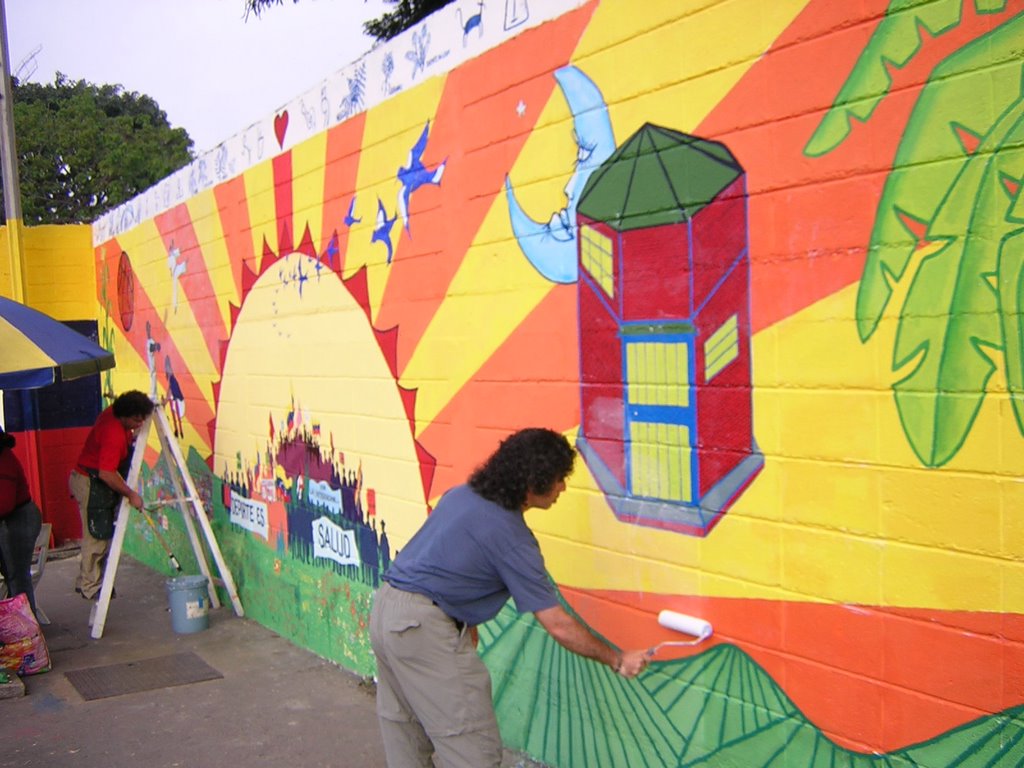 Maybe its the growing recognition (finally!) that immigrants face some of the worse oppressions in this dominant economic paradigm, and that this only develops the inner strenght in our communities as we fight back and continue to build healthy, sustainable and just economies. Maybe its the growing recognition (finally!) that immigrants face some of the worse oppressions in this dominant economic paradigm, and that this only develops the inner strenght in our communities as we fight back and continue to build healthy, sustainable and just economies.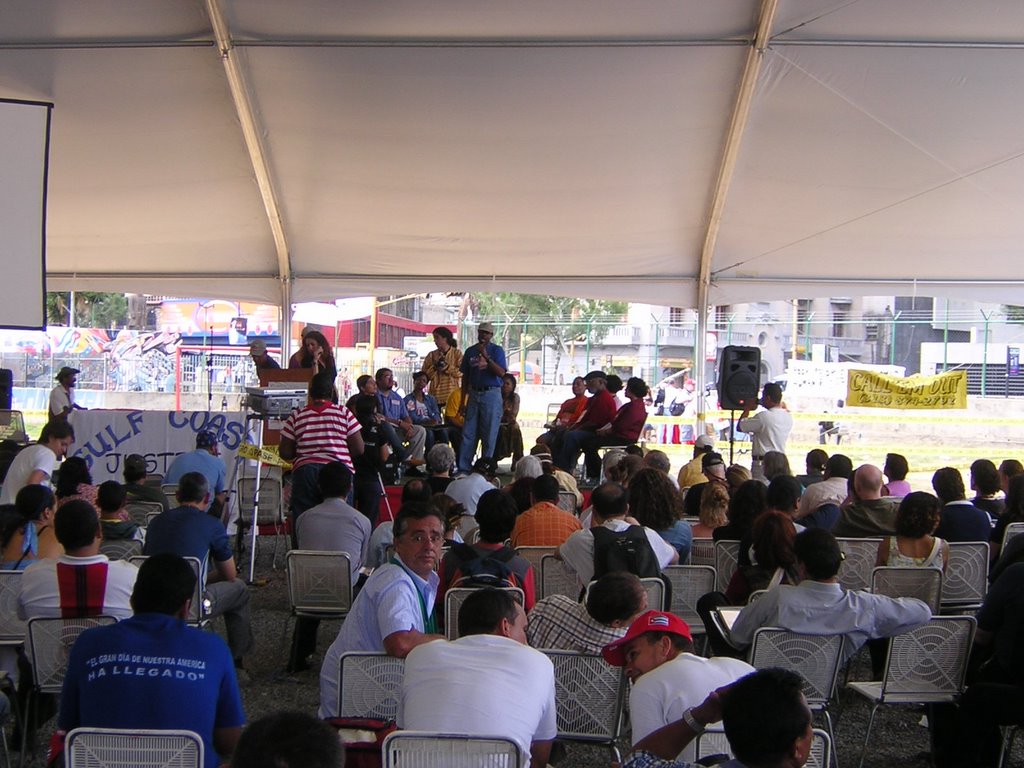 The numerous workshops and panels NNIRR and our members were invited to speak at, is an indicator of this. Whether it was Luckner Millien (from the FL Farmworkers Association) giving testimony about being in a detention camp and being deported to Haiti to hundreds at the US Oppression workshop, or Susan Alva (NNIRR board member) presenting analysis on migration policies at a panel on Overcoming the Neoliberal Economy, or Joycelyn Campbell (from Domestic Workers United) describing how they are abused by their employers and how they've fought back, these are living testimonies the struggles faced by immigrant communities not just oppress but empower us. The numerous workshops and panels NNIRR and our members were invited to speak at, is an indicator of this. Whether it was Luckner Millien (from the FL Farmworkers Association) giving testimony about being in a detention camp and being deported to Haiti to hundreds at the US Oppression workshop, or Susan Alva (NNIRR board member) presenting analysis on migration policies at a panel on Overcoming the Neoliberal Economy, or Joycelyn Campbell (from Domestic Workers United) describing how they are abused by their employers and how they've fought back, these are living testimonies the struggles faced by immigrant communities not just oppress but empower us.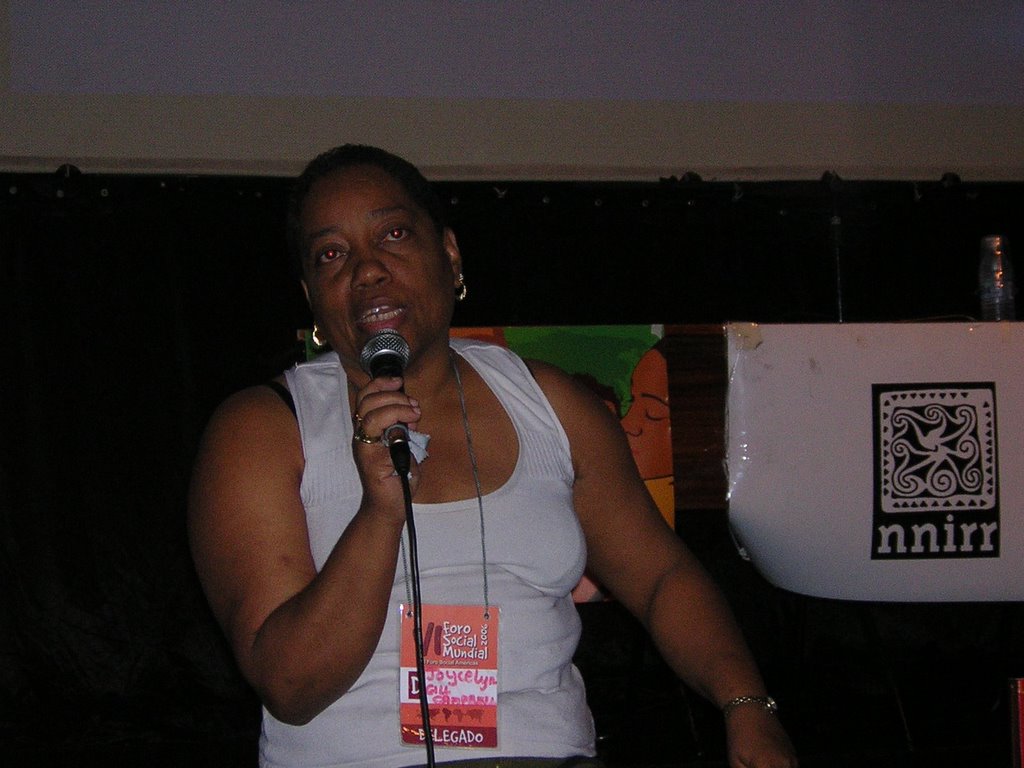 At NNIRR's own workshop, not only Luckner's and Joyce's testimonies, but also that of Chayya Chhoum (CAAAV), Chris Punongbayan (FAA), Greg Simons (CHIRLA), Mari Rose Taruc (APEN), Genaro Lopez-Rendon (SWU) and other diverse immigrant communities in the US, alongside those from Peruvian refugees in Argentina, indigenous migrants from Colombia, and Ecudorian migrants from Central America, speak courageous words to the worlwide oppression imposed by an economic and militaristic force. And yet, we're not victims, not mere survivors, but we are organizing growing movements of change that are converging here. At NNIRR's own workshop, not only Luckner's and Joyce's testimonies, but also that of Chayya Chhoum (CAAAV), Chris Punongbayan (FAA), Greg Simons (CHIRLA), Mari Rose Taruc (APEN), Genaro Lopez-Rendon (SWU) and other diverse immigrant communities in the US, alongside those from Peruvian refugees in Argentina, indigenous migrants from Colombia, and Ecudorian migrants from Central America, speak courageous words to the worlwide oppression imposed by an economic and militaristic force. And yet, we're not victims, not mere survivors, but we are organizing growing movements of change that are converging here. Venezuela itself creates cause for hope. The new National ID might seem an imposition on civil liberties to those of us in the US, it is in actuality a broad amnesty program to provide documentation to undocumented migrants here, and along with that, the rights and privileges equal to any other Venezuelan citizen. With immigration accounting for about 80% of the new population growth, and about 90% of the numerous street vendors here being migrants from Colombia and other neighboring regions, it is no doubt that this will enable migrant to go beyond the underground economy and into more sustainable livelihoods, while having recognized and enforced rights. Venezuela itself creates cause for hope. The new National ID might seem an imposition on civil liberties to those of us in the US, it is in actuality a broad amnesty program to provide documentation to undocumented migrants here, and along with that, the rights and privileges equal to any other Venezuelan citizen. With immigration accounting for about 80% of the new population growth, and about 90% of the numerous street vendors here being migrants from Colombia and other neighboring regions, it is no doubt that this will enable migrant to go beyond the underground economy and into more sustainable livelihoods, while having recognized and enforced rights.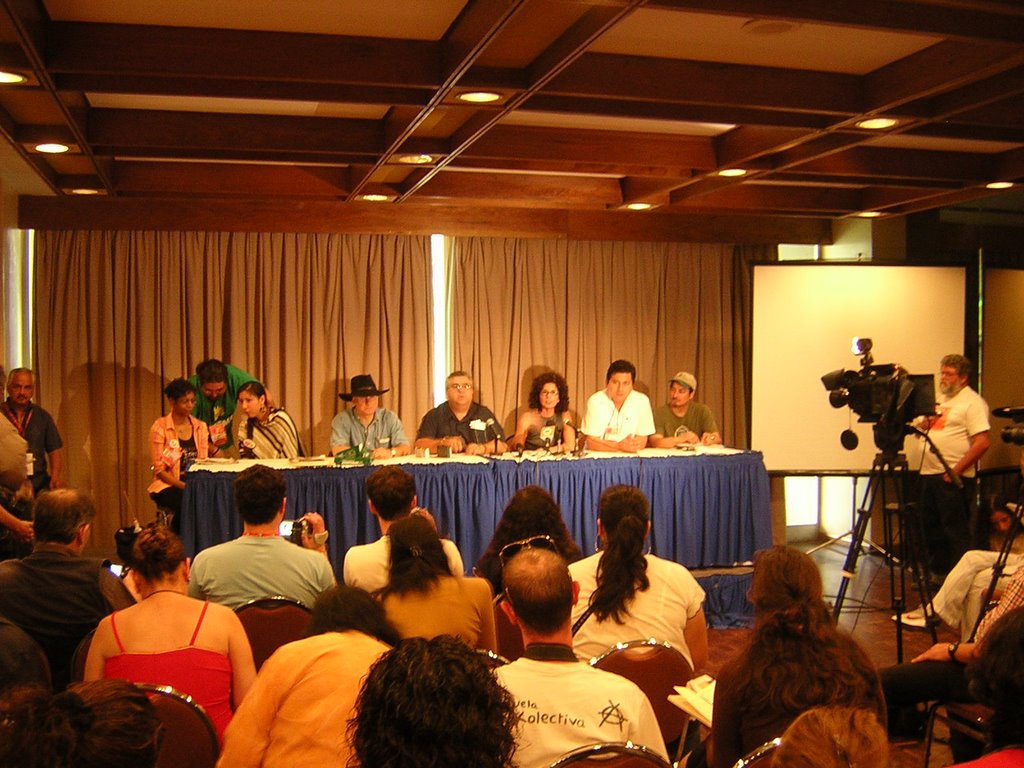 And if thats not enough to create some hope, then consider this latest development that has just emerged out of a series of meetings and exchanges in here the past couple of days. A mass northward mobilization of indigenous and other peoples from around Latin America, converging with a mobilization of immigrant and other communities from North America (led by GGJ and its members organizations including NNIRR), at the US-Mexico border this May, with popular actions at the border wall, and a border social forum, all involving tens of thousands of people! At the press conference to annouce this, Susan and Ruben Solis (from NNIRR's ally organization, Southwest Workers Union) described how while immigration policies have been increasingly repressive, for many years there have been growing mobilizations to reclaim and tear down the inhumane borders. And this is the opportunity we've been waiting for! Keep posted here and at NNIRR.org for more developments on this soon... And if thats not enough to create some hope, then consider this latest development that has just emerged out of a series of meetings and exchanges in here the past couple of days. A mass northward mobilization of indigenous and other peoples from around Latin America, converging with a mobilization of immigrant and other communities from North America (led by GGJ and its members organizations including NNIRR), at the US-Mexico border this May, with popular actions at the border wall, and a border social forum, all involving tens of thousands of people! At the press conference to annouce this, Susan and Ruben Solis (from NNIRR's ally organization, Southwest Workers Union) described how while immigration policies have been increasingly repressive, for many years there have been growing mobilizations to reclaim and tear down the inhumane borders. And this is the opportunity we've been waiting for! Keep posted here and at NNIRR.org for more developments on this soon...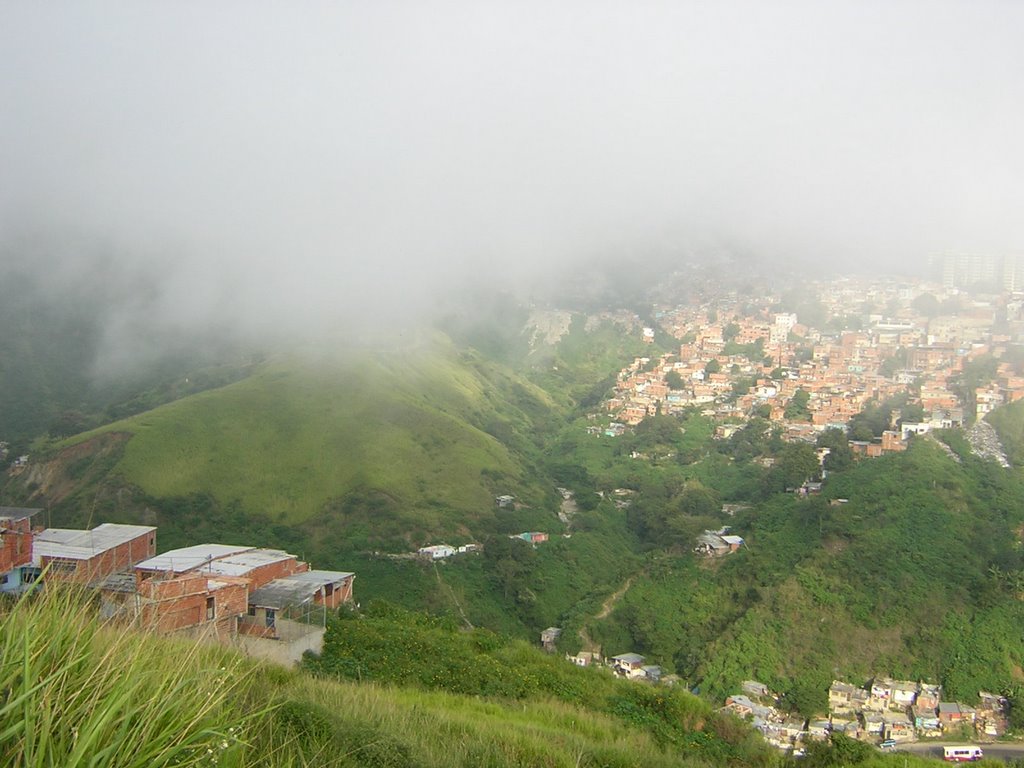 Meanwhile, we leave here with this hope. While things just seem to get worse and worse on the surface, there is a powerful undercurrent as we build monumental movements across the Americas and the world that will bring about significant social change. The time seems to be coming and immigrant communities are poised to be at the forefront of these. Meanwhile, we leave here with this hope. While things just seem to get worse and worse on the surface, there is a powerful undercurrent as we build monumental movements across the Americas and the world that will bring about significant social change. The time seems to be coming and immigrant communities are poised to be at the forefront of these. |
Wednesday, January 25, 2006
Logistical Nightmares at the 6th WSF
by Colin Rajah reporting from Caracas, Venezuela
The logistics were a nightmare. The main highway from the airport runs across a bridge that collapsed significantly a week ago. Timing could not be worse (and rumors of sabotage are rampant), as over 100,000 people from around the Americas converge into Caracas for the World Social Forum this week.
Most of our Grassroots Global Justice (GGJ) delegation made it in safe and sound however, in spite of 6-hour waits at the airport, 3-hour bus rides through windy mountain roads, and navigating massive traffic jams in the city to get to our hotel and orientation. And when we did, it was a coming home of sorts - connections and relationships among a vastly immigrant, people-of-color, grassroots delegation tug at not just the political, but our emotional bonds.
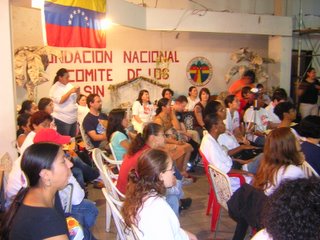 As other logistical "challenges" faced our orientation and meeting with a local host organization, we endured that with patience and tenacity. We formed out workgroups to embark on our mission this week - to make international/hemispheric grassroots connections with other communities in the Global South, and to challenge the stereotypes about U.S. society and communities.
Most importantly for us, presenting a broader, more diverse representation of immigrant communities in the U.S. who have to endure forced displacements in their home countries, and then oppressive political and economic forces in the U.S., is vital.
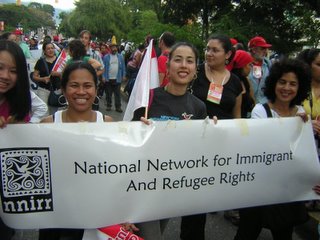 But we confidently forged ahead, especially in the opening march. NNIRR board member Susan Alva, alongside NNIRR members from CAAAV, CHIRLA and the Florida Farmworkers Association, carried the NNIRR banner high as we joined in our larger delegation´s chant "...Justice for the Whole World!...Que Viva!"
So the 6th WSF week has begun, in spite of the challenges. And as we look forward to this week, we know we´ll face even more challenges, logistical and otherwise. In the wake of a Congressional bill that proposes to build a wall on the US-Mexico border and seeks to essentially separate the U.S. from all of Latin America, the concept of a united Americas seems remote and distant. But for people who build communities across these borders, we have something to say about it, and we will.
The logistics were a nightmare. The main highway from the airport runs across a bridge that collapsed significantly a week ago. Timing could not be worse (and rumors of sabotage are rampant), as over 100,000 people from around the Americas converge into Caracas for the World Social Forum this week.
Most of our Grassroots Global Justice (GGJ) delegation made it in safe and sound however, in spite of 6-hour waits at the airport, 3-hour bus rides through windy mountain roads, and navigating massive traffic jams in the city to get to our hotel and orientation. And when we did, it was a coming home of sorts - connections and relationships among a vastly immigrant, people-of-color, grassroots delegation tug at not just the political, but our emotional bonds.
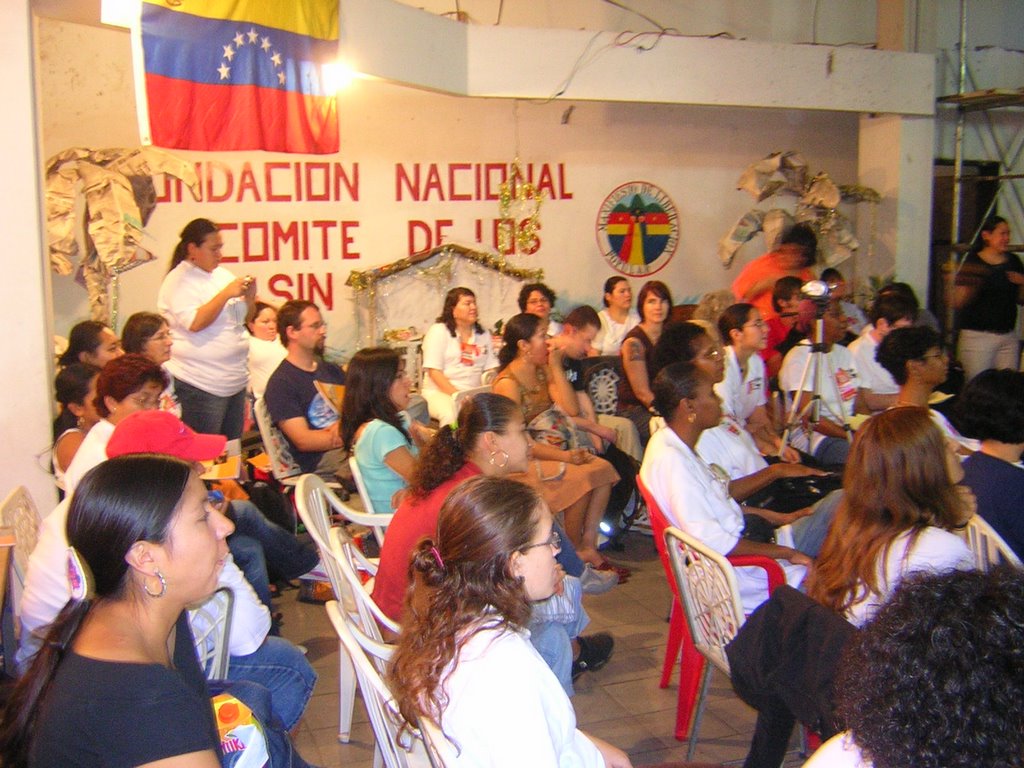 As other logistical "challenges" faced our orientation and meeting with a local host organization, we endured that with patience and tenacity. We formed out workgroups to embark on our mission this week - to make international/hemispheric grassroots connections with other communities in the Global South, and to challenge the stereotypes about U.S. society and communities.
Most importantly for us, presenting a broader, more diverse representation of immigrant communities in the U.S. who have to endure forced displacements in their home countries, and then oppressive political and economic forces in the U.S., is vital.
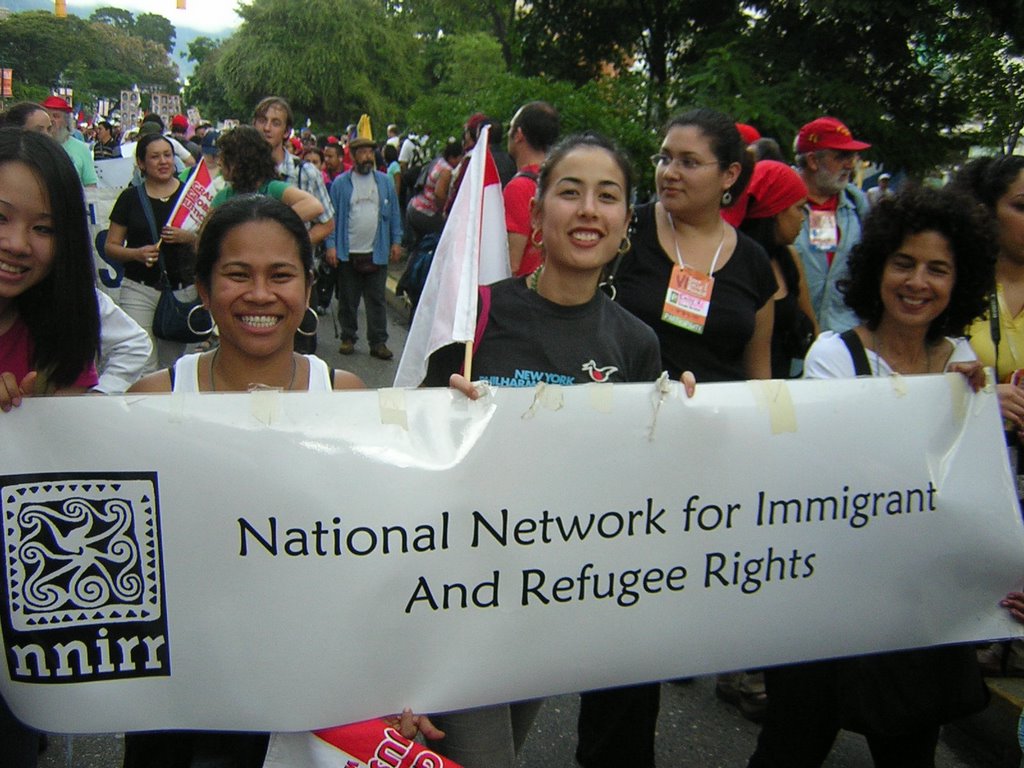 But we confidently forged ahead, especially in the opening march. NNIRR board member Susan Alva, alongside NNIRR members from CAAAV, CHIRLA and the Florida Farmworkers Association, carried the NNIRR banner high as we joined in our larger delegation´s chant "...Justice for the Whole World!...Que Viva!"
So the 6th WSF week has begun, in spite of the challenges. And as we look forward to this week, we know we´ll face even more challenges, logistical and otherwise. In the wake of a Congressional bill that proposes to build a wall on the US-Mexico border and seeks to essentially separate the U.S. from all of Latin America, the concept of a united Americas seems remote and distant. But for people who build communities across these borders, we have something to say about it, and we will.
Saturday, January 21, 2006
NNIRR at the WSF in Caracas
by Colin Rajah
The National Network for Immigrant and Refugee Rights (NNIRR) and a number of its members (CAAAV - Organizing Asian Communities, Committee for Humane Immigrant Rights in Los Angels - CHIRLA, Domestic Workers United - DWU, Farmworkers Association of Florida, Filipinos for Affirmative Action - FAA, Mujeres Unidas y Activas - MUA etc.) will be among the 120+ person grassroots US delegation of Grassroots Global Justice (GGJ) at the polycentric World Social Forum (WSF) in Caracas, Venezuela from January 24th through the 30th.
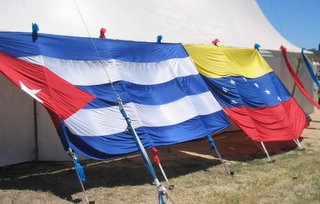 Among various activities, NNIRR will be organizing a workshop on "Globalization & Migrant Rights: Migrant Testimonies Challenging Neoliberal Economic Policies". The workshop details are as follows:
Date: Friday, Jan 27th
Time: 8:30-11:30am
Place: Sala 01 (Teatro), CELARG Altamira, Ave. Luis Roche
We invite all NNIRR allies and partners who will be Caracas for the WSF, to join us in our many activities, especially this critical workshop which seeks to expose the impact globalization has had on migration and migrant rights, and find ways to build a migrant rights movement around it.
Colin Rajah (NNIRR's International Program Coordinator) and Susan Alva (NNIRR's board member) will be coordinating NNIRR's caucus and presence at the WSF. They can be reached at:
Hotel Conde, Esquina el Conde, Caracas
+58-212-811-1171
crajah@nnirr.org
Please watch this space for updates directly from Caracas in the next few days...
The National Network for Immigrant and Refugee Rights (NNIRR) and a number of its members (CAAAV - Organizing Asian Communities, Committee for Humane Immigrant Rights in Los Angels - CHIRLA, Domestic Workers United - DWU, Farmworkers Association of Florida, Filipinos for Affirmative Action - FAA, Mujeres Unidas y Activas - MUA etc.) will be among the 120+ person grassroots US delegation of Grassroots Global Justice (GGJ) at the polycentric World Social Forum (WSF) in Caracas, Venezuela from January 24th through the 30th.
 Among various activities, NNIRR will be organizing a workshop on "Globalization & Migrant Rights: Migrant Testimonies Challenging Neoliberal Economic Policies". The workshop details are as follows:
Date: Friday, Jan 27th
Time: 8:30-11:30am
Place: Sala 01 (Teatro), CELARG Altamira, Ave. Luis Roche
We invite all NNIRR allies and partners who will be Caracas for the WSF, to join us in our many activities, especially this critical workshop which seeks to expose the impact globalization has had on migration and migrant rights, and find ways to build a migrant rights movement around it.
Colin Rajah (NNIRR's International Program Coordinator) and Susan Alva (NNIRR's board member) will be coordinating NNIRR's caucus and presence at the WSF. They can be reached at:
Hotel Conde, Esquina el Conde, Caracas
+58-212-811-1171
crajah@nnirr.org
Please watch this space for updates directly from Caracas in the next few days...
Wednesday, December 14, 2005
Migrants Are Not For Sale!
by Colin Rajah
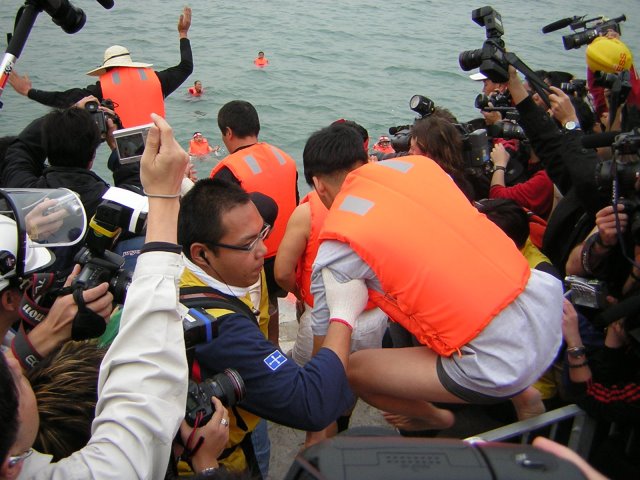
 The media coverage of this WTO meeting has been relatively impactful. But the unfortunate focus on sensationalist stories,
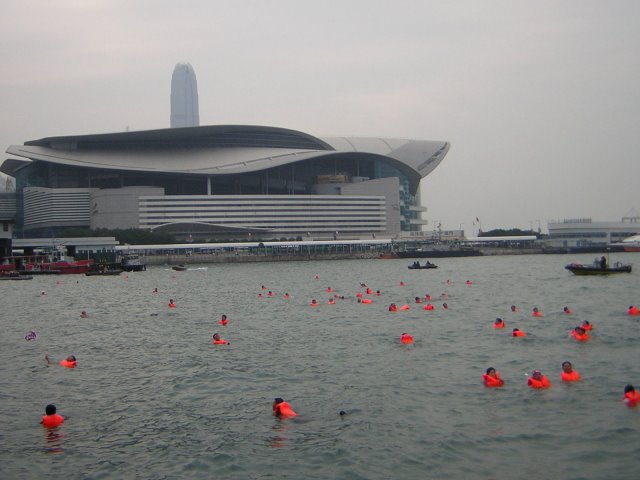
 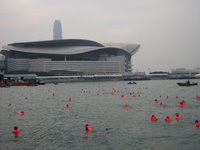 such as supposed threats of "riots" and "violence" by protestors, especially the large Korean farmers delegation, have been gravely exagerated. At the opening march and rally, the farmers staged a "swim" to the WTO's convention center - hardly a case of "rioting" or "violence" the mainstream media seems intent on delivering.
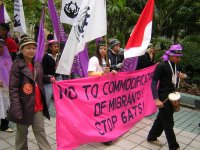 In spite of the many creative acts of protests both inside and outside the WTO convention center, what the media has been missing are the other real stories.
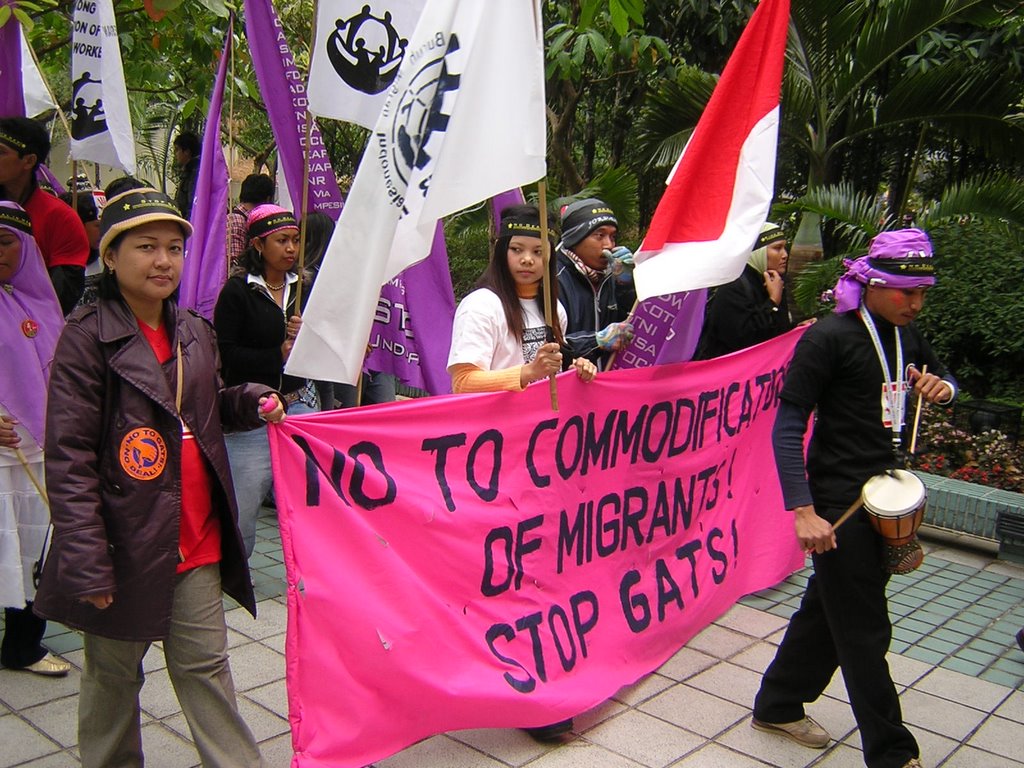
 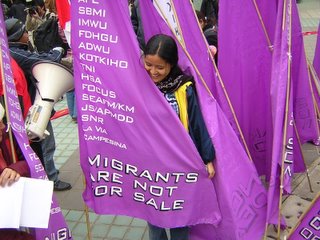 The negotiations among WTO delegates are probably no match for the the intense discussions between the vastly disparate groups that are outside the convention center. These revolve around the WTO's policies and its impacts on various sectors of society, as well as sharings, encounters and exchanges on the day-to-day realities communities face due to globalization. The resounding message from migrant groups were that "Migrants are not for sale" as well as demands that we not be treated as commodities.
 Migrant Forum Asia (MFA) led a No to GATS (General Agreement on Trade in Services) march and rally, right up the convention center and faced a stand-off with the police and an increasing presence of the riot squad.
 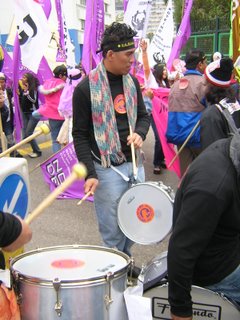 Negotiations between the march's leaders (including MFA's William Gois) with the police officers, proved futile as the police seemed intent on keeping us as far away as possible from the convention center's holy perimeter. In spite of the sudden blockade being erected by the police, the migrant groups present chanted loud and strong, played drums, danced, and made our collective message clear that the WTO had no right to trade migrants within the GATS policies.
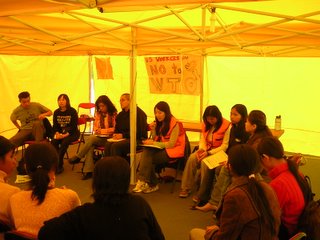 Our own US Asian Pacific Islander (API) delegation organized an intense session, where migrant youth and workers shared stories about the impacts of globalization on them and their communities, and heard very similar stories from migrants from Taiwan, Korea, the Philippines and Cambodia.
We joined other migrant groups to take similar messages to the many embassies located here, culminating of course at the U.S. embassy. And tomorrow, we will have our joint forum on Mode 4 (the WTO's proposed global guestworker program) alongside AFSC and MRI. But even before then, its clear that we have raised the issues of the interlinkages of migration and globalization, and more importantly, raised the voices and perspectives of migrant communities about these. One thing should be clear to the WTO by now, migrants are NOT for sale!
 The media coverage of this WTO meeting has been relatively impactful. But the unfortunate focus on sensationalist stories,
  such as supposed threats of "riots" and "violence" by protestors, especially the large Korean farmers delegation, have been gravely exagerated. At the opening march and rally, the farmers staged a "swim" to the WTO's convention center - hardly a case of "rioting" or "violence" the mainstream media seems intent on delivering.
 In spite of the many creative acts of protests both inside and outside the WTO convention center, what the media has been missing are the other real stories.
 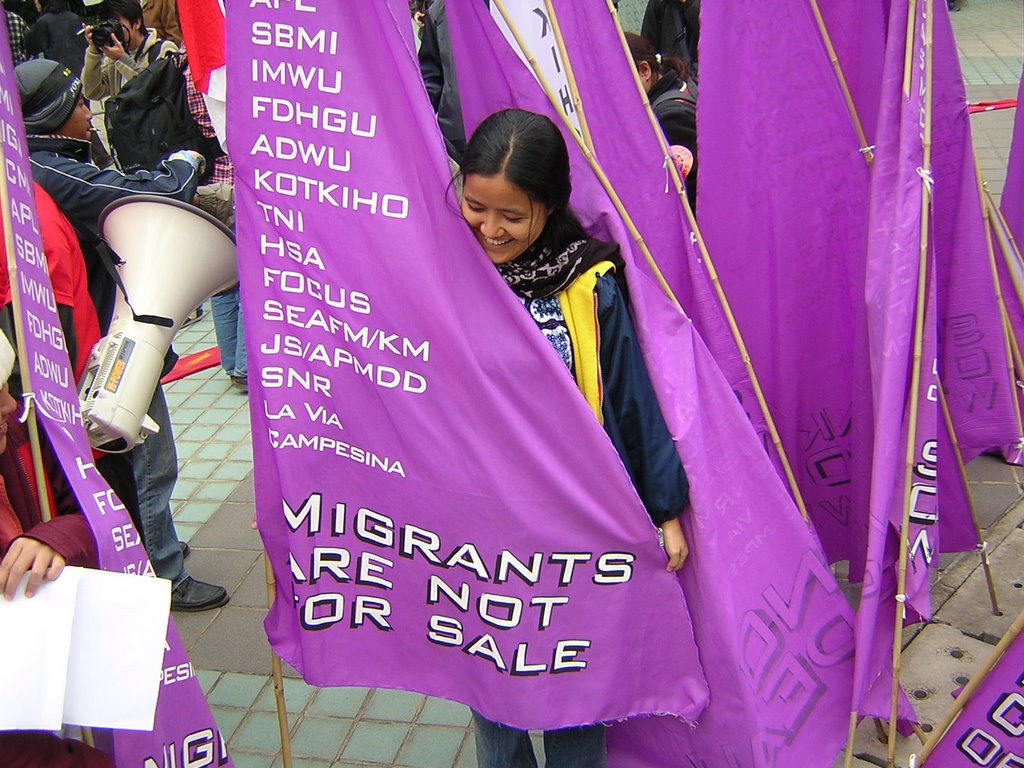 The negotiations among WTO delegates are probably no match for the the intense discussions between the vastly disparate groups that are outside the convention center. These revolve around the WTO's policies and its impacts on various sectors of society, as well as sharings, encounters and exchanges on the day-to-day realities communities face due to globalization. The resounding message from migrant groups were that "Migrants are not for sale" as well as demands that we not be treated as commodities.
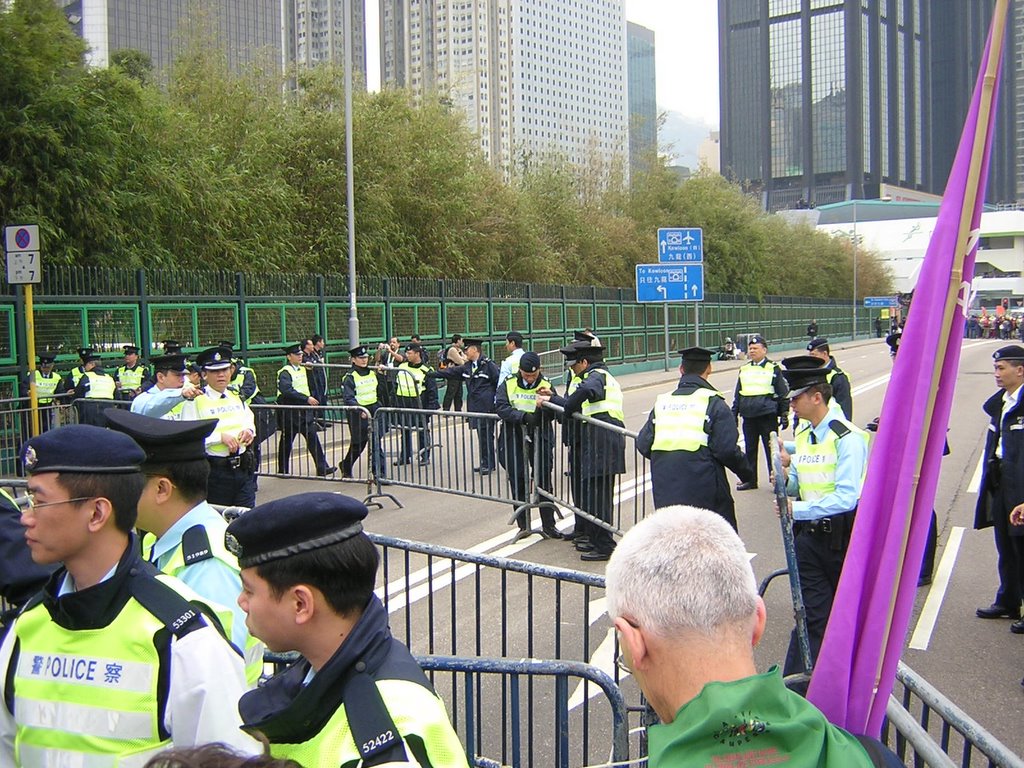 Migrant Forum Asia (MFA) led a No to GATS (General Agreement on Trade in Services) march and rally, right up the convention center and faced a stand-off with the police and an increasing presence of the riot squad.
  Negotiations between the march's leaders (including MFA's William Gois) with the police officers, proved futile as the police seemed intent on keeping us as far away as possible from the convention center's holy perimeter. In spite of the sudden blockade being erected by the police, the migrant groups present chanted loud and strong, played drums, danced, and made our collective message clear that the WTO had no right to trade migrants within the GATS policies.
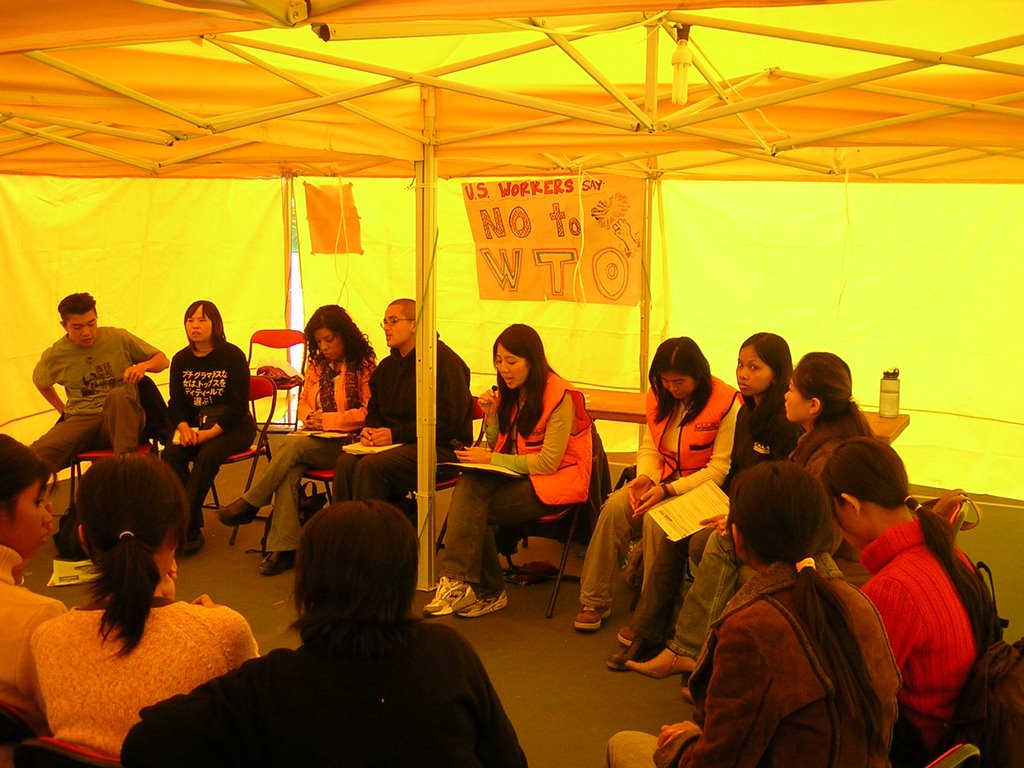 Our own US Asian Pacific Islander (API) delegation organized an intense session, where migrant youth and workers shared stories about the impacts of globalization on them and their communities, and heard very similar stories from migrants from Taiwan, Korea, the Philippines and Cambodia.
We joined other migrant groups to take similar messages to the many embassies located here, culminating of course at the U.S. embassy. And tomorrow, we will have our joint forum on Mode 4 (the WTO's proposed global guestworker program) alongside AFSC and MRI. But even before then, its clear that we have raised the issues of the interlinkages of migration and globalization, and more importantly, raised the voices and perspectives of migrant communities about these. One thing should be clear to the WTO by now, migrants are NOT for sale!
Raids, Detentions, Deportations, Harrassment & Persecution: Migrants at the WTO meetings
by Colin Rajah
My nerves began tensing up in that familiar way as I walked up to the immigration officer. Been through this a hundred times before but each time it seems like holding my breath becomes almost a reflex reaction. My papers were in order, I had been informed by the Chinese Embassy in San Francisco that, like U.S. passport holders, I wouldn't need a visa if I entered Hong Kong for less than 90 days. So I should be ok. But i've thought that before with less than desirable consequences.
In a manner of formality, the officer asked me my purpose for entering Hong Kong. I told him the WTO meetings. He looked up at me. Uh-oh, I've seen that look before, and not long after I found myself sitting in the interogation center alongside other migrants. After 2 more hours of intense questioning and interrogation, and in spite of my documentation of where I would be staying, the details of our symposium, phone numbers and contact info of everyone I thought could vouch for me, the interrogating officer informed me that he was still unsatisfied with my responses and he would be denying my entry into Hong Kong. I would be detained and deported on the next flight back in the morning.
My frustrations and persistence turned to desperation. I pleaded with them to call at least one of the contacts I had provided. No luck. I was being searched, most of my personal items were being taken away in a big envelope, and I was being escorted to the detention center. I was at least allowed a couple of local phone calls.
Despite (or maybe because of) my impending sense of depression, I immediately called Genevieve Gencianos of Migrant Rights International (MRI) eventhough it was past 1am. Gen understood the situation immediately, having dealt with similar ones countless of times before. She consoled me and said they would mobilize around it. I also called Alex of Chinese Progressive Association (CPA), part of the Bay Area WT-No delegation to inform him and the delegation who had stayed up late worrying why I hadn't arrived, that I wouldn't be able to make it.
More than 10 hours later and less than 1-1/2 hours before my scheduled departure back to the U.S., and after a few more "interviews" with my officer, I was told that I was being released. Turns out that Gen, along with Jessica Walker Beaumont and Amy Gottlieb of American Friends Service Committee (AFSC) had stayed up most of the night, to make numerous calls to various authorities and allies, to demand for my release and entry into Hong Kong.
My co-workers, Arnoldo and Eunice had apparently also launched a snap action alert mobilizing NNIRR members, allies and friends to send faxes, emails and calls to the ranking immigration officer at the airport. It had all worked. The director of the airport immigration department himself came to inform me that due to to each and every one of those, they had reconsidered my case and would grant me entry into Hong Kong for the week.
As I exited the airport detention center, Jessica and Amy were waiting to accompany me to join the Bay Area WT-No delegation, and to begin the week of the 6th WTO ministerial in Hong Kong.
 But the week had already begun for many other migrants here. I found out later that a number of Filipino and Pakistani migrants coming to Hong Kong for the same purposes, were also detained and were only released after similar mobilizations pressured the Hong Kong immigration offices to do so. Mentioning the WTO and being an immigrant, seems to trigger an immediately strong response from the authorities.
 The offices of the Indonesian Migrant Workers Union (IMWU) and KOTKIHO (an Indonesian migrant coalition) were also raided by Hong Kong police not once or twice, but no less than THREE times in two days, apparently in a vain attempt to uncover random "illegals" and wild accusations of "bombs and explosives". None were found, of course, but the message had been delivered clearly. Let the WTO go about its business or else the harrassment and persecution of migrants would be intensified.
 Regardless, it hasn't stoped us. Alongside Migrant Forum Asia (MFA) and Asian Migrant Centre (AMC), we challenged the WTO with a resounding "No to the commodification of migrants", and to declare that "Migrants are not for sale!" We took it right to the door-steps of the WTO meetings, as well as to the numerous embassies whose governments have been in negotiations through the WTO.
 And we're not stopping there. More actions and networking activities, are being planned for the rest of the week to send a clear message back to the WTO and its policing authorities - We will not be intimidated in spite of their harrassment and persecution. Migrants have rights, and we will continue fighting for these to be respected in trade deals, and to demand for our right to be heard in spite of the looming obstacles before us.
My nerves began tensing up in that familiar way as I walked up to the immigration officer. Been through this a hundred times before but each time it seems like holding my breath becomes almost a reflex reaction. My papers were in order, I had been informed by the Chinese Embassy in San Francisco that, like U.S. passport holders, I wouldn't need a visa if I entered Hong Kong for less than 90 days. So I should be ok. But i've thought that before with less than desirable consequences.
In a manner of formality, the officer asked me my purpose for entering Hong Kong. I told him the WTO meetings. He looked up at me. Uh-oh, I've seen that look before, and not long after I found myself sitting in the interogation center alongside other migrants. After 2 more hours of intense questioning and interrogation, and in spite of my documentation of where I would be staying, the details of our symposium, phone numbers and contact info of everyone I thought could vouch for me, the interrogating officer informed me that he was still unsatisfied with my responses and he would be denying my entry into Hong Kong. I would be detained and deported on the next flight back in the morning.
My frustrations and persistence turned to desperation. I pleaded with them to call at least one of the contacts I had provided. No luck. I was being searched, most of my personal items were being taken away in a big envelope, and I was being escorted to the detention center. I was at least allowed a couple of local phone calls.
Despite (or maybe because of) my impending sense of depression, I immediately called Genevieve Gencianos of Migrant Rights International (MRI) eventhough it was past 1am. Gen understood the situation immediately, having dealt with similar ones countless of times before. She consoled me and said they would mobilize around it. I also called Alex of Chinese Progressive Association (CPA), part of the Bay Area WT-No delegation to inform him and the delegation who had stayed up late worrying why I hadn't arrived, that I wouldn't be able to make it.
More than 10 hours later and less than 1-1/2 hours before my scheduled departure back to the U.S., and after a few more "interviews" with my officer, I was told that I was being released. Turns out that Gen, along with Jessica Walker Beaumont and Amy Gottlieb of American Friends Service Committee (AFSC) had stayed up most of the night, to make numerous calls to various authorities and allies, to demand for my release and entry into Hong Kong.
My co-workers, Arnoldo and Eunice had apparently also launched a snap action alert mobilizing NNIRR members, allies and friends to send faxes, emails and calls to the ranking immigration officer at the airport. It had all worked. The director of the airport immigration department himself came to inform me that due to to each and every one of those, they had reconsidered my case and would grant me entry into Hong Kong for the week.
As I exited the airport detention center, Jessica and Amy were waiting to accompany me to join the Bay Area WT-No delegation, and to begin the week of the 6th WTO ministerial in Hong Kong.
 But the week had already begun for many other migrants here. I found out later that a number of Filipino and Pakistani migrants coming to Hong Kong for the same purposes, were also detained and were only released after similar mobilizations pressured the Hong Kong immigration offices to do so. Mentioning the WTO and being an immigrant, seems to trigger an immediately strong response from the authorities.
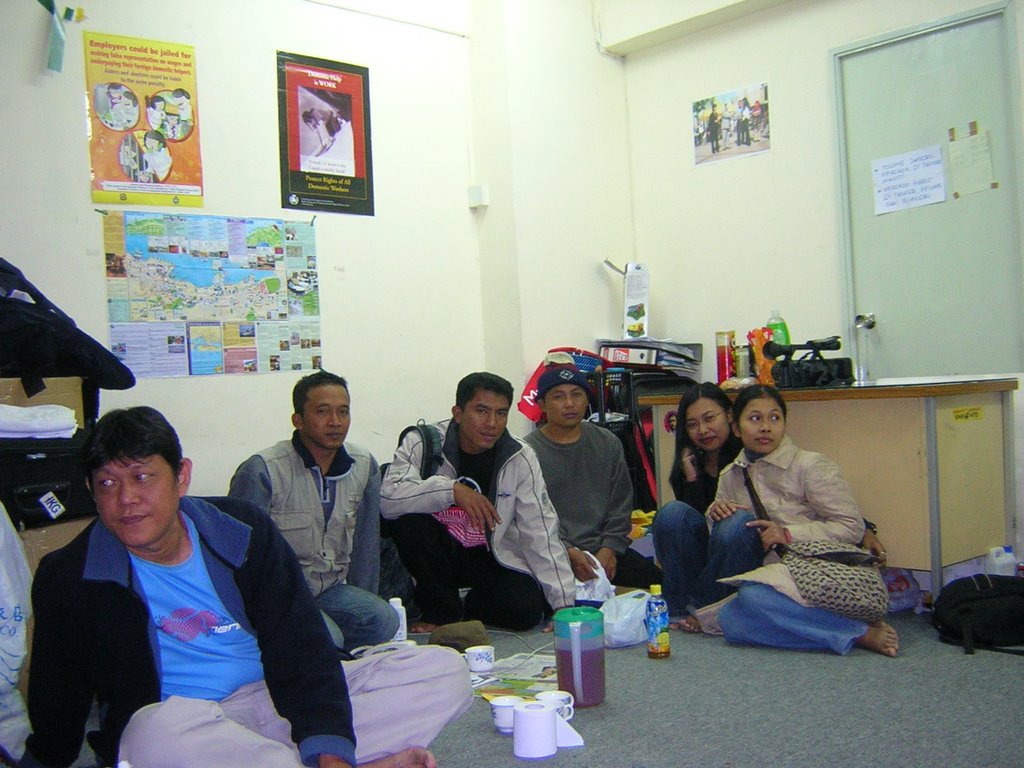 The offices of the Indonesian Migrant Workers Union (IMWU) and KOTKIHO (an Indonesian migrant coalition) were also raided by Hong Kong police not once or twice, but no less than THREE times in two days, apparently in a vain attempt to uncover random "illegals" and wild accusations of "bombs and explosives". None were found, of course, but the message had been delivered clearly. Let the WTO go about its business or else the harrassment and persecution of migrants would be intensified.
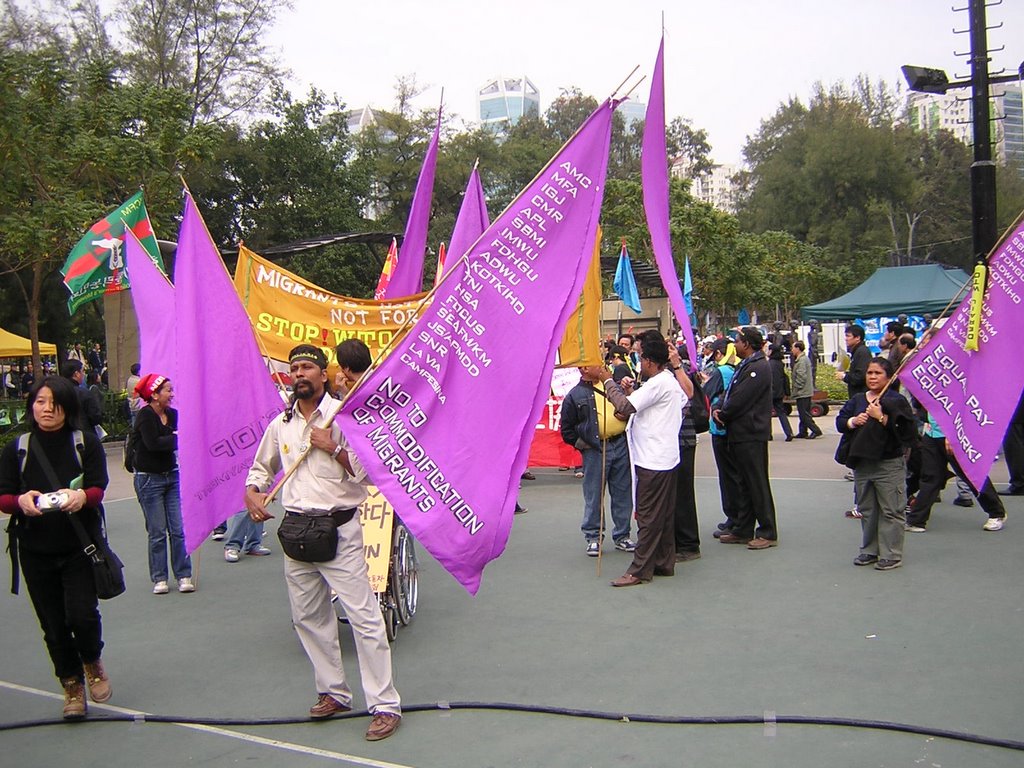 Regardless, it hasn't stoped us. Alongside Migrant Forum Asia (MFA) and Asian Migrant Centre (AMC), we challenged the WTO with a resounding "No to the commodification of migrants", and to declare that "Migrants are not for sale!" We took it right to the door-steps of the WTO meetings, as well as to the numerous embassies whose governments have been in negotiations through the WTO.
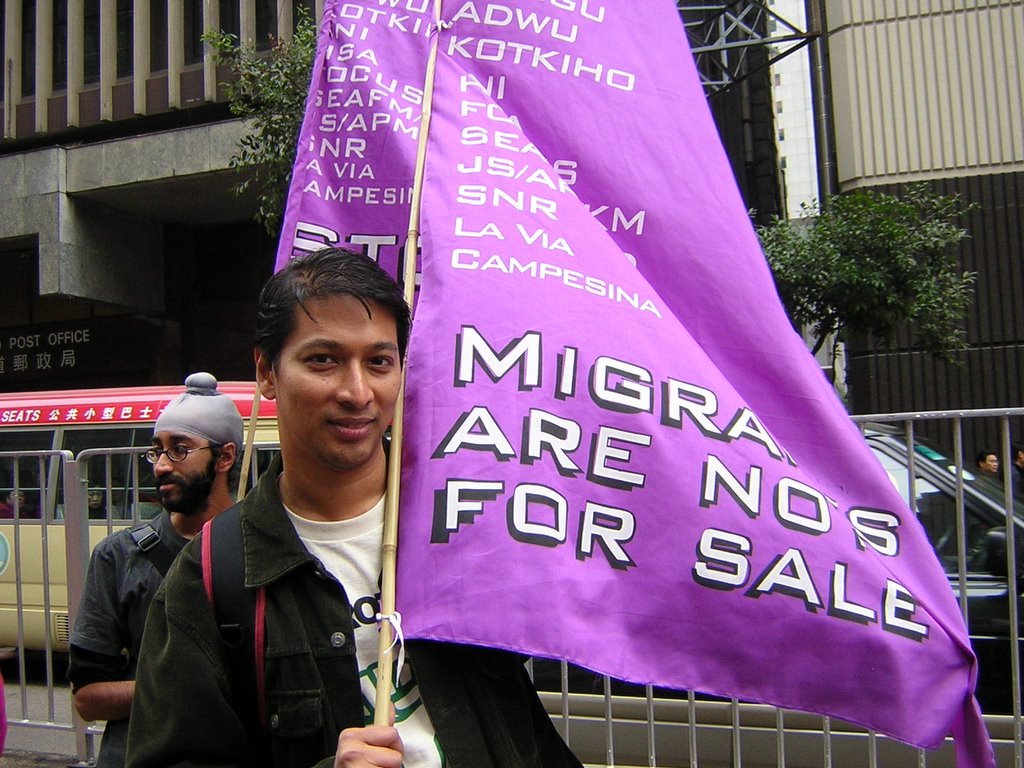 And we're not stopping there. More actions and networking activities, are being planned for the rest of the week to send a clear message back to the WTO and its policing authorities - We will not be intimidated in spite of their harrassment and persecution. Migrants have rights, and we will continue fighting for these to be respected in trade deals, and to demand for our right to be heard in spite of the looming obstacles before us.
Thursday, December 01, 2005
Preview to the 6th WTO meeting in Hong Kong
by Colin Rajah
Colin Rajah, the International Migrant Rights Program Coordinator of the National Network for Immigrant & Refugee Rights (NNIRR), will be representing the National Network at the upcoming World Trade Organization's (WTO) 6th Ministerial Meeting in Hong Kong, December 13th - 18th, 2005.
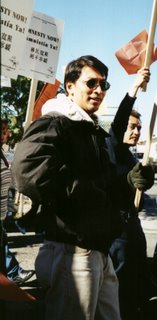 Part of the San Francisco Bay Area WT-No delegation, and in close collaboration with similar contingents from Los Angeles, New York, and Philadelphia, Colin will be among the thousands of people who will be challenging the WTO and its global economic policies, while trying to uphold the voices of immigrants that are being unheard at the WTO.
The Bay Area WT-No delegation includes Chinese Progressive Associates (CPA), Chin Jurn Wor Ping (CJWP), Korean Community Center of the East Bay (KCCEB), and other activists and artists of Asian-Pacific Islander (API) descent. The national U.S. API contingent also includes the Garment Workers Center (GWC), Multi-ethnic Immigrant Workers Oranizing Network (MIWON), CAAAV: Organizing Asian Communities, and Community Organizing Committee (CYOC).
In Hong Kong, the National Network will be coordinating a number of activities including co-organizing a solidarity tent with WT-No and the U.S. API delegation at Victoria Park on December 14th & 15th, from 2pm-5pm, for low-wage workers, especially migrant workers. This solidarity tent space is entitled "Building Solidarity Amongst Garment, Farm, and Other Migrant Workers from San Francisco to Hong Kong."
The National Network will also be co-convening a symposium entitled "Migrant Workers, Human Rights & Trade: Unpacking GATS Mode 4" on the WTO's proposed global guest-worker program, alongside the American Friends Service Committee (AFSC) and Migrant Rights International (MRI). This symposium will be at Victoria Park on December 16th from 11am-5pm. Invited presenters and participants at this 1/2-day forum include the Migrant Forum of Asia (MFA), Migrante-International, FOCUS on the Global South, South Centre, the International Brotherhood of Teamsters, Via Campesina, and many other migrants from around the region and the world. The symposium will overview what Mode 4 entails, the experiences of other guest-worker programs, testimonials of migrant guest-workers from around the world, as well as discuss strategies and collaborations to embark on from Hong Kong onwards.
In the U.S., the National Network has also co-issued a national call to action alongside Grassroots Global Justice (GGJ) and Jobs with Justice (JwJ) for a week of action for global justice and immigrant rights from December 10th-18th. In addition, the National Network has also called for vigils and other actions and events for Thursday, December 15th, to recognize International Migrants Day (December 18), including highlighting the role the WTO and other similar economic institutions have played in impoverishing and displacing communities around the world and forcing mass migrations, while proposing and implementing mechanisms such as Mode 4 which violate migrant workers' rights and maintaining a pool of cheap, disposable labor for corporate interests. It is expected that dozens of grassroots and community-based organizations will organize actions in cities across the U.S. on December 15th and throughout that week of action.
Watch this space for postings from Hong Kong and the U.S. about activities and experiences related to the WTO meeting, as well as International Migrants Day!
Colin Rajah, the International Migrant Rights Program Coordinator of the National Network for Immigrant & Refugee Rights (NNIRR), will be representing the National Network at the upcoming World Trade Organization's (WTO) 6th Ministerial Meeting in Hong Kong, December 13th - 18th, 2005.
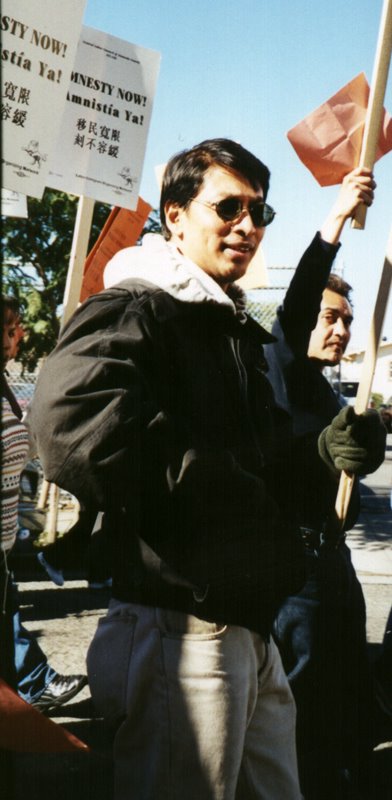 Part of the San Francisco Bay Area WT-No delegation, and in close collaboration with similar contingents from Los Angeles, New York, and Philadelphia, Colin will be among the thousands of people who will be challenging the WTO and its global economic policies, while trying to uphold the voices of immigrants that are being unheard at the WTO.
The Bay Area WT-No delegation includes Chinese Progressive Associates (CPA), Chin Jurn Wor Ping (CJWP), Korean Community Center of the East Bay (KCCEB), and other activists and artists of Asian-Pacific Islander (API) descent. The national U.S. API contingent also includes the Garment Workers Center (GWC), Multi-ethnic Immigrant Workers Oranizing Network (MIWON), CAAAV: Organizing Asian Communities, and Community Organizing Committee (CYOC).
In Hong Kong, the National Network will be coordinating a number of activities including co-organizing a solidarity tent with WT-No and the U.S. API delegation at Victoria Park on December 14th & 15th, from 2pm-5pm, for low-wage workers, especially migrant workers. This solidarity tent space is entitled "Building Solidarity Amongst Garment, Farm, and Other Migrant Workers from San Francisco to Hong Kong."
The National Network will also be co-convening a symposium entitled "Migrant Workers, Human Rights & Trade: Unpacking GATS Mode 4" on the WTO's proposed global guest-worker program, alongside the American Friends Service Committee (AFSC) and Migrant Rights International (MRI). This symposium will be at Victoria Park on December 16th from 11am-5pm. Invited presenters and participants at this 1/2-day forum include the Migrant Forum of Asia (MFA), Migrante-International, FOCUS on the Global South, South Centre, the International Brotherhood of Teamsters, Via Campesina, and many other migrants from around the region and the world. The symposium will overview what Mode 4 entails, the experiences of other guest-worker programs, testimonials of migrant guest-workers from around the world, as well as discuss strategies and collaborations to embark on from Hong Kong onwards.
In the U.S., the National Network has also co-issued a national call to action alongside Grassroots Global Justice (GGJ) and Jobs with Justice (JwJ) for a week of action for global justice and immigrant rights from December 10th-18th. In addition, the National Network has also called for vigils and other actions and events for Thursday, December 15th, to recognize International Migrants Day (December 18), including highlighting the role the WTO and other similar economic institutions have played in impoverishing and displacing communities around the world and forcing mass migrations, while proposing and implementing mechanisms such as Mode 4 which violate migrant workers' rights and maintaining a pool of cheap, disposable labor for corporate interests. It is expected that dozens of grassroots and community-based organizations will organize actions in cities across the U.S. on December 15th and throughout that week of action.
Watch this space for postings from Hong Kong and the U.S. about activities and experiences related to the WTO meeting, as well as International Migrants Day!
Subscribe to:
Posts (Atom)